

Blog
Ayurvedic Medicine for Knee Pain: Oils, Formulations and Janu Basti, Chosen for Your Knee

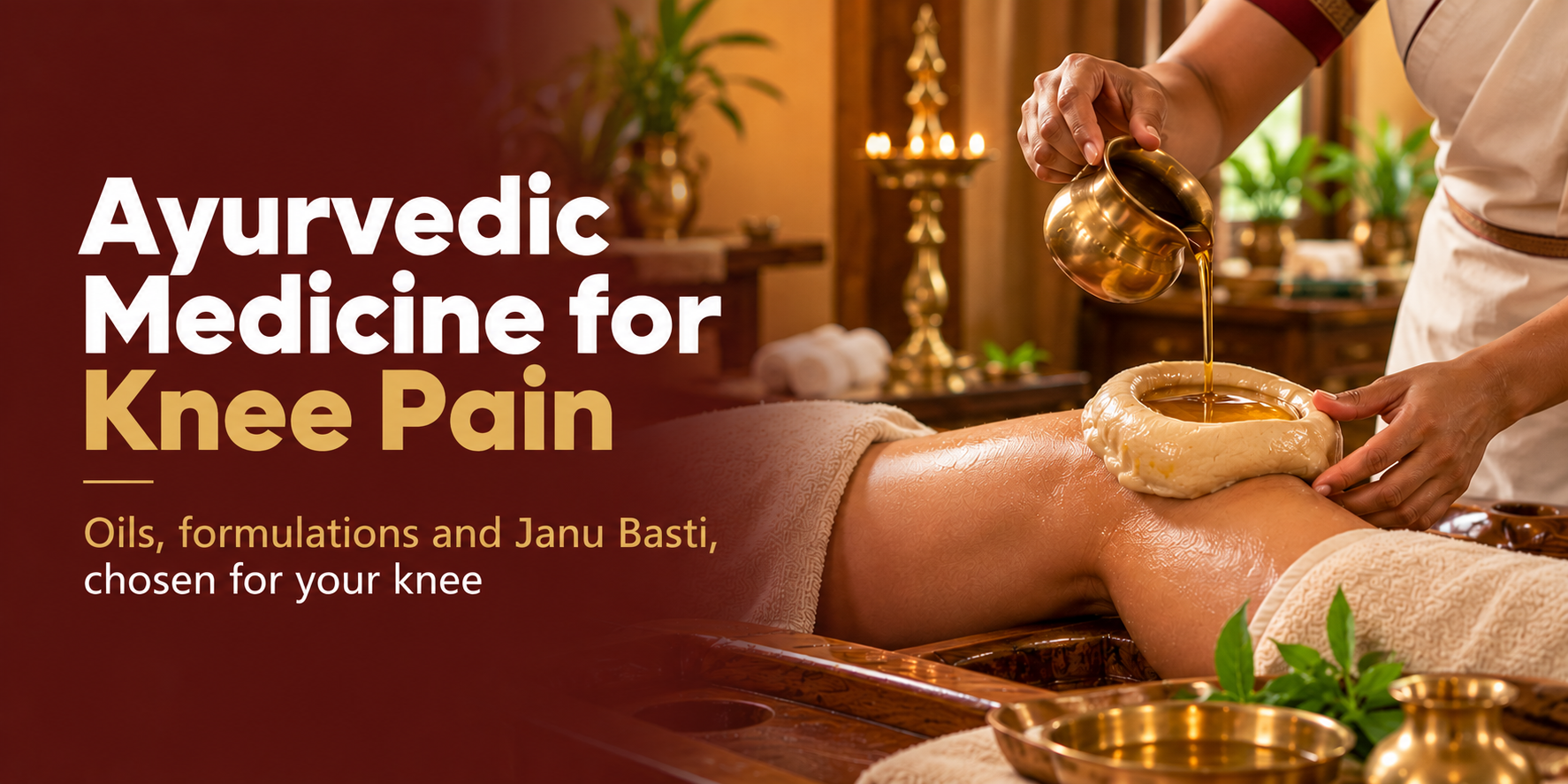
Which Knee Pain Suits Which Approach: Medicated Oils, Oral Formulations Like Shallaki and Arthrohills, Janu Basti and Panchakarma, and Why a Doctor Should Decide
The right Ayurvedic medicine for knee pain depends on what kind of knee pain you have. Ayurveda offers several approaches: medicated oils applied to the knee, oral formulations such as Shallaki or Arthrohills, localised therapies like Janu Basti, where warm medicated oil is held over the knee, and, for deeper or long-standing concerns, Panchakarma. A doctor’s assessment decides which one, or which combination, suits your knee, because stiffness from joint wear needs a different plan from a fresh injury or a hot, swollen joint.
Why there is no single best medicine for every knee
If you search for the best Ayurvedic medicine for knee pain, you will find long lists of oils and tablets. The trouble is that knee pain is not one condition. Morning stiffness that eases as you walk, pain climbing stairs, a knee that feels heavy and puffy, and a sudden twist on a walk are all different problems.
In Ayurveda, each is understood differently, often in terms of Vata, Pitta and Kapha, and each calls for a different combination of oil, oral formulation, therapy and routine. That is why choosing Ayurvedic medicine for knee pain from a shelf, without an assessment, so often disappoints.
This guide explains the main options, what each is typically used for, and how a doctor decides between them.
When knee pain needs a medical check first
Some knee problems should be seen by a medical doctor before any Ayurvedic therapy begins:
- A recent injury, a fall or a twist with sudden swelling.
- A knee that is hot, red and swollen, especially with fever.
- Inability to bear weight, or a knee that locks or gives way.
- Severe pain at night or pain that keeps getting worse.
Ayurvedic care can work alongside modern medicine, but it should never delay a needed scan, test or treatment. A responsible Ayurvedic doctor will tell you when a check comes first. For a clear medical overview of joint wear, see the NHS guide to osteoarthritis.
How an Ayurvedic doctor assesses knee pain
Before recommending any Ayurvedic medicine for knee pain, the doctor asks when the pain started, what makes it better or worse, whether there is stiffness, swelling, heat or clicking, and how it affects walking, stairs and sleep. They also ask about digestion, weight, activity and any diagnosis you already have, such as osteoarthritis or gout.
A physical examination of the knee and Nadi Parikshan, or pulse assessment, help the doctor understand your constitution and current imbalance. Only then is Ayurvedic medicine for knee pain chosen, whether that is an oil, an oral formulation, a therapy or a combination. Read more about this step in our guide to Nadi Pariksha in Ayurveda.
Medicated oils for knee pain
Medicated oils are among the most widely used forms of Ayurvedic medicine for knee pain. They are prepared by cooking herbs into a base oil, so each oil carries a specific purpose. Warm oils are commonly chosen for dry, stiff, Vata-type knees, while a knee that feels warm or inflamed may need a different approach altogether.
Herbal Hills uses more than 40 Ayurvedic oils across its therapies, and our doctors choose the one that suits your knee. For home use, the doctor may prescribe an oil such as Arthrohills joint care oil, with clear instructions on how and when to apply it.
When people ask for the best Ayurvedic oil for knee pain, the honest answer is the one chosen for their knee, applied the right way, alongside the rest of the plan.
Oral formulations: Shallaki, Arthrohills and others
Oral Ayurvedic medicine for knee pain works from the inside and is often used together with oils and therapies. Two that our doctors frequently consider are:
- Shallaki, from the resin of the Boswellia tree, traditionally used to support joint comfort and mobility.
- Arthrohills, Herbal Hills’ medicated ghee-based joint formulation, often prescribed with Arthrohills joint care oil.
Other classical formulations may be added depending on your constitution, digestion and diagnosis. Any oral Ayurvedic medicine for knee pain should be prescribed by a doctor who knows your health history and current medicines, not chosen from an online list.

For more on supplements and when to start them, read our guide to joint supplements in Ayurveda.
Do Ayurvedic tablets for knee pain work on their own?
Tablets and formulations are a common form of Ayurvedic medicine for knee pain, and they can help, but they rarely work best alone. Knee pain usually improves most when oral Ayurvedic medicine for knee pain is combined with the right external oil, a localised therapy where needed, gentle movement and attention to weight and digestion.
Think of it as a plan rather than a pill. Your doctor sets the plan, reviews your progress and adjusts it over time.
Janu Basti: the localised knee therapy
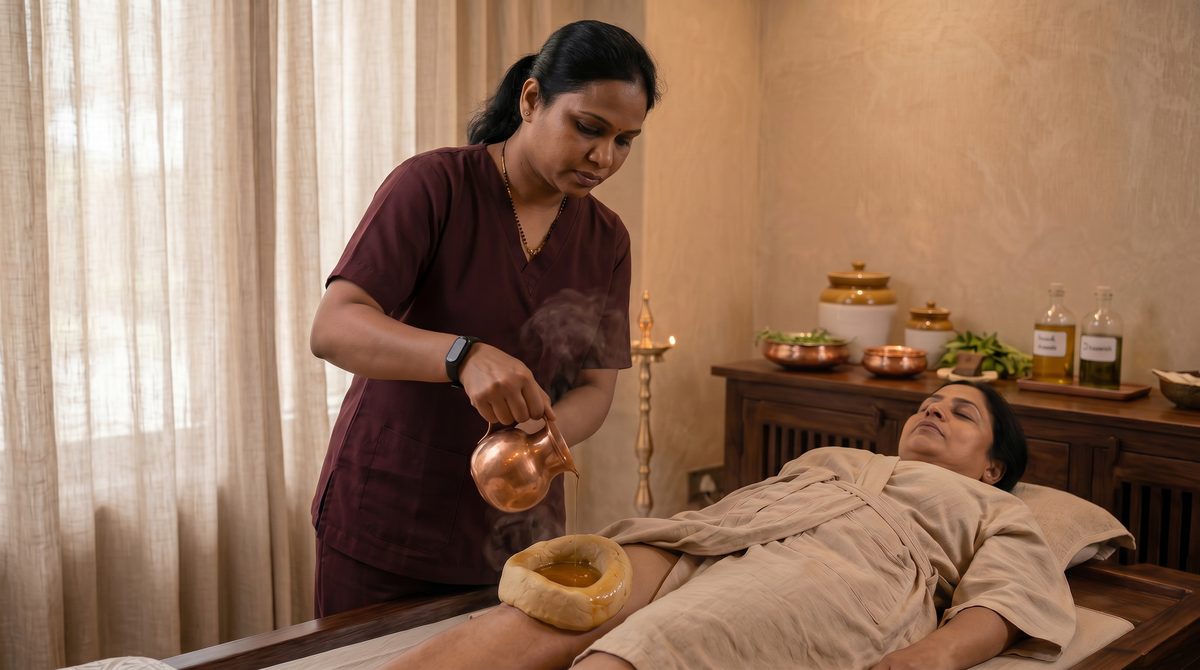
Janu means knee, and Basti here means a retaining structure. In Janu Basti, a ring or dam is built around the knee using a dough made from black gram (urad dal) flour or wheat flour. Warm medicated oil is poured into this well and held there for a set time, so the knee is bathed in steady warmth and oil.
It is most often recommended for Vata-type knee stiffness, joint wear and mild osteoarthritis-type discomfort. Janu Basti is one form of Ayurvedic medicine for knee pain applied as a therapy rather than taken by mouth. Read the full details on our Janu Basti treatment page.
What happens during a Janu Basti session
- Assessment. Your doctor examines the knee and discusses your history before confirming Janu Basti is right for you.
- Preparation. A dough ring is built around the knee, creating a shallow well.
- Oil retention. Warm medicated oil, chosen for your constitution and concern, is poured in and kept warm for the session.
- Gentle massage and rest. After the oil is removed, the area may be gently massaged, followed by a short rest.
- After-care advice. Your doctor advises on activity, warmth and any follow-up sessions.
Like other forms of Ayurvedic medicine for knee pain, it is chosen after an assessment. The sensation is warm and soothing. If the warmth ever feels too strong, tell the therapist straight away.
Janu Basti is not the same as Panchakarma Basti
The word Basti appears in both, but they are very different. Janu Basti is an external therapy that holds oil over the knee. The Basti used in Panchakarma is an internal, medicated enema therapy given as part of a planned programme under supervision.
Similar external therapies exist for other areas, such as Kati Basti for the lower back and Greeva Basti for the neck. Our guide to Ayurvedic treatments explains the difference in more detail.
When Panchakarma is considered for knee pain
Sometimes Ayurvedic medicine for knee pain alone is not enough. For long-standing joint concerns, or when knee pain is part of a wider pattern of stiffness, weight gain or sluggish digestion, the doctor may suggest a planned Panchakarma programme. This can include preparation with oils and herbal steam, followed by classical therapies such as Basti, chosen for your needs.
Panchakarma is not needed for everyone with knee pain. When it is suitable, it is planned and supervised by a doctor. Read more in our guide to Panchakarma treatment in Mumbai.
Ayurvedic medicine for knee pain in older adults
Knee stiffness is common after 50, but it is not something you simply have to accept. For older adults, Ayurvedic medicine for knee pain is usually chosen with extra care: gentler oils, lower-intensity therapies, and formulations that suit digestion and any medicines already being taken for blood pressure, sugar or thyroid.
The aim is steady, comfortable movement, so walks, stairs and family outings stay possible. A doctor-led plan also checks for other causes of pain and coordinates with your regular physician. Read more in our guide to joint care in Mumbai.
Why digestion matters for your knees
Ayurveda links joint comfort closely with digestion, or Agni. When digestion is weak, the body is thought to build up heaviness that can settle in the joints. That is why a doctor may include simple diet changes and digestive support alongside any Ayurvedic medicine for knee pain.
Eating warm, freshly cooked meals at regular times, avoiding heavy late dinners, and staying active through the day all support this. Small changes here often make the rest of the plan work better.
Safety: what to tell your doctor
- Any diagnosis you have, such as osteoarthritis, rheumatoid arthritis, gout or diabetes.
- All medicines and supplements you take, including painkillers and blood thinners.
- Any recent injury, surgery or injection in the knee.
- Pregnancy, skin conditions or allergies that could affect oils or therapies.
Sharing this helps the doctor choose Ayurvedic medicine for knee pain that is safe for you. Never stop a prescribed medicine on your own because you have started an Ayurvedic plan.
Comparing the options
| Option | What it involves | Often considered for |
|---|---|---|
| Medicated oil | Warm herbal oil applied to the knee, at the centre or at home | Stiffness and dryness, daily support |
| Oral formulations | Doctor-prescribed formulations such as Shallaki or Arthrohills | Ongoing joint support from within |
| Janu Basti | Warm oil held over the knee in a dough ring | Vata-type stiffness, joint wear |
| Abhyanga | Full-body warm oil massage | General stiffness and wellbeing |
| Panchakarma | A planned programme of classical therapies | Deeper, long-standing patterns |
Each is a form of Ayurvedic medicine for knee pain, but these are not choices to make on your own. A doctor’s assessment decides whether one option alone, or a combination, is right for your knee.
Daily habits that support your knees
- Keep moving gently every day: walking on flat ground, simple leg strengthening and stretching.
- Maintain a healthy weight, since every extra kilo adds load to the knees.
- Prefer warm, freshly cooked food and avoid long gaps between meals.
- Keep the knees warm in air-conditioned rooms and during cooler months.
- Avoid sitting cross-legged or squatting for long periods if it worsens pain.
These habits make any Ayurvedic medicine for knee pain work better, and they are worth starting before pain becomes a daily problem. Read our guide on preventive joint care after 50.
Do not wait for knee pain to get worse
Many people delay Ayurvedic medicine for knee pain and put up with stiffness for years, treating it as a normal part of ageing. In Ayurveda, early care is easier and gentler than late care. Starting the right oil, formulation and routine at the first signs of stiffness can help keep you walking comfortably for longer.
If knee pain is already affecting your walks, stairs or sleep, it is time for an assessment rather than another painkiller. Our guide on whether a painkiller is enough for osteoarthritis explains why.
How long before you notice a difference?
How quickly Ayurvedic medicine for knee pain helps depends on the type and duration of your knee pain, your age, weight and activity, and how consistently you follow the plan. Some people feel easier movement after a few sessions of therapy; long-standing joint wear usually needs a longer course.
Your doctor will review your progress and adjust the plan. Be cautious of any product that promises instant or complete relief: genuine Ayurvedic medicine for knee pain works steadily, as part of a planned approach.
One or two sessions, or a planned course?
Many people ask whether a short burst of Ayurvedic medicine for knee pain is enough. One or two sessions of Janu Basti or oil therapy can leave the knee feeling warmer and looser, and that relief is welcome. But stiffness that has built up over months or years usually needs a planned course: a series of therapies, doctor-prescribed formulations, daily oil and exercise at home, and follow-up visits.
At Herbal Hills, the doctor explains both options honestly, including our one-month joint care plans, and you decide what suits you. Explore Ayurvedic joint pain treatment at Herbal Hills.
Buying Ayurvedic medicine for knee pain online: a word of caution
It is easy to order oils and tablets online, and many promise quick relief. But the same Ayurvedic medicine for knee pain can suit one person and not another, and some products are not what their labels claim.
Choose formulations from a trusted manufacturer, prescribed by a doctor who has examined your knee. If you already use a product, bring it to your consultation so the doctor can check whether it fits your plan. You can also visit our Ayurvedic medicine shop at our Mumbai centres, where Herbal Hills formulations are available.
Start with an assessment, not a product name
If you have heard about a particular oil, tablet or Janu Basti for your knee, the right next step is a consultation to confirm what actually suits you. Our doctors assess your knee and constitution, then recommend oils, oral formulations, therapy or a combination, as part of a genuine joint care plan.
That way, the Ayurvedic medicine for knee pain you use is chosen for your knee, not for the average knee.
Frequently asked questions
There is no single best medicine for every knee. The right choice depends on the type of knee pain, your constitution and any diagnosis. Oils, oral formulations such as Shallaki or Arthrohills, and therapies like Janu Basti are often used together, as recommended by a doctor.
Warm medicated oils are commonly used for dry, stiff knees, but the right oil depends on your knee and constitution. Our doctors choose from more than 40 Ayurvedic oils, and may prescribe an oil such as Arthrohills joint care oil for home use.
Janu Basti is a localised Ayurvedic therapy in which warm medicated oil is held over the knee inside a ring made from black gram or wheat flour dough, for a set time, to support stiffness and local circulation.
No. It is usually a warm, soothing sensation. If the warmth ever feels too strong or uncomfortable, tell the therapist straight away.
Ayurvedic oils, formulations and therapies are used to support stiffness and comfort as part of a broader plan. They do not replace ongoing medical care for a diagnosed arthritic condition, so discuss your diagnosis with the consulting doctor before starting.
It is better not to. Oral formulations should be prescribed by a doctor who knows your health history and current medicines, so they suit your knee and do not clash with other treatment.
This article is for general education and does not replace medical advice. Ayurvedic therapies and medicines at Herbal Hills are planned by qualified doctors after a personal consultation.
Find a Herbal Hills centre near you
Our wellness centres are spread across Western Mumbai, from Juhu to Borivali, so individuals, families and companies in the western suburbs can reach doctor-led joint care easily. A doctor will assess your knee, explain which approach suits you and plan the right course. Open Tuesday to Sunday, 10 am to 7 pm. Find your nearest centre.
Your knees deserve a plan, not a guess.
One thought on “Ayurvedic Medicine for Knee Pain: Oils, Formulations and Janu Basti, Chosen for Your Knee”