
Ayurvedic Para-Surgical Therapy · Pain Care
Agnikarma Treatment for Chronic Pain in Mumbai – Ayurvedic Thermal Cautery
Agnikarma is an Ayurvedic para-surgical heat therapy in which a heated metal rod (shalaka) is applied to specific points on the body under an Ayurvedic doctor’s supervision. Herbal Hills Center offers Agnikarma treatment for chronic pain in Mumbai; a session takes about 20–30 minutes.
Looking for Agnikarma treatment for chronic pain in Mumbai? This guide explains what Agnikarma is, how a session works, which concerns it is traditionally used for, who should avoid it and how a course is planned at our five centres.
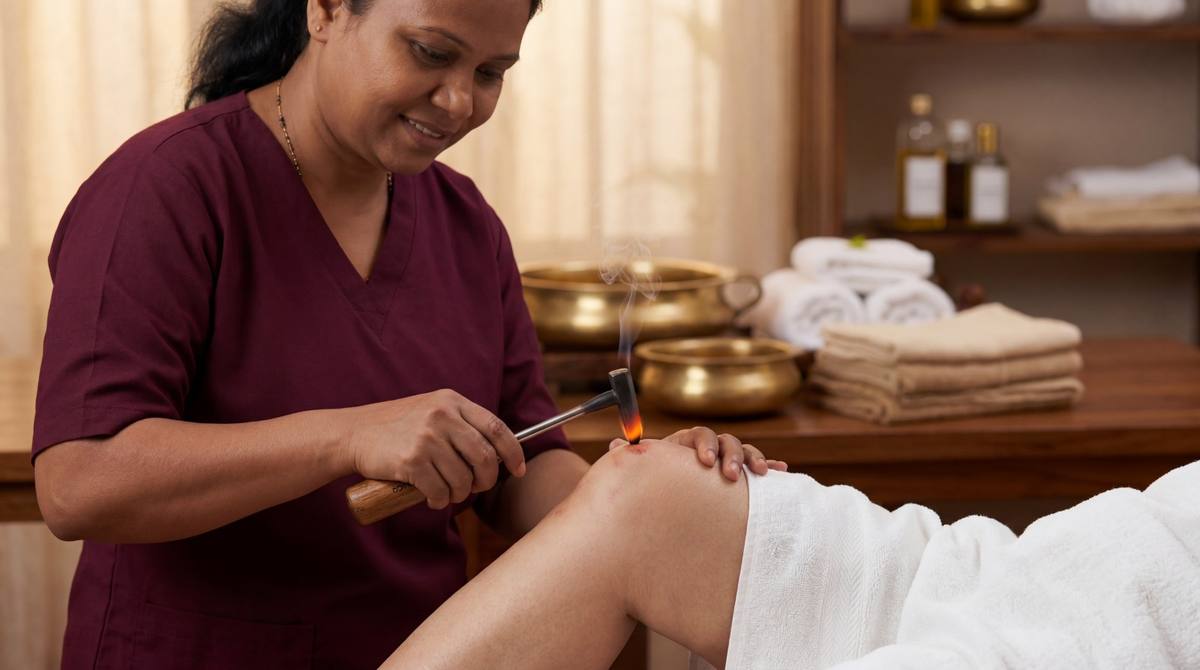
A Classical Para-Surgical Therapy
Agnikarma is described in the Sushruta Samhita, the classical Ayurvedic text on surgery, as a method of applying controlled heat to relieve pain arising from Vata and Kapha.
⏱️
Duration
20 – 30 Mins
🏥
Session Type
In-Clinic
🎯
Treatment Goal
Chronic Pain Support
🔄
Sessions Needed
As Suggested by Our Doctor
What Is Agnikarma?
Agnikarma (literally “fire procedure”) is one of the classical para-surgical procedures of Ayurveda. A specially crafted metal rod called a shalaka is carefully heated and applied for a moment to precise points on the body, with control and under a doctor’s supervision.
The focused heat is traditionally described as clearing blocked channels (srotas), settling aggravated Vata and Kapha dosha and supporting the body’s own healing response at the site of pain. Classical texts recommend it especially when pain is local, long-standing and has not settled with rest, oil therapies or physiotherapy.
At Herbal Hills, Agnikarma treatment for chronic pain is offered only after a consultation with an Ayurvedic doctor, who decides whether the therapy suits you, which points to treat and how many sessions you need.
Agnikarma Treatment for Chronic Pain: How It Is Thought to Work
In Ayurveda, most long-standing pain is linked to Vata, the principle of movement, often combined with Kapha, which brings heaviness and stiffness. Vata is cold, dry and mobile; Kapha is cold, heavy and stable. Heat is the classical opposite of both.
Agnikarma delivers that heat to a very small area for a very short time. The aim is a precise, local effect: to ease stiffness, improve circulation at the point and help the tissue respond. This is why Agnikarma treatment for chronic pain is usually focused on clearly defined spots, such as a tender point at the heel, the side of the elbow or the back of the knee, rather than a large area of the body.
Your doctor chooses the shalaka (made of metals such as copper, iron or panchadhatu, an alloy of five metals) and the pattern of contact points based on how deep the discomfort sits — at the level of skin, muscle, tendon or joint.
What It Supports
Benefits of Agnikarma
The benefits of Agnikarma described in Ayurveda centre on local pain, stiffness and mobility. Results vary from person to person, and your doctor will explain what to expect in your case.
🎯
Targeted Pain Support
Heat is applied only at the specific points your doctor identifies.
🔥
Eases Local Stiffness
Traditionally used to soften stiffness linked to Vata and Kapha.
🚶
Supports Mobility
Designed to help you move the affected joint more comfortably.
🩸
Supports Local Circulation
Heat is thought to improve blood flow at the treated point.
⏱️
Short Sessions
Contact lasts seconds per point; a session takes about 20–30 minutes.
🌿
Classical Ayurvedic Method
Described in the Sushruta Samhita and practised by trained Ayurvedic doctors.
Is It for You?
Concerns Agnikarma Is Traditionally Used For
Ayurvedic doctors commonly consider Agnikarma treatment for chronic pain in the concerns below. It supports your wellbeing alongside — never instead of — any treatment prescribed by your physician.
💪
Frozen Shoulder & Shoulder Pain
Used at tender points around the shoulder.
🦶
Heel Pain & Plantar Fasciitis
One of the most common reasons people choose Agnikarma.
⚡
Sciatica-Type Leg Pain
As part of a wider plan with local therapies.
🤝
Tennis Elbow & Neck Stiffness
Small, well-defined points respond to focused heat.
🦴
Muscle Stiffness & Joint Discomfort
Where stiffness has settled into one area.
How It Works
The Agnikarma Procedure, Step by Step
Whichever centre you choose for Agnikarma treatment for chronic pain, the procedure follows the same four stages.
1
Ayurvedic Consultation
Our Ayurvedic doctor examines your condition, pain history and dosha balance to confirm Agnikarma is right for you and to identify the precise treatment points.
2
Area Preparation
The target area is cleaned and the surrounding skin protected. The correct shalaka is chosen based on tissue level — skin, muscle, ligament or bone.
3
Controlled Heat Application
The heated shalaka is applied with precise pressure to specific points, often Marma points. Contact lasts only seconds per point and is carried out systematically across the area. Sensation: a brief, sharp warmth that most people tolerate well. Duration: about 20–30 minutes per session.
4
Post-Treatment Care
A cooling herbal application such as aloe vera or a medicated paste is applied to soothe the area. You rest briefly while the doctor advises on aftercare, diet and follow-up sessions if required.
Agnikarma in Classical Ayurveda
Acharya Sushruta, regarded as the father of Ayurvedic surgery, described Agnikarma in detail more than two thousand years ago. He noted that conditions treated with Agnikarma are less likely to return, and he listed the tools, the shapes of the burns (such as dots, rings and lines) and the seasons best suited to the procedure.
He also grouped Agnikarma by depth: twak (skin), mamsa (muscle), sira and snayu (vessels and ligaments) and sandhi and asthi (joints and bone). Today’s practice follows the same idea. For superficial discomfort a lighter contact is used; for deeper joint pain a different shalaka and pattern may be chosen. Modern Ayurvedic doctors adapt this classical guidance with careful hygiene, consent and aftercare, which is how we approach every Agnikarma treatment at Herbal Hills.
Agnikarma treatment is therefore not a new trend but a time-tested method, now delivered in a clinical setting by trained doctors.
What Agnikarma Feels Like
Most people are surprised at how quick each contact is during Agnikarma treatment. You feel a brief, sharp heat — often compared to a quick sting — that fades within seconds. The doctor works point by point, checking with you as they go, so you are always in control of the pace.
After the session, the treated points may look like tiny pink or brown dots. These are expected and usually fade over the following days. Many people report that the area feels lighter or less stiff soon after a session, though the response differs from person to person and depends on how long the pain has been present. Your doctor will review the points at each visit as part of your Agnikarma treatment plan.
Agnikarma for Arthritis Pain and Joint Stiffness
Agnikarma for arthritis pain is one of the most common reasons people visit us. In Ayurveda, degenerative knee pain (Sandhigata Vata) is a classic Vata condition, and Agnikarma is one of the local therapies an Ayurvedic doctor may add to a wider plan.
That plan usually also includes oil therapies, a supportive diet and gentle movement. For knee pain, Agnikarma is often combined with Janu Basti (warm medicated oil pooled over the knee) or Ekang Lepam (a herbal paste applied to one area). If you want to understand the full approach to joints, see our page on Ayurvedic joint pain treatment in Mumbai and our Ayurvedic knee joint pain treatment.
Agnikarma treatment does not replace the care of an orthopaedic doctor or rheumatologist. If you are already under treatment, please bring your reports and medicine list to the consultation.
Agnikarma and Other Ayurvedic Pain Therapies
Agnikarma treatment works best as part of a plan rather than on its own. Depending on where your pain sits and how long it has lasted, your doctor may combine Agnikarma treatment for chronic pain with:
- Janu Basti — warm medicated oil held over the knee.
- Kati Basti — warm medicated oil held over the lower back.
- Greeva Basti — warm medicated oil held over the neck.
- Pichu — a cloth soaked in warm medicated oil placed over the painful area.
- Elakizhi — warm herbal leaf bolus massage for stiffness and aches.
- Niruha Basti — a Panchakarma therapy that works on Vata at its main seat.
You can explore all of our Ayurvedic therapies to see how each one fits into a complete plan.
Agnikarma Treatment Through Mumbai’s Seasons
Sushruta advised that Agnikarma can be carried out in most seasons, but with extra care in the hottest months and in the heat of early autumn, when Pitta is high. In Mumbai this means April–May and the October heat. During these months your doctor may space sessions further apart, keep the number of points small and give cooling aftercare advice. In the monsoon and the cooler months, sessions are usually planned in the normal way.
Agnikarma Treatment Cost and Planning
The cost of Agnikarma treatment depends on how many areas are treated, how many points are needed and how many sessions your doctor recommends. Because this is decided only after examining you, we do not quote a fixed price online. Your first consultation and Nadi Parikshan are free, and the doctor will explain the full plan and the cost of each session before you decide.
How Many Agnikarma Sessions Will I Need?
This depends on your condition. Acute or early-stage problems often respond in 1–2 sessions. Chronic, long-standing pain may need 3–5 sessions spaced 3–7 days apart, as recommended by your doctor after consultation.
The gap between sessions lets the treated points settle and gives the doctor time to see how your body is responding. Choosing an Agnikarma treatment centre close to your home or office makes it easier to keep to the schedule.
Before and After Your Agnikarma Session
Before your session
- Wear loose clothing that lets the doctor reach the painful area easily.
- Eat a light meal; avoid coming in on a completely empty stomach.
- Tell the doctor about any medicines, blood thinners, skin conditions, diabetes or pregnancy.
After your session
- Keep the treated area clean and dry for the time your doctor advises.
- Avoid scratching, rubbing or applying anything other than the paste or gel prescribed.
- Avoid cold water on the area, cold drinks and strenuous use of the joint on the day of treatment.
- Report any unusual redness, swelling or discomfort to the doctor straight away.
Following this simple aftercare helps each Agnikarma treatment session settle comfortably.
Is Agnikarma Safe? Who Should Avoid It?
Agnikarma involves heat applied to the skin, so it must be carried out only by a qualified Ayurvedic doctor using the correct instruments, careful technique and clean conditions. At Herbal Hills, the procedure is performed by our Ayurvedic doctors in a clinical setting, and the doctor explains the process and takes your consent before beginning.
Agnikarma is generally not recommended for pregnant women, people with active skin infections at the treatment site, bleeding disorders or uncontrolled diabetes, and it is used with care in people with very sensitive skin or reduced sensation. A doctor consultation decides whether Agnikarma treatment is suitable for you. Agnikarma supports your wellbeing alongside your prescribed care; it does not replace medical treatment.
Choosing an Agnikarma Treatment Centre in Mumbai
Because Agnikarma is a para-surgical procedure, who performs it matters most. When you compare Agnikarma treatment centres, look for a centre where a qualified Ayurvedic doctor examines you first and performs the procedure personally, where instruments are cleaned between patients and where you receive clear written aftercare.
At Herbal Hills, all five centres follow the same consultation-first standard. Your first visit starts with a free consultation and Nadi Parikshan (pulse diagnosis); only if Agnikarma suits you will the doctor plan the points and the number of sessions.
Find Us
Agnikarma Treatment for Chronic Pain: Our 5 Mumbai Centres
Every centre offers the same doctor-performed Agnikarma treatment, private treatment rooms and clear aftercare. Choose the location nearest to you.
Herbal Hills Kandivali West
Unit No. 101, Maitri Swami Kripa, Mahatma Gandhi Cross Rd No. 3, Kamala Nagar, Kandivali West, Mumbai 400067
+91 88288 55200 · Tue–Sun
Herbal Hills Goregaon West
Office No. 1, Ground Floor, Swarupam, Plot No. 79, Jawahar Nagar Road No. 10, Goregaon West, Mumbai 400104
+91 86577 77967 · Tue–Sun
Herbal Hills Borivali West (L.T. Road)
Office No. A/102, 1st Floor, New Gopal Premises CHS, L.T. Road, 212 TPS Road, Borivali West, Mumbai 400092
+91 86575 55515 · Tue–Sun
Herbal Hills Borivali West (Yogi Nagar)
Rajkamal CHS, 1st Floor, Office No. 2, Next to Celebration Restaurant, Yogi Nagar, Borivali West, Mumbai 400092
+91 97696 26565 · Tue–Sun
Herbal Hills Andheri West (Juhu Lane)
G-3/4, Ground Floor, Bharat Apartment, C. D. Barfiwala Marg, Juhu Lane, Andheri West, Mumbai 400058
+91 86579 15422 · Tue–Sun
Ayurveda is a recognised system of medicine in India under the Ministry of AYUSH, and our doctors follow its classical principles.
Common Questions
Frequently Asked Questions About Agnikarma
You may feel a brief, sharp heat sensation during application — similar to a quick sting. It lasts only seconds and is well tolerated by most patients. Many report feeling lighter and less stiff soon after the session.
This depends on your condition. Acute or early-stage problems often respond in 1–2 sessions. Chronic, long-standing pain may require 3–5 sessions spaced 3–7 days apart, as recommended by your doctor after consultation.
Agnikarma is considered safe when it is performed by trained Ayurvedic doctors using correct instruments and protocols. At Herbal Hills Center, Agnikarma procedures are carried out by our Ayurvedic doctors in a clean, clinical setting after a consultation.
Agnikarma is generally not recommended for pregnant women, people with active skin infections at the treatment site, bleeding disorders, or uncontrolled diabetes. A thorough doctor consultation will determine your suitability before treatment begins.
Agnikarma is designed to work on pain at the tissue level rather than only masking it. How long the benefit lasts differs from person to person and depends on your condition, its severity, your lifestyle and the follow-up care advised by your doctor.
Yes, Agnikarma for arthritis pain is a common use. Ayurvedic doctors often add it to a wider plan for knee osteoarthritis that also includes oil therapies such as Janu Basti, diet and gentle movement. It supports, and does not replace, care from your orthopaedic doctor.
Herbal Hills offers Agnikarma treatment at five centres in Mumbai: Kandivali West, Goregaon West, Borivali West (L.T. Road and Yogi Nagar) and Andheri West (Juhu Lane). Every course starts with a free consultation with an Ayurvedic doctor.
Why Herbal Hills Center
Trusted by Thousands. Authentic Ayurveda.
🏆
20+ Years
of Excellence
👨⚕️
Qualified Doctors
Ayurvedic specialists
📍
5 Centres
Across Mumbai
💧
Fresh Herbal Oils
Every session
🔒
100% Private
Confidential care
Ready to Get Relief from Chronic Pain?
Consult our Ayurvedic doctor today — the consultation is free — and find out if Agnikarma is the right treatment for you. Book your Agnikarma treatment for chronic pain consultation at the centre closest to you.
Agnikarma – Ayurvedic Thermal Cautery for Chronic Pain Free consultation at 5 Mumbai centres