

Blog
Is Ayurveda Effective for Arthritis? What Doctors Actually Recommend

Ayurveda for Arthritis Explained Honestly: Janu Basti, Oral Formulations, Diet and Daily Routine, What They Can Support, What They Cannot Promise, and Why Your Rheumatologist Stays in the Loop
Ayurveda for arthritis can support the way you live with joint pain: less stiffness in the morning, better local circulation, easier movement and a daily routine that is kinder to your joints. It is not a one-time fix for arthritis, it cannot undo joint damage that has already happened, and it works best alongside the medical care you already receive, not instead of it. If you have been diagnosed with arthritis, or you live with joint pain and have heard that Ayurveda might help, it is fair to ask directly whether it actually works or whether it is just a marketing claim. This guide gives you a specific, honest answer: what Ayurvedic doctors actually recommend, what the realistic goals are, where Ayurveda fits next to your rheumatologist or orthopaedic doctor, and what a responsible plan looks like.
What does effective actually mean here?
Arthritis is a diagnosed medical condition, and its management is a medical matter. At Herbal Hills, Ayurveda for arthritis is never positioned as a replacement for that care. What it can support is how you feel and function day to day: reduced stiffness, improved local circulation, comfort around the joint and general Vata balance, which in Ayurvedic terms is closely linked with dryness, stiffness and pain in the joints.
That is a real, honest claim, and it is a very different claim from saying Ayurveda makes arthritis disappear. When people ask whether Ayurveda for arthritis is effective, the useful answer is: effective at what? For symptom support and daily function, many people find it helpful. For reversing structural joint damage or switching off an autoimmune process, no responsible practitioner, Ayurvedic or otherwise, should promise that.
Arthritis is not one condition
The word arthritis covers more than a hundred conditions. Three are seen most often at our centres, and each needs a different plan:
- Osteoarthritis, the wear-and-tear type, most common in knees, hips and hands, usually after 45 or after injury. See our Joint Care osteoarthritis programme.
- Rheumatoid arthritis, an autoimmune condition where the immune system inflames the joint lining, often in small joints on both sides of the body. See our Joint Care rheumatoid arthritis programme.
- Gout, sudden, very painful attacks linked with uric acid, often in the big toe. See our Joint Care gout programme.
This matters because Ayurveda for arthritis is never one recipe. A therapy that suits a stiff, dry osteoarthritic knee may be wrong during an inflamed rheumatoid flare. The type, stage and current activity of your arthritis decide what the doctor recommends.
How Ayurveda reads joint pain
Classical Ayurveda describes joint conditions mainly through Vata, the principle of movement and dryness, and Ama, the residue of incomplete digestion. Sandhivata is the classical term most often compared with osteoarthritis, and Amavata with inflammatory joint conditions such as rheumatoid arthritis.
These are traditional frameworks, not modern diagnoses, and they do not replace blood tests or X-rays. But they explain why Ayurveda for arthritis looks beyond the joint itself: at digestion, sleep, routine, cold and dry exposure, and the way you move through the day. Two people with the same scan may receive different advice, because their constitution and digestion differ.
What Ayurvedic doctors actually recommend for arthritis support
A genuine plan usually has three parts, chosen and sequenced by the doctor after assessment.
1. In-clinic localised therapy
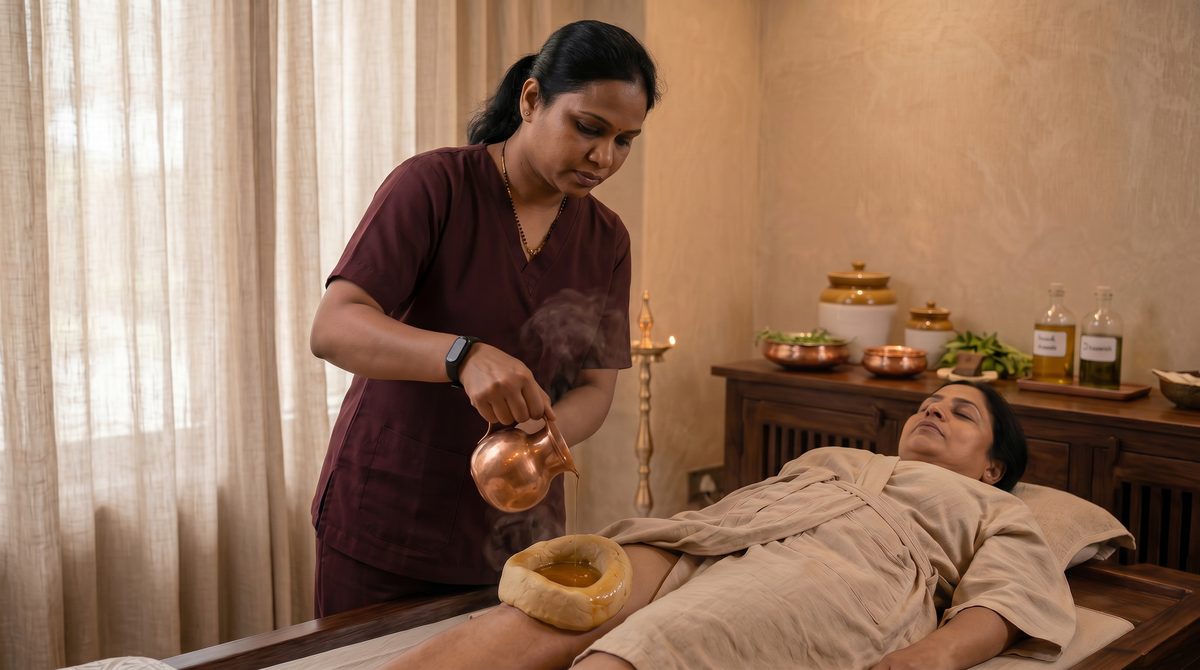
For localised stiffness, therapies such as Janu Basti for the knee are commonly recommended. Warm medicated oil is held over the joint inside a ring of dough to support circulation and ease stiffness. Our Janu Basti treatment page explains exactly what it involves. For the back and neck, the doctor may suggest Kati Basti or Greeva Basti instead.
2. Oral formulations for ongoing support
Daily oral Ayurvedic formulations are often prescribed for ongoing management, alongside, not instead of, any medicine prescribed by your treating doctor. The doctor chooses them for your type of arthritis, digestion and other medicines. Our guide to Ayurvedic medicine for knee pain explains why a formulation that suits one person may not suit another.
3. Diet and lifestyle guidance
Diet, movement and daily routine are part of any genuine plan, aimed at reducing Vata aggravation and supporting joint function over time. This is often the part that makes the biggest difference between visits.
Is Ayurveda for arthritis supported by evidence?
Research on Ayurveda for arthritis exists, including some clinical studies on specific formulations for osteoarthritis and rheumatoid arthritis, but most are small, and results are mixed. That is why we describe Ayurvedic care as supportive symptom management, not as a proven alternative to modern treatment.
The NHS overview of arthritis is a useful, neutral starting point if you want to understand the main types and standard treatments. A good Ayurvedic doctor will be comfortable with that evidence base and will not ask you to choose between the two systems.
What Ayurveda cannot honestly promise
- It is not a one-time fix for arthritis, and no responsible practitioner should claim otherwise.
- It should not replace medicines or medical management prescribed by your treating doctor for a diagnosed arthritic condition.
- It cannot reverse joint damage that has already occurred, such as worn cartilage seen on an X-ray.
- Results vary widely by person, by the type and stage of arthritis, and by how consistently the plan is followed. There is no fixed timeline or outcome.
If anyone promises that Ayurveda for arthritis will make your condition vanish, or asks you to stop your medicines, treat that as a warning sign.
Ayurveda for arthritis alongside medical care, not instead of it
The most responsible way to think about Ayurveda for arthritis is as a complementary layer to your existing care. You continue any prescribed medicine and follow-up with your treating physician, and add Ayurvedic therapies and lifestyle guidance for symptom support.
If you are under a rheumatologist or orthopaedic specialist, that relationship continues. Rheumatoid arthritis in particular needs specialist monitoring, because modern disease-modifying medicines protect the joints in ways that Ayurveda cannot replace. Ayurvedic care at Herbal Hills works next to that care, and we encourage you to keep your doctor informed. Our osteoarthritis guide explains why a painkiller alone is rarely the whole plan, and why neither system has to stand alone.
What a responsible Ayurvedic arthritis consultation looks like
- An honest conversation about your diagnosis, reports, current treatment and what you hope Ayurvedic care will add.
- Nadi Parikshan pulse assessment and questions about digestion, sleep, activity and how the pain behaves through the day.
- A realistic explanation of what is likely to help, such as stiffness, circulation and general function, and what it will not change, such as existing joint damage or the underlying disease process.
- A plan that complements your existing medical management, with therapies, formulations and diet chosen for you.
- No outcome promises, and no suggestion to stop prescribed medicine without your treating doctor’s involvement.

Ayurveda for arthritis by type: what changes
| Type | What Ayurveda for arthritis usually focuses on | What stays with your medical doctor |
|---|---|---|
| Osteoarthritis | Local oil therapies such as Janu Basti, gentle movement, warmth, Vata-calming diet and routine | Diagnosis, imaging, pain medicine decisions, joint replacement advice |
| Rheumatoid arthritis | Digestion and Ama, gentle therapies chosen around flares, diet and sleep support | Disease-modifying medicines, blood tests, flare management |
| Gout | Diet guidance, hydration, weight and routine support between attacks | Uric acid testing, attack treatment, long-term medicines |
During an acute flare, the doctor may pause or change therapies. Heat and oil that soothe a stiff joint may not suit a hot, swollen one.
Diet and daily habits that support your joints
Ayurveda for arthritis puts real weight on what happens between visits. Common advice, adjusted to your type and digestion, includes:
- Warm, freshly cooked meals at regular times, with fewer cold, heavy, fried and processed foods.
- Keeping joints warm, especially in air-conditioned offices and during the monsoon.
- Gentle, regular movement that the doctor or a physiotherapist approves, rather than long periods of sitting.
- Steady sleep and a calmer evening routine, since poor sleep often makes pain feel worse.
- Maintaining a healthy weight to reduce load on knees and hips.
For rheumatoid arthritis, our rheumatoid arthritis diet guide goes into foods to favour and limit.
How long before Ayurveda for arthritis shows results?
There is no fixed answer. People with mild, recent stiffness sometimes notice easier movement within a few weeks of a planned course. Long-standing arthritis usually needs more patience, and some changes are about slowing the slide in function rather than a dramatic improvement.
What we can say is that one session rarely changes much. Ayurveda for arthritis works as a course: therapies over weeks, daily formulations as prescribed, and habits kept up at home. Your doctor reviews progress at follow-up visits and adjusts the plan.
Who should be careful before starting
- People with an acute, hot, swollen joint or fever should see their medical doctor first.
- People on blood thinners, steroids or disease-modifying medicines should share the full list before any formulation is prescribed.
- People with diabetes, kidney or liver conditions need formulations chosen with extra care.
- Anyone who is pregnant or breastfeeding should tell the doctor before any therapy or medicine.
None of these rule out Ayurveda for arthritis. They simply mean the plan is built around your health, not a standard package.
Signs that need your medical doctor urgently
Some joint symptoms should never wait for an Ayurvedic appointment. See your medical doctor promptly if a joint suddenly becomes red, hot and very swollen, if you have fever with joint pain, if you cannot bear weight after an injury, or if pain wakes you every night and is getting worse. These can signal infection, a fracture or a severe flare.
Once those are ruled out or treated, Ayurveda for arthritis can be considered as supportive care.
Living with arthritis in Mumbai
City life adds its own load on the joints. Long commutes standing in trains, stairs at stations, hours at a desk in a cold air-conditioned office and the damp of the monsoon are common reasons people tell us their stiffness feels worse. Many also notice that joint pain flares when sleep is short and meals are late.
None of this means you have to change your whole life. Small, steady adjustments, such as a warm shawl or knee cover in the office, a short walk after lunch, a fixed dinner time and a few minutes of the movements your doctor or physiotherapist approves, often help more than an occasional intense effort. Ayurveda for arthritis builds these habits into the plan, so the care continues after you leave the centre.
What to bring to your first consultation
- Your diagnosis and any letters from your rheumatologist or orthopaedic doctor.
- Recent blood tests, such as inflammatory markers, rheumatoid factor or uric acid, if you have them.
- X-ray or MRI reports of the affected joints.
- A full list of medicines, supplements and oils you currently use.
- A short note of when the pain is worst, what eases it and what you most want to be able to do again.
This helps the doctor plan realistic goals from the first visit, instead of guessing, and makes it easier to coordinate with the doctors already looking after you.
How Herbal Hills plans Ayurveda for arthritis
At Herbal Hills, every arthritis plan starts with a free doctor consultation. From there, the doctor may suggest single therapies, a structured one-month Joint Care programme, or a combination with oral formulations and diet guidance. You can read about the full range on our Ayurvedic joint pain treatment and arthritis treatment pages.
We review progress at follow-up visits, keep the plan flexible around flares, and tell you plainly if we think Ayurveda for arthritis is not the right step for you at that moment.
Questions to ask any Ayurvedic clinic before you start
- Who is the doctor, and will the same doctor review my progress?
- How does this plan fit with my current medicines and specialist care?
- What exactly can I expect to change, and what will not change?
- Which therapies and formulations, for how long, and why for me?
- What should I do at home between sessions?
A clinic offering genuine Ayurveda for arthritis will answer these clearly, without pressure.
An honest answer, not a sales pitch
So, is Ayurveda for arthritis effective? For many people it helps with stiffness, comfort and daily function, alongside existing medical care. It is not a replacement for that care and it is not a one-time fix. Herbal Hills doctors will give you that same honest assessment in consultation, at any of our Mumbai centres, and plan Ayurveda for arthritis only where it makes sense for you.
Frequently asked questions
Ayurveda for arthritis can support symptom management, such as reduced stiffness, better local circulation and easier daily movement, alongside existing medical treatment. It is not a one-time fix and should not replace medicines or care prescribed by your treating doctor. Results vary from person to person.
No. Arthritis is a medical condition, and no responsible Ayurvedic or medical practitioner should promise to reverse it or undo joint damage. Ayurvedic care is positioned as supportive symptom management alongside medical treatment, not a replacement for it.
No. Do not stop or change any prescribed medicine without your treating doctor’s involvement. Ayurvedic care at Herbal Hills is planned to work alongside your existing medical management, and the Ayurvedic doctor needs your full medicine list before prescribing anything.
Therapies such as Janu Basti, oral formulations chosen by the doctor, and diet and routine guidance aim to reduce stiffness, support local circulation and calm Vata. These are realistic, specific goals rather than a promise to remove the condition.
It can be used as supportive care, but rheumatoid arthritis needs ongoing specialist treatment and monitoring. Tell both your rheumatologist and the Ayurvedic doctor about each other’s plan, and never stop disease-modifying medicines on your own.
Start with a consultation. The doctor will review your diagnosis, reports and current treatment, explain what is realistic to add, and plan therapies and formulations for you, rather than promising a specific outcome in advance.
This article is for general education and does not replace medical advice. Ayurvedic therapies and medicines at Herbal Hills are planned by qualified doctors after a personal consultation.
Find a Herbal Hills centre near you
If arthritis is slowing you down, a doctor can assess your joints, review your reports and explain what Ayurvedic care can realistically add to your current treatment. Herbal Hills has five centres in Western Mumbai, in Juhu (Andheri West), Goregaon West, Kandivali West and two in Borivali West, open Tuesday to Sunday, 10 am to 7 pm. Find your nearest centre.
Honest joint care starts with an honest conversation.