

Blog
If It Is Osteoarthritis, What Should I Do? Is Taking a Painkiller Enough?

A Complete Joint Care Plan for Better Mobility
If it is osteoarthritis, what should I do — and is taking a painkiller enough?
Many people with knee pain ask this question after a doctor mentions the word “osteoarthritis”. The honest answer is that a painkiller may bring short-term comfort, but effective osteoarthritis treatment needs much more than one tablet. It needs the right diagnosis, a personalised plan, supportive therapies, the right food and the right kind of movement.
At Herbal Hills Wellness Centre, our Ayurvedic doctors look at osteoarthritis as a condition of the whole person, not only of one joint. This guide explains what osteoarthritis is, why painkillers alone fall short, and what complete, doctor-led osteoarthritis treatment looks like — step by step.
What Is Osteoarthritis? Understanding Sandhigata Vata
Osteoarthritis is a degenerative joint condition. Over time, the protective cartilage that cushions the ends of the bones slowly wears down. The joint loses its smooth gliding surface, and this can lead to pain, stiffness, swelling, a grating or cracking sound, and difficulty with everyday movements.
It most commonly affects weight-bearing joints such as the knees and hips, but it can also involve the lower back, neck, fingers and other joints. You can read more about how common the condition is in the World Health Organization’s osteoarthritis fact sheet.
In Ayurveda, osteoarthritis closely corresponds to Sandhigata Vata — a condition in which aggravated Vata dosha settles in the joints (Sandhi). Vata is dry, light, cold and mobile by nature. When it increases with age, overuse, injury, irregular routines or poor nutrition, it can dry out the joint tissues and reduce their natural lubrication. The result is the familiar picture of creaking, painful, stiff joints.
Not every knee pain is osteoarthritis, though. Ligament injuries, rheumatoid arthritis, gout and other conditions can look similar in the early stages. That is why good osteoarthritis treatment always starts by confirming the cause — our article Is Your Joint Pain Really Osteoarthritis (Sandhivata)? explains the difference in detail.
Common signs of osteoarthritis
- Knee or joint pain that worsens after walking, climbing stairs or standing for long.
- Morning stiffness that eases after moving around.
- A cracking or grating sound (crepitus) when bending the knee.
- Swelling or a feeling of warmth around the joint.
- Reduced range of movement — difficulty sitting cross-legged, squatting or getting up from a chair.
- A feeling that the knee is weak or may “give way”.
Is Taking a Painkiller Enough for Osteoarthritis Treatment?
Painkillers have a place in osteoarthritis treatment. When the pain is severe, a medicine prescribed by your doctor can help you get through the day. But it is important to understand what a painkiller does — and what it does not do.
A painkiller works on the symptom. It reduces the sensation of pain for a few hours. It does not rebuild joint strength, improve lubrication, correct the underlying Vata imbalance, reduce excess body weight or strengthen the muscles that protect the knee. When the effect wears off, the pain often returns — and many people find themselves taking tablets more and more often.
Long-term, unsupervised use of painkillers may also carry risks for some people, including effects on the stomach, kidneys and blood pressure. Please never start, stop or change any prescribed medicine without speaking to your doctor.
So, is a painkiller enough? For most people, the answer is no. Lasting osteoarthritis treatment means addressing several things together:
- The cause — confirming the diagnosis and understanding your body constitution (Prakriti) and dosha imbalance.
- The joint — improving nourishment, lubrication and flexibility of the affected joint.
- The muscles — strengthening the muscles around the knee so the joint carries less load.
- The body weight — reducing strain on weight-bearing joints.
- The daily routine — food, activity and habits that either calm or aggravate Vata.
This is exactly why our doctors follow a structured, whole-person approach to osteoarthritis treatment rather than a single prescription.
Your Osteoarthritis Treatment Journey: From Joint Pain to Better Mobility
A good joint care plan follows a clear path. Here is how the journey looks at Herbal Hills Wellness Centre:
Every step of osteoarthritis treatment builds on the one before it. Skipping the consultation and diagnosis and going straight to a tablet — whether modern or herbal — is one of the most common reasons people do not get the relief they hope for.
The 360° Joint Care Programme at Herbal Hills
Our 360° Joint Care Programme is a comprehensive Ayurvedic management programme designed around one idea: every patient’s joint problem is different, so every osteoarthritis treatment plan must be different too.
Step 1: Detailed doctor consultation
Your journey begins with an unhurried consultation with our Ayurvedic doctor. The doctor will ask about your symptoms, how long you have had them, what makes them better or worse, your daily routine, diet, sleep, digestion and any other health conditions or medicines. A traditional pulse assessment (Nadi Parikshan) helps the doctor understand your Prakriti and current dosha balance.
Step 2: Confirming the diagnosis
The doctor examines the affected joints — their movement, swelling, tenderness and stability. If needed, the doctor may advise an X-ray or blood tests, or review reports you already have. This makes sure your osteoarthritis treatment is built for osteoarthritis and not for a condition that only looks similar.
Step 3: Your personalised joint care plan
Based on your assessment, the doctor prepares a personalised plan. Depending on your condition, your osteoarthritis treatment plan may include:
- Internal Ayurvedic medicines, which may include ArthroHill Capsule where clinically appropriate.
- External application, such as ArthroHill Joint Care Oil.
- Panchakarma and local therapies for the affected joints.
- Diet guidance to balance Vata and support healthy weight.
- Simple exercises and lifestyle changes you can follow at home.
- Regular follow-ups to track your progress and adjust the plan.
You can explore our complete Ayurvedic treatment for osteoarthritis and the wider joint care programme to see how these elements come together.
ArthroHill Capsule: A Clinically Evaluated Part of the Plan
Our doctors may recommend ArthroHill Capsule as part of a comprehensive Ayurvedic management programme for osteoarthritis. It is a formulation developed from classical Ayurvedic principles using herbs traditionally described for joint health and Sandhigata Vata.
ArthroHill Capsule has been clinically evaluated in patients with osteoarthritis. These evaluations looked at important aspects such as pain, stiffness, physical function and safety. You can read the full story in our article on why our doctors have confidence in ArthroHill Capsule.
It is important to be clear about one thing: ArthroHill Capsule is not a standalone cure. It is one part of a doctor-led osteoarthritis treatment plan. Our doctors prescribe it only after a consultation, when it suits your condition, and always together with the other elements of your joint care programme. The dose and duration are decided by your doctor.
ArthroHill Joint Care Oil for Local Support
Alongside internal medicines, osteoarthritis treatment also benefits from direct, external care. Your doctor may recommend ArthroHill Joint Care Oil for gentle local application and massage on the knees or other painful joints.
In Ayurveda, warm oil application (Snehana) is one of the most important ways to counter the dryness and stiffness of aggravated Vata. Regular application, as advised by your doctor, supports comfort, flexibility and ease of movement as part of your daily routine at home.
Panchakarma for Osteoarthritis: Therapies Your Doctor May Recommend
Panchakarma and related Ayurvedic therapies work directly on the joints and muscles. At our centres, these therapies are planned by the doctor and performed by trained therapists. Depending on your condition, your doctor may recommend one or more of the following Panchakarma for osteoarthritis therapies:
Janu Basti — focused knee care
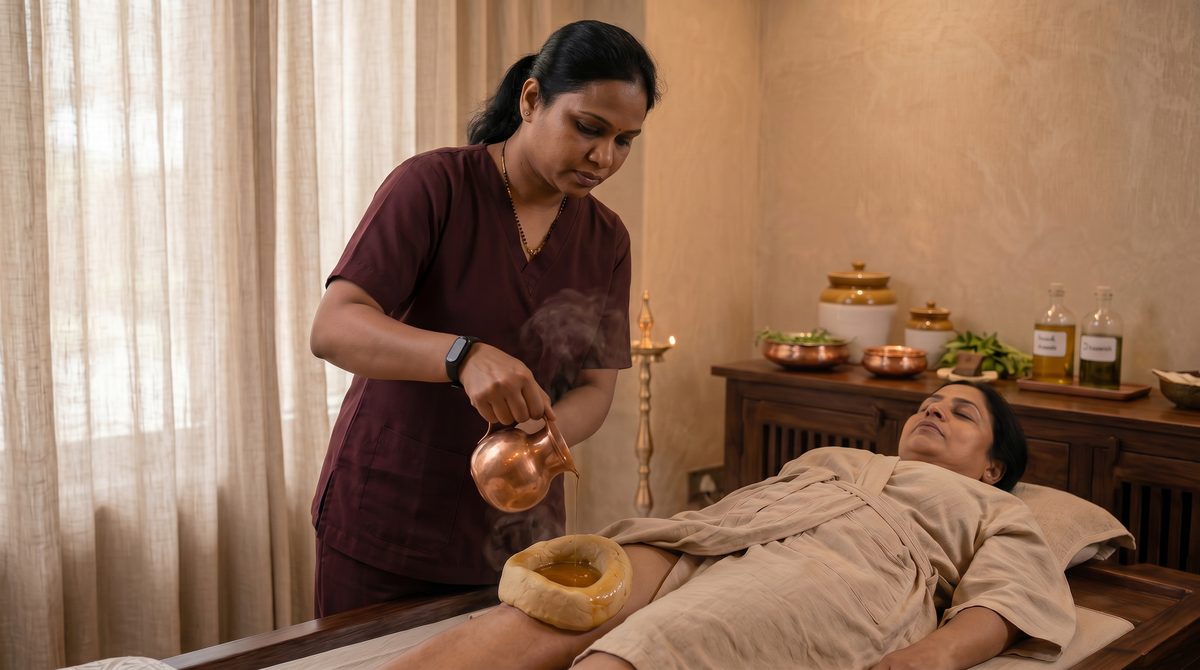
In Janu Basti, a ring made of dough is placed around the knee and filled with warm medicated oil, which is held over the joint for a set time. It is one of the most widely used forms of Ayurvedic treatment for knee pain and knee stiffness, as it nourishes and lubricates the joint area directly.
Kati Basti — for the lower back
Osteoarthritis often affects the lower spine as well. Kati Basti applies the same principle to the lower back, pooling warm medicated oil over the lumbar area to ease stiffness and support comfortable movement.
Abhyanga — full-body oil massage
Abhyanga is a full-body massage with warm herbal oils. It calms Vata throughout the body, relaxes tight muscles, supports circulation and prepares the body for other therapies.
Patra Pinda Sweda — herbal leaf bolus fomentation
In Patra Pinda Sweda, fresh medicinal leaves are cooked in oil, tied into a cloth bolus (potli) and applied warm with rhythmic strokes over painful joints and muscles. The combination of warmth, oil and herbs helps relieve stiffness and supports mobility.
Bashpa Sweda — herbal steam
Bashpa Sweda is a herbal steam therapy that usually follows oil application. The gentle heat opens the channels, helps the oil work more deeply and eases stiffness in the joints and muscles.
Remember: Every patient’s joint problem is different. That is why every osteoarthritis treatment plan at Herbal Hills Wellness Centre begins with a detailed doctor consultation — not a standard prescription, a single tablet or a fixed package.
Diet and Lifestyle: The Daily Side of Osteoarthritis Treatment
What you do every day matters as much as what happens in the treatment room — this is where osteoarthritis treatment continues at home. Your doctor will give you advice suited to your constitution, but these general principles help most people with osteoarthritis.
Food that supports your joints
- Prefer warm, freshly cooked, easily digestible meals.
- Include healthy fats such as a little ghee or sesame oil, as advised by your doctor.
- Eat plenty of seasonal vegetables, lentils and whole grains.
- Drink warm water through the day rather than chilled drinks.
- Limit cold, dry, stale, fried and heavily processed foods, which tend to aggravate Vata.
- Eat at regular times and avoid very late dinners.
Movement that protects your knees
- Stay active — complete rest usually makes stiffness worse.
- Choose gentle, low-impact activity such as walking on level ground, as advised.
- Strengthen the thigh muscles (quadriceps) with simple exercises shown by your doctor or physiotherapist.
- Practise gentle yoga and stretching under guidance, avoiding postures that strain the knees.
- Avoid long periods of squatting, sitting cross-legged on the floor or climbing many stairs during painful phases.
Daily habits that make a difference
- Maintain a healthy body weight — every kilo less reduces the load on your knees.
- Keep a regular daily routine for waking, meals and sleep, which helps keep Vata balanced.
- Protect your joints from cold and damp; keep them warm.
- Wear comfortable, supportive footwear.
- Follow your medicines and home oil application regularly, as advised.
When Should You See a Doctor for Knee Pain?
Please consult a doctor early if you notice any of the following:
- Knee pain that lasts more than a few weeks or keeps coming back.
- Pain that disturbs your sleep or daily activities.
- Visible swelling, redness or warmth around the joint.
- Stiffness that is getting worse over time.
- A need to take painkillers regularly just to get through the day.
Early osteoarthritis treatment gives you more options. Consulting an experienced Ayurvedic doctor for joint pain helps you understand your condition and start the right plan before the joint becomes more limited.
The Goal: Better Mobility, Better Living
The purpose of osteoarthritis treatment is not only to reduce pain for a few hours. The real goal is to help you move with more comfort and confidence — to walk, climb stairs, travel, attend family functions, play with grandchildren and enjoy daily life with greater ease.
Comprehensive osteoarthritis treatment that combines the right diagnosis, suitable medicines, supportive therapies, the right food and regular movement gives you the best chance of improving joint mobility and quality of life over time. Results of any osteoarthritis treatment vary from person to person, and your doctor will guide you on what to expect in your case.
Why Choose Herbal Hills Wellness Centre for Osteoarthritis Treatment?
- Individualised consultation with experienced Ayurvedic doctors.
- An evidence-informed approach that combines classical Ayurveda with clinical evaluation.
- Clinically evaluated ArthroHill Capsule, prescribed only where appropriate.
- Panchakarma therapies performed by trained therapists under medical supervision.
- Diet, exercise and lifestyle guidance for everyday joint care.
- Regular follow-up and monitoring of your progress.
- Five centres across Mumbai — Andheri West, Goregaon West, Kandivali West and two in Borivali West (L.T. Road and Yogi Nagar).
Ayurveda is a recognised system of medicine in India under the Ministry of AYUSH, and our approach to osteoarthritis treatment follows its classical principles alongside modern clinical understanding.
Frequently Asked Questions About Osteoarthritis Treatment
Is taking a painkiller enough to treat osteoarthritis?
For most people, no. A painkiller may give short-term relief from pain, but it does not address joint strength, lubrication, body weight or the underlying Vata imbalance. Lasting osteoarthritis treatment combines diagnosis, a personalised plan, supportive therapies, diet and exercise under a doctor’s guidance.
What is the Ayurvedic view of osteoarthritis?
In Ayurveda, osteoarthritis corresponds closely to Sandhigata Vata, a condition in which aggravated Vata dosha settles in the joints, causing dryness, pain, stiffness and reduced movement. Ayurvedic osteoarthritis treatment focuses on calming Vata and nourishing the joint tissues.
Is ArthroHill Capsule a cure for osteoarthritis?
No. ArthroHill Capsule is not a standalone cure. It is a clinically evaluated Ayurvedic formulation that our doctors may recommend as part of a comprehensive Ayurvedic management programme, only after a consultation and when it suits your condition.
Which Panchakarma therapies help with osteoarthritis?
Depending on your condition, your doctor may recommend Janu Basti for the knees, Kati Basti for the lower back, Abhyanga full-body oil massage, Patra Pinda Sweda herbal leaf bolus fomentation and Bashpa Sweda herbal steam. The therapies and number of sessions are decided by the doctor.
Can I continue my current medicines during Ayurvedic treatment?
Please do not stop or change any prescribed medicine on your own during osteoarthritis treatment. Share all your current medicines and reports with our doctor during the consultation, so your plan can be prepared safely.
Does diet really matter in osteoarthritis?
Yes. Warm, freshly cooked, easily digestible food and a healthy body weight help reduce strain on the joints and support Vata balance, while cold, dry, stale and processed foods tend to aggravate it. Your doctor will give you diet advice suited to your constitution.
Is exercise safe if I have knee osteoarthritis?
In most cases, gentle and regular movement is helpful, while complete rest can increase stiffness. Low-impact activity and simple muscle-strengthening exercises, as advised by your doctor or physiotherapist, help protect the knee and improve joint mobility.
Book Your Joint Care Consultation Today
If osteoarthritis or persistent knee pain is affecting your daily life, consult our Ayurvedic doctors for a detailed evaluation and a personalised joint care plan designed for your condition.
Book Your Joint Care ConsultationThis article is for general education and does not replace a medical consultation. Treatment recommendations, including medicines and therapies, are made only after an individual assessment by a qualified doctor.