

Blog
Lighter, Not Starved: How Panchakarma for Weight Loss Really Works

Panchakarma for Weight Loss Explained Honestly: How Apatarpana, Udvartana Powder Massage and Lekhan Basti Work Together, Why Kapha and Digestion Come First, and What No Therapy Can Promise
Panchakarma for weight loss is not a crash diet or a slimming massage. It is a doctor-planned set of Ayurvedic therapies, chosen after assessing your digestion and constitution, that aims to reduce excess Kapha, heaviness and undigested residue (Ama) while you change how you eat, move and sleep. At Herbal Hills, three therapies usually sit at the centre of this work: Apatarpana, a structured lightening programme; Udvartana, a firm dry herbal powder massage; and, where suitable, Lekhan Basti, a medicated enema traditionally used for reducing excess. This guide explains how they fit together, the Ayurvedic principle behind them, who they suit, and, just as importantly, what no therapy can honestly promise for weight.
What panchakarma for weight loss actually means
Panchakarma is the classical Ayurvedic system of cleansing and reducing therapies. When people search for panchakarma for weight loss, they are usually looking for something more structured than diet tips and more natural than a quick fix. That is a reasonable hope, as long as expectations are honest.
In practice, panchakarma for weight loss means a short course of selected therapies, planned by a doctor, combined with diet, activity and routine guidance. It is not one procedure, it is not the same for everyone, and it is never a substitute for the daily habits that decide body weight over months and years.
The therapies are chosen for one purpose: to support the body in shifting from heaviness and sluggishness towards lightness and better digestion. How far that goes depends on you, your health and how consistently the plan is followed.
The principle behind it: Langhana and Kapha dosha
Classical Ayurveda describes two broad directions of care. Langhana means lightening or reducing. Brimhana means nourishing or building. A doctor chooses the direction after looking at your constitution, your digestion and the problem you came with.
Ayurveda describes three doshas, Vata, Pitta and Kapha. Kapha dosha is the principle of structure, stability and moisture. In balance it gives strength and steadiness. In excess it is linked with heaviness, slowness, a tendency to gain weight, congestion and lethargy. Ayurveda also places great weight on Agni, the digestive fire. When Agni is low, food is not fully processed and Ama builds up.
Many weight-related patterns are read as a mix of high Kapha, low Agni and accumulated Ama. Panchakarma for weight loss follows the Langhana direction: reduce excess Kapha, clear Ama and rekindle Agni, rather than simply cut calories.
Langhana and Brimhana: two directions of care
| Langhana (lightening) | Brimhana (nourishing) | |
|---|---|---|
| Used when | Heaviness, excess Kapha, sluggish digestion, Ama | Weakness, low weight, depletion, recovery |
| Diet direction | Lighter, warm, easy to digest, smaller evening meals | Richer, nourishing, building foods |
| Therapy examples | Apatarpana, Udvartana, steam, Lekhan Basti | Santarpana, oil massage, nourishing Basti |
| Goal | Lightness, better digestion, Kapha balance | Strength, healthy weight, stamina |
Choosing the wrong direction is one of the most common mistakes in self-directed wellness. Someone who looks overweight may in fact be weak, anaemic or recovering from illness, and for that person aggressive lightening could do harm. That is why panchakarma for weight loss always begins with a doctor’s assessment, not with a package name.
Apatarpana: the lightening programme at the centre
Apatarpana is a reducing therapeutic approach. At Herbal Hills it is offered as a doctor-curated Apatarpana programme for weight-focused care. It brings together targeted herbal massage, localised steam and, where suitable, medicated Basti, along with diet and routine guidance.
Within panchakarma for weight loss, Apatarpana sets the overall direction: a structured reducing plan that aims to counter Kapha-related heaviness and accumulated Ama while supporting digestion. It is applied as a course, not a quick fix, and the doctor reviews how you respond before deciding the next step. For more background, see our guide to Apatarpana.
Udvartana: the dry herbal powder massage
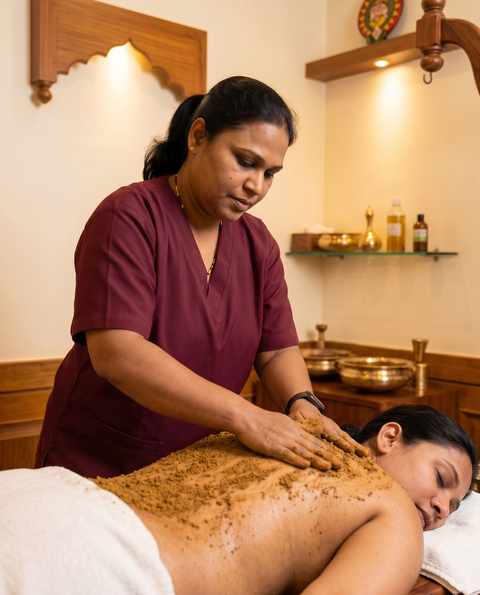
Udvartana is a vigorous dry or semi-dry herbal powder massage. Instead of oil, the therapist uses a blend of medicated herbal powders and applies firm strokes against the direction of hair growth. It is one of the most practical external forms of lightening therapy.
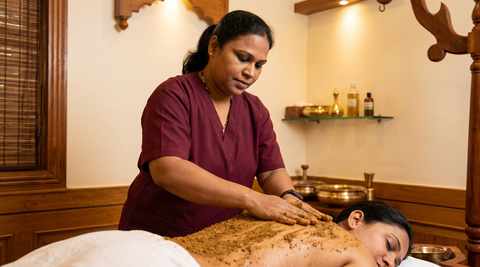
In panchakarma for weight loss, Udvartana is commonly used to support circulation, help tone the skin and tissue, and assist in reducing localised Kapha. It is also offered on its own as an Udvartana treatment and as Udvartana body polishing for smoother skin.
Can massage for weight loss really work?
This is one of the most common questions, and it deserves a straight answer. No massage, Ayurvedic or otherwise, melts fat on its own or replaces diet and activity. Anyone who claims that a massage for weight loss will remove a fixed number of kilos is overstating what touch can do.
What an Ayurvedic massage for weight loss such as Udvartana can do is more modest and more useful: support circulation, leave the body feeling lighter and more active, exfoliate the skin, and, for many people, give real motivation to keep up the food and activity changes that do the main work. Within panchakarma for weight loss, it is one helpful part of a plan, not the plan itself.
Lekhan Basti: when the doctor adds it
Basti, the medicated enema, is considered one of the most important Panchakarma procedures. Lekhan Basti uses herbal preparations traditionally described as scraping or reducing, and is one of the classical tools for Kapha and excess.
It is not given to everyone. The doctor decides whether Lekhan Basti suits you after reviewing your digestion, bowel habits, strength and health conditions, and explains the preparation and aftercare beforehand. For some people, panchakarma for weight loss uses only external therapies such as Udvartana and steam, with diet changes, and that is perfectly appropriate.
How the three therapies work together
Apatarpana sets the direction, Udvartana is one of the hands-on therapies that carries it out, and Lekhan Basti may be added where the doctor finds it suitable. Together with diet and routine, they form one coordinated plan rather than separate treatments booked at random.
| Element | What it is | What it is aimed at |
|---|---|---|
| Apatarpana | A reducing therapeutic programme | Countering Kapha-related heaviness and accumulated Ama |
| Udvartana | Herbal powder massage against hair growth | Circulation, toning, localised Kapha reduction |
| Lekhan Basti | Medicated Basti, only where suitable | Classical reducing support for Kapha and excess |
| Diet, activity and routine | Doctor-set guidance | Supporting Agni and keeping the gains between sessions |
| Doctor review | Regular check of how you respond | Adjusting intensity, therapies and pace |
Udvartana and Abhyanga: why the difference matters
| Udvartana | Abhyanga | |
|---|---|---|
| Medium | Dry or semi-dry herbal powder | Warm medicated oil |
| Strokes | Firm, against hair growth | Gentle, flowing, with hair growth |
| Direction of care | Langhana (lightening) | Mostly nourishing and calming |
| Main aim | Kapha reduction, circulation, toning | Circulation, Vata balance, relaxation |
People sometimes book an oil massage expecting it to help with weight. In Ayurvedic terms, Abhyanga mostly nourishes, while Udvartana lightens. This is one more reason panchakarma for weight loss is planned by a doctor rather than chosen from a menu.
What panchakarma for weight loss looks like at Herbal Hills
- Consultation. A doctor reviews your history, digestion, sleep, medicines and constitution, often with Nadi Parikshan.
- Direction. The doctor confirms whether a lightening approach is right for you, or whether a gentler or nourishing plan should come first.
- Plan. Therapies such as Apatarpana, Udvartana and, where suitable, Lekhan Basti are chosen, with diet and routine guidance.
- Course. Sessions are given as a series. The doctor sets and reviews the number of sessions according to how you respond, rather than applying one fixed count to everyone.
- Review and aftercare. Progress is checked, the plan is adjusted, and you get guidance to keep the routine going at home.
For a structured month of care, our Weight Management Package and Detox Pro for Weight Management combine therapies, doctor consultation and medication. For a broader classical reset, the doctor may discuss the 5 Days Panchakarma Package. Your doctor will tell you which suits you.
Diet alongside the therapies
Ayurveda treats diet and therapy as one plan. Panchakarma for weight loss works best when the food between sessions supports it. The doctor will give you specific advice, but common lightening-style guidance includes:
- Warm, freshly cooked, lighter meals, with the main meal at midday
- A smaller, earlier dinner
- Fewer cold, heavy, fried, very sweet and processed foods
- Warm water through the day
- Regular meal times, without constant snacking
- Avoiding daytime naps, which Ayurveda links with Kapha
None of this replaces a medical diet you have been given for diabetes, thyroid or any other condition. Tell your Ayurvedic doctor about it so the advice fits together.
Movement and daily routine
Lightening care is not only about what happens on the therapy table. Regular activity is part of Langhana in the classical sense. For most people this means daily walking, simple yoga or another activity suited to their strength and joints.
Routine matters too. Waking, eating and sleeping at regular times all support Agni. Small habits kept every day usually do more than an intense week followed by a return to old patterns. Any weight loss therapy, Ayurvedic or modern, depends on this foundation.
What panchakarma for weight loss can and cannot promise
- It can support digestion, circulation and Kapha balance as part of a broader lifestyle approach.
- It works alongside diet and activity changes. It is not a substitute for either.
- No one can honestly promise a specific number of kilos in a specific number of sessions. Results vary by person, constitution, health and consistency.
- It should not replace medical management of a diagnosed metabolic or hormonal condition, such as diabetes, thyroid disorders or PCOS. Continue your treating doctor’s care and keep them informed.
Be wary of any panchakarma weight loss offer that promises fixed figures. A responsible Ayurvedic doctor will talk about direction, habits and review, not a number fixed in advance. For general guidance on healthy weight, the NHS healthy weight advice is a practical read.
How panchakarma for weight loss differs from other weight loss therapy
Many clinics offer a weight loss therapy built around machines, wraps or very low-calorie plans. Panchakarma for weight loss works differently. It starts from your digestion and constitution, uses herbal powders, medicated preparations and classical procedures, and treats diet and routine as part of the same plan.
Neither approach replaces steady habits. The real difference is that panchakarma for weight loss is planned around the person, reviewed by a doctor, and adjusted when something does not suit you, instead of one programme applied to everyone who walks in.
Who should not start without a doctor’s advice
Lightening therapies are not right for everyone. A doctor may postpone or adjust panchakarma for weight loss for people who:
- Are pregnant or breastfeeding
- Are underweight, weak, anaemic or recovering from illness or surgery
- Have a fever or acute illness
- Have skin infections, open wounds or very sensitive skin (for Udvartana)
- Have uncontrolled blood pressure, diabetes, heart, kidney or liver disease
- Have a history of disordered eating
This is why every weight-focused plan at Herbal Hills begins with a consultation. Tell the doctor about every condition and medicine you have.
Signs it may be time to talk to a doctor
- Steady weight gain despite reasonable eating
- Heaviness, sluggishness or sleepiness after meals
- Low appetite in the morning, a coated tongue or bloating
- Feeling stiff, slow or low on energy most days
These signs can have many causes, including thyroid or other medical conditions. A consultation helps separate a digestive or Kapha imbalance, which panchakarma for weight loss may help, from something that needs medical tests first.
Panchakarma for weight loss in a busy Mumbai routine
Long commutes, desk-bound days, late dinners and irregular sleep are common in Mumbai, and Ayurveda would read many of them as Kapha-raising habits. Panchakarma for weight loss works best when it is built around your timetable, with sessions spaced sensibly and diet changes you can actually follow at work.
The monsoon and the cooler months are also times when many people notice heavier digestion. Your doctor may consider the season when planning the timing and intensity of therapy.
Keeping the results going after a course
A course of therapy is only part of the work. What you do in the weeks afterwards decides how much of the lighter feeling stays with you. The gains of panchakarma for weight loss are protected by the same habits that supported it: warm, simple meals, regular timings, daily movement and enough sleep.
Many people return for a follow-up consultation a few weeks after finishing a course of panchakarma for weight loss. The doctor can check digestion and energy, adjust diet advice for the season, and suggest whether occasional maintenance sessions would help.
Lighter, not starved: the honest summary
Panchakarma for weight loss is a real, specific part of Ayurveda, not a marketing package promising a number on a scale. Apatarpana sets the direction, Udvartana and, where suitable, Lekhan Basti carry it out, and diet, activity and routine do much of the lasting work. A doctor chooses and reviews each step.
If you are considering panchakarma for weight loss, start with a consultation so your doctor can decide whether it suits you, which therapies to use, and how it should fit alongside any medical care you already have.
Frequently asked questions
It can support weight-focused care by reducing heaviness, supporting digestion and helping Kapha balance, alongside diet and activity changes. It is not a standalone fix, and no fixed amount of weight loss can be promised. Results vary from person to person.
At Herbal Hills the doctor usually considers Apatarpana, a structured lightening programme; Udvartana, a dry herbal powder massage; and, where suitable, Lekhan Basti. The choice depends on your assessment, and not everyone receives every therapy.
A massage alone does not remove fat. Udvartana, an Ayurvedic powder massage, can support circulation, tone the skin and help you feel lighter, which many people find motivating. The main results still come from diet, activity and routine.
Langhana is the Ayurvedic principle of lightening the body by reducing excess Kapha, heaviness and undigested residue. It includes lighter diet, digestive support, activity and selected therapies, chosen by a doctor after assessing your constitution and health.
There is no single number for everyone. The doctor sets the number of sessions after your consultation and reviews it as you respond. Sessions are given as a course rather than one visit, alongside diet and routine changes.
People who are pregnant, underweight, weak, recovering from illness, or who have uncontrolled medical conditions or a history of disordered eating should not start without a doctor’s advice. Every plan at Herbal Hills begins with a consultation.
This article is for general education and does not replace medical advice. Ayurvedic therapies and medicines at Herbal Hills are planned by qualified doctors after a personal consultation.
Find a Herbal Hills centre near you
A doctor can assess your digestion and constitution, tell you whether lightening care suits you and plan the right therapies and number of sessions. Herbal Hills has five centres in Western Mumbai, in Juhu (Andheri West), Goregaon West, Kandivali West and two in Borivali West, open Tuesday to Sunday, 10 am to 7 pm. Find your nearest centre.
Lighter starts with the right plan.