

Blog
When Your Eyes Feel Dry

Dry Eyes: Why Your Eyes Feel Gritty, Simple Dry Eye Remedies for Daily Life, and Drishti, the Signature Ayurvedic Eye-Care Therapy
Dry eyes happen when your eyes do not make enough tears, or the tears dry up too quickly, so the surface of the eye feels gritty, burning, tired or even watery. Most cases are linked with screens, air conditioning, age and contact lenses, and often improve with simple daily care such as blinking more, resting the eyes and lubricating drops advised by a pharmacist. If you have pain, redness, light sensitivity or any change in vision, see an eye doctor first. Ayurveda adds gentle, doctor-planned eye care, such as Drishti, the Herbal Hills Signature therapy, as support alongside that medical advice.
The short version
- Dry eyes are very common, especially with long screen hours and air-conditioned rooms.
- Typical signs are grittiness, burning, redness, tired eyes and, oddly, watery eyes.
- Simple dry eye remedies, such as blinking, screen breaks and moist air, help many people.
- Pain, sudden blurred vision or a very red eye needs an eye doctor first.
- Ayurveda links dryness of the eyes with Vata and Pitta and uses cooling, nourishing care.
- Drishti combines four therapies, including Netra Tarpana, planned by a doctor.
What are dry eyes?
Your eyes are covered by a thin layer of tears called the tear film. It has three parts: an oily outer layer that slows evaporation, a watery middle layer, and an inner mucous layer that helps tears stick to the eye.
Dry eyes develop when this film is not enough or is not stable. The surface then dries between blinks. Doctors often call it dry eye disease or dry eye syndrome.
Common symptoms of dry eyes
- A gritty or sandy feeling, as if something is in the eye.
- Burning, stinging or itching.
- Redness, especially by evening.
- Tired, heavy eyes after reading or screen work.
- Blurred vision that clears when you blink.
- Discomfort with contact lenses.
- Watery eyes, as the eye makes reflex tears that do not settle the dryness.
Symptoms are often worse late in the day.
Why do my eyes feel dry? The main causes
Dry eyes usually have more than one cause working together. The most common ones are:
- Screens: we blink less while looking at a phone or laptop.
- Air: air conditioning, fans, heaters and travel by air.
- Age: tear production tends to fall as we get older.
- Hormones: changes around menopause are often linked with dryness.
- Contact lenses worn for long hours.
- Some medicines, such as certain allergy tablets.
- Eyelid problems, such as blocked oil glands.
Screens and dry eyes: the blinking problem
When you focus on a screen, you tend to blink less often, and many blinks are only half-closed. Each full blink spreads a fresh layer of tears across the eye. Fewer and weaker blinks let the surface dry.
This is why office workers, students and anyone who spends evenings on the phone often notice dryness by the end of the day. Tired, strained eyes from screen work are a related but separate topic, covered in our blog on screen time and eye care.
Air conditioning, fans and the Mumbai climate
Mumbai is humid for much of the year, yet many people spend most of the day in cold, dry, air-conditioned offices, malls and cars. Air conditioning removes moisture from the air, and a fan or AC vent blowing at your face speeds up evaporation of tears.
Two-wheeler rides in wind and dust, and smoke or pollution, can add to irritation.
Age, hormones and health conditions
Dry eyes become more common with age. Women may notice them more around menopause. Some health conditions are also linked with dryness, including certain autoimmune conditions, thyroid problems, diabetes and inflammation of the eyelids (blepharitis).
Dryness can also follow laser eye surgery for a while. If you have any of these, your eye doctor should guide the plan.
When to see an eye doctor first
Most dry eyes are mild, but some eye symptoms need prompt medical care. See an eye doctor (ophthalmologist) first, before any home or Ayurvedic care, if you have:
- Eye pain, rather than mild discomfort.
- Sudden blurred vision or loss of vision.
- Strong sensitivity to light.
- A very red eye, thick discharge or swelling.
- An injury, or a chemical splash into the eye.
- Symptoms that do not improve after a few weeks of simple care.
The NHS guide to dry eyes gives similar advice.
12 simple dry eye remedies for daily life
The dry eye remedies below are simple habits that suit most people. Start with two or three and follow them for a few weeks.
If you already use drops or treatment from an eye doctor, keep following it. These steps support that care. If you are pregnant, have a known eye condition or have had eye surgery, ask your eye doctor before trying anything new near the eyes.
Remedy 1: Blink fully and often
Make a habit of slow, full blinks, especially during screen work. Every so often, close your eyes gently for two seconds, then open them. This spreads fresh tears across the surface. A small note on your monitor saying blink can help at first.
Many people find this simple step eases the dryness more than they expected. Some medicines, such as certain allergy tablets, can also reduce tears, so ask your doctor if yours could be adding to the problem. Never stop a prescribed medicine on your own.
Remedy 2: Take regular screen breaks
Look away from your screen often. A popular guide is the 20-20-20 rule: every 20 minutes, look at something about 20 feet away for 20 seconds. Also stand up and move for a few minutes every hour.
Reducing phone use in the last hour before bed gives your eyes a longer rest and supports better sleep.
Remedy 3: Set up your screen correctly
- Keep the monitor about an arm’s length away.
- Place the top of the screen at or slightly below eye level, so you look slightly down. This keeps the eyes less wide open and reduces evaporation.
- Increase text size instead of leaning closer.
- Reduce glare from windows and lights.
- Match screen brightness to the room.
Remedy 4: Keep air off your face
Move your chair so that the AC vent, fan or heater does not blow directly at your face. In the car, point the vents towards your body, not your eyes.
In very dry rooms, a humidifier or even a bowl of water near the desk may help a little. Outdoors, wraparound sunglasses protect the eyes from wind and dust.
Remedy 5: Use lubricating eye drops wisely
Lubricating drops, often called artificial tears, are a common first step. Ask a pharmacist or eye doctor which type suits you. Preservative-free drops are often advised if you need them several times a day.
Avoid redness-relief drops for regular use unless your doctor advises them. Do not put home-made liquids, juices or oils into the eyes. Medicated eye care should only be given by a trained doctor.
Remedy 6: Try warm compresses and lid care
Blocked oil glands in the eyelids are a common reason tears evaporate too fast. A warm, clean, damp cloth over closed eyes for a few minutes can soften the oil. Then gently clean the lid edges as your eye doctor advises.
Make sure the compress is warm, not hot. Use a fresh cloth each time and stop if it causes discomfort.
Remedies 7 to 9: Water, food and sleep
- Remedy 7, drink enough water: sip through the day, especially in air-conditioned rooms.
- Remedy 8, eat well: include fresh vegetables, fruits, nuts and seeds. Foods with omega-3 fats, such as flaxseed and walnuts, are often suggested, though research on supplements is mixed.
- Remedy 9, sleep seven to eight hours: the eyes rest and recover when they are closed.
Remedies 10 to 12: Protect and rest
- Remedy 10, avoid smoke: cigarette smoke and incense smoke can irritate the eyes.
- Remedy 11, give contact lenses a break: wear glasses on some days if your optometrist agrees.
- Remedy 12, remove eye make-up gently every night and avoid applying liner on the inner lid edge.
Together, these dry eye remedies reduce the daily load on the tear film.
Dry eyes through the lens of Ayurveda
In Ayurveda, the eyes are closely linked with Pitta, the dosha of heat and transformation, and Alochaka Pitta is said to govern sight. Dryness, roughness and grittiness are qualities of Vata.
Classical texts describe a condition called Shushkakshipaka, which is often compared with dry eye disease. The Ayurvedic approach is to calm Vata and Pitta with cooling, nourishing care, regular routine and good sleep, always planned after a personal consultation.
Daily Ayurvedic habits that support the eyes
- Wake and sleep at regular times, and avoid late nights on screens.
- Splash the closed eyes gently with clean, cool water in the morning.
- Eat warm, home-cooked meals and limit very spicy, fried and sour food, which Ayurveda links with excess Pitta.
- Include a little ghee in food if your doctor agrees.
- Have a regular foot massage with oil before bed, a classical habit linked with eye comfort and good sleep.
Herbal medicines should be taken only as prescribed by a doctor.
Drishti: the Signature eye-care therapy for dry eyes and tired eyes
Drishti is one of the Herbal Hills Signature therapies, designed by MD Panchakarma doctors for people whose eyes feel the load of modern life. It is planned for people with long screen time, digital fatigue and eye irritation, headaches linked with screens, and dry, itchy or watery eyes.
Drishti brings together four Ayurvedic therapies that aim to cool, soothe and nourish the eyes and calm the mind. The doctor decides whether it suits you after a consultation.
What Drishti includes
| Therapy | What it involves |
|---|---|
| Netra Dhara | A gentle stream of cool herbal decoction poured over the eyes, traditionally used to soothe burning and redness. |
| Netra Lepam | A soothing herbal paste applied over the closed eyelids for a cooling, relaxing effect. |
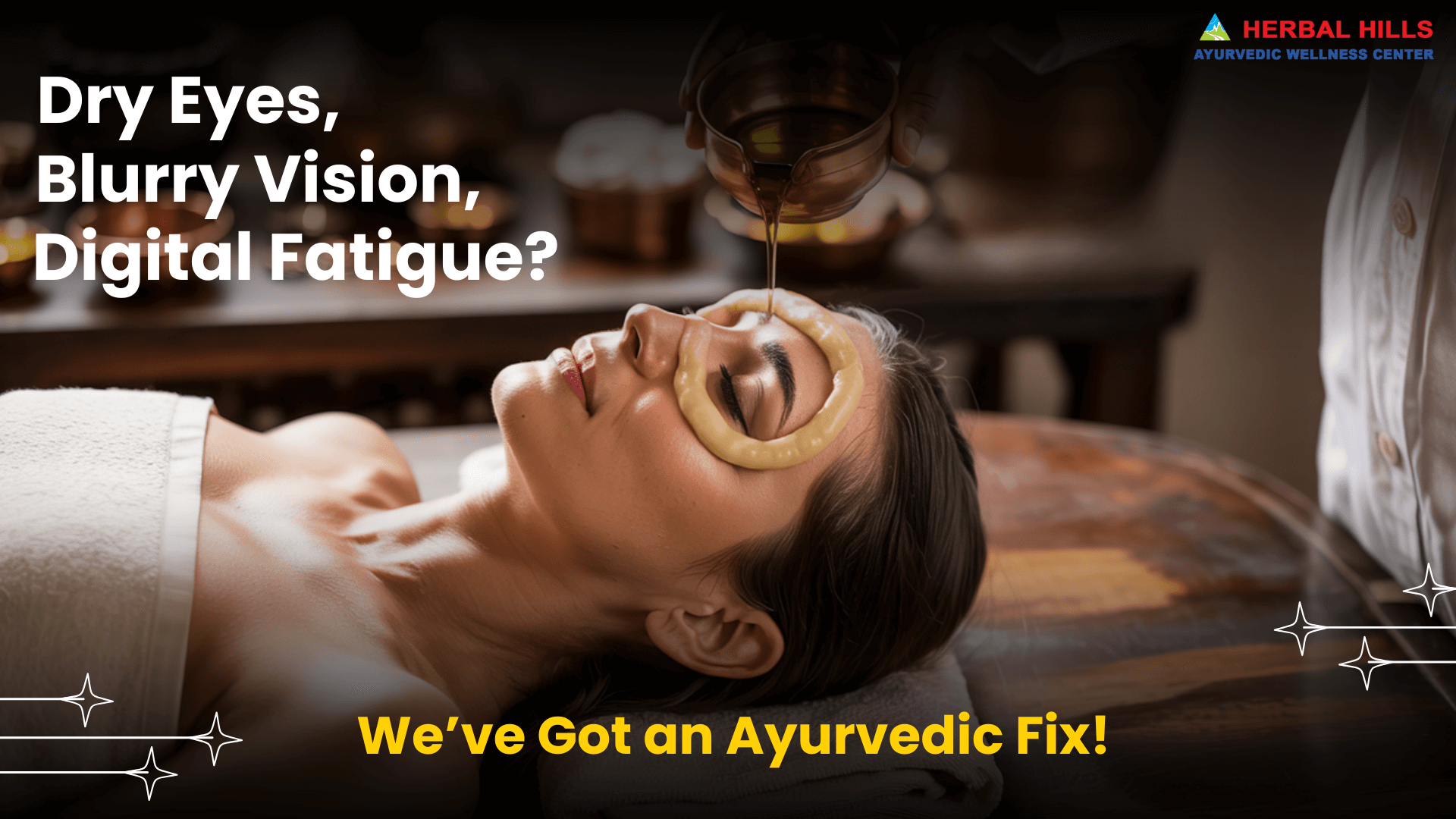
| Netra Tarpana | Warm medicated ghee held around the eyes within a dough ring, traditionally used for dryness and tired eyes. |
| Pada Abhyanga | A relaxing foot massage with oil, linked in Ayurveda with calm sleep and eye comfort. |
Netra Tarpana: the core of Drishti
Netra Tarpana is the classical Ayurvedic therapy most closely linked with dry eyes. A soft ring of dough is placed around each eye, and warm medicated ghee is gently filled inside it while you keep your eyes closed, and then open and close them slowly as guided.
The ghee is meant to lubricate and nourish the surface of the eye and the lids. You can read more about it on our Netra Tarpan page. It is done only by trained therapists, under a doctor’s plan.
Netra Dhara, Netra Lepam and Pada Abhyanga
Netra Dhara pours a cool herbal liquid over the eyes in a slow stream. Netra Lepam places a cooling herbal paste over the eyelids, which helps the muscles around the eyes relax.
Pada Abhyanga, the Ayurvedic foot massage, may seem far from the eyes, but in Ayurveda the feet and eyes are linked through certain marma points, and the massage calms the mind and supports sleep.
Who may benefit from Drishti
- People who spend long hours on laptops and phones.
- Students preparing for exams.
- People who work in cold, air-conditioned offices.
- Those whose dryness is mild and already checked by an eye doctor.
- Anyone who wants a calm, restful eye-care session.
The aim is comfort and relaxation. Drishti supports, but does not replace, care from your eye doctor.
Who should not take Drishti yet
Drishti is not suitable for everyone, or not at every time. The doctor may advise you to wait if you have an active eye infection, conjunctivitis, a recent eye injury, a recent eye operation, an undiagnosed red or painful eye, or a high fever.
People with glaucoma, retinal problems or other eye conditions should first speak to their eye doctor. Always tell the doctor about every eye drop and medicine you use.
Myths about dry eyes
Myth: Watery eyes cannot be dry eyes
Fact: Dry eyes often cause reflex watering, because the irritated eye makes thin tears that do not stay.
Myth: Any oil or home-made drop is safe for the eyes
Fact: Only use drops advised by a pharmacist or doctor. Medicated eye therapies are given only by trained staff.
Myth: Dry eyes are only an old-age problem
Fact: Young people with long screen time get them too.
Myth: One session fixes everything
Fact: Daily habits matter most.
How Herbal Hills can help
At Herbal Hills, care begins with a free doctor consultation, including Nadi Parikshan, to understand your body type, sleep, diet, screen habits and stress. The doctor will ask whether an eye doctor has checked your eyes and may advise you to see one first.
If suitable, your plan may include Drishti, other eye therapies, diet and routine guidance, and Ayurvedic medicines if prescribed. Therapies take place in private rooms with attached showers, using Herbal Hills oils.
Your first two weeks of eye care
- Days 1 to 3: Move your screen and chair so no air blows on your face.
- Days 1 to 7: Practise full blinks and the 20-20-20 rule.
- Days 4 to 7: Add a warm compress at night if your eye doctor agrees.
- Week 2: Cut screen time in the last hour before bed.
- Week 2: Note how your eyes feel each evening.
If symptoms persist, see an eye doctor, then speak to an Ayurvedic doctor about supportive care.
Frequently asked questions
The most common causes are long screen time with less blinking, air conditioning and fans, age, hormone changes, contact lenses, some medicines and eyelid problems. Often several causes work together.
Blink fully and often, take regular screen breaks, keep air vents off your face, use lubricating drops advised by a pharmacist or eye doctor, try a warm compress, drink enough water and sleep well.
See an eye doctor first if you have eye pain, sudden blurred vision, strong light sensitivity, a very red eye, discharge, an injury, or symptoms that do not improve after a few weeks of simple care.
Netra Tarpana is a classical Ayurvedic therapy in which warm medicated ghee is held around the closed eyes inside a ring of dough. It is traditionally used for dryness and tired eyes and is done only by trained therapists under a doctor’s plan.
Drishti is a Herbal Hills Signature therapy that includes Netra Dhara, Netra Lepam, Netra Tarpana and Pada Abhyanga. A doctor decides whether it suits you after a consultation.
Ayurveda links dryness of the eyes with Vata and Pitta and uses cooling, nourishing routine, diet and therapies such as Netra Tarpana as support. It works alongside, not instead of, care from your eye doctor.
This article is for general education and does not replace medical advice. Ayurvedic therapies and medicines at Herbal Hills are planned by qualified doctors after a personal consultation.
Find a Herbal Hills centre near you
A doctor can look at your routine, screen habits and eye comfort and suggest the right next step. Herbal Hills has five centres in Western Mumbai, in Juhu (Andheri West), Goregaon West, Kandivali West and two in Borivali West, open Tuesday to Sunday, 10 am to 7 pm. Find your nearest centre.
Rest your eyes. Restore your comfort.
One thought on “When Your Eyes Feel Dry”