

Blog
Not All Oil Is Medicine

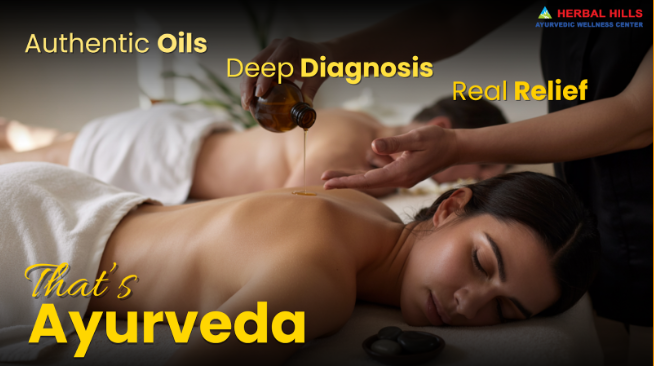
Authentic Ayurveda: 6 Signs That Separate a Real Ayurvedic Therapy From a Massage
Authentic Ayurveda begins with a doctor’s assessment, uses medicated oils chosen for your body type, is delivered by therapists trained in classical technique, and fits into a plan with follow-up. If a session skips the assessment and gives everyone the same oil and routine, it may be relaxing, but it is a massage, not Ayurvedic care.
What does authentic Ayurveda really mean?
Ayurveda is a complete system of medicine, not a style of massage. Its classical texts, such as the Charaka Samhita, describe how to examine a person, how to choose a therapy for that person, and how to judge whether the therapy is working. Authentic Ayurveda follows that logic from start to finish.
In practice, that means every therapy has a reason. Abhyanga, Shirodhara, Kati Basti or Navarakizhi is prescribed for a person, for a goal, with a specific oil or preparation, for a certain number of sessions. The same stroke done with a scented oil can feel pleasant, but without the assessment and the reasoning behind it, it is not authentic Ayurveda.
India’s Ministry of AYUSH recognises Ayurveda as a formal system of medicine with trained, registered practitioners. That is a useful reminder: an authentic Ayurvedic therapy should feel closer to a clinic visit than a salon booking.
Why is it hard to tell the difference today?
The word “Ayurvedic” now appears on hotel menus, salon price lists and online product listings. Many of these services are pleasant, but they borrow the name without the method. For someone booking their first therapy, it can be hard to know what they are actually getting.
The six signs below are simple checks anyone can make, in person or over the phone, before paying for a session. None of them needs medical knowledge.
Sign 1: Does a doctor see you before the therapy?
The first sign of authentic Ayurveda is that someone qualified looks at you before anyone touches you. At Herbal Hills, every new client meets an Ayurvedic doctor in a separate consultation room. The doctor asks about sleep, digestion, pain, stress, energy and medical history, and uses Nadi Parikshan (pulse assessment) as part of that picture.
The consultation decides what you should have and, just as importantly, what you should not. Some therapies are not suitable during fever, pregnancy, certain heart conditions, skin infections or acute injury. A therapist alone is not trained to make those calls. An assessment protects you.
What a good consultation covers
- Your main concern and how long you have had it.
- Current medicines, supplements and recent reports.
- Digestion, appetite, sleep and stress.
- Your body type (Prakriti) and current imbalance (Vikriti).
- Which therapy, which oil, how many sessions, and why.
Sign 2: Is the oil chosen for you, or for everyone?
In authentic Ayurveda the oil is part of the medicine. Classical oils such as Mahanarayan, Ksheerabala, Dhanvantaram, Bala Ashwagandhadi and Pinda Tailam are prepared by slowly cooking herbs into a base oil, often sesame, so that the herbs’ properties pass into it. Each is chosen for a different need: a stiff, dry joint, a tired nervous system, a hot and irritated skin.
At Herbal Hills the doctor chooses from more than 40 Ayurvedic oils, based on your body type and concern, rather than using one oil for every client. Our oils come from Herbal Hills’ own Ayurvedic manufacturing, which has been making Ayurvedic preparations for over 20 years.
A simple test
Ask: “Which oil will you use for me, and why?” An authentic centre will answer clearly, in plain language. If the answer is “our special massage oil” for everyone, that is a sign the session is a general massage.
Sign 3: Are the therapists trained in Ayurvedic technique?
Classical therapies have defined strokes, pressure, direction, temperature and timing. Abhyanga follows the direction of hair growth and pays attention to marma points. Shirodhara needs a steady, unbroken stream at the right height and temperature. Basti therapies need careful preparation and observation. Podikizhi and Navarakizhi need boluses heated and reheated to the right warmth.
Therapists at Herbal Hills are trained in these techniques and work under the doctor’s plan, so the session follows what was prescribed. Many therapies are done by two therapists working in rhythm, which is how they are traditionally performed.
Sign 4: Is the space clean, private and built for therapy?
Warm oil, steam and close contact mean hygiene is not optional. Look for fresh linen for every client, a clean wooden droni (therapy table) designed to hold oil, a private room, and a shower straight after the therapy.
Every Herbal Hills therapy room has its own attached shower, and steam (Swedana) is part of most sessions. Our standards for cleanliness and privacy are one of the main reasons clients choose us; we explain them in why hygiene matters at our centres.
Sign 5: Is there a plan, not just a single session?
One session can leave you rested and lighter. Lasting change usually needs a series, with the doctor reviewing how you respond. Authentic Ayurveda thinks in courses: a set number of sessions, diet and routine advice, sometimes medicines, and a follow-up.
That is why Herbal Hills offers structured options rather than a menu of one-off massages:
- 12 Signature therapies for regular self-care, each a 2-hour session built from classical therapies for one clear goal.
- One-month Health Packages that combine therapies with doctor-curated medicines for concerns such as digestion, sugar, weight, joints, hormones and stress.
- The 5 Days Panchakarma Package as a reset for healthy adults.
Sign 6: Is the price explained honestly?
Authentic Ayurveda costs more than a general massage because it includes a doctor’s time, medicated oils, longer sessions with steam and rest, and trained therapists. What matters is that you know exactly what you are paying for before you start.
Our Signature therapies, for example, are 120-minute sessions at ₹6,000, including the therapies, steam, shower and rest, and the doctor consultation comes first and is free. If you want to understand the cost question in depth, read Is Ayurvedic treatment worth the cost?
How is authentic Ayurveda different from a general massage?
| What to check | General massage | Authentic Ayurveda |
|---|---|---|
| Before the session | Choose from a menu | Doctor’s assessment with Nadi Parikshan |
| Oil | Same oil for everyone | Medicated oil chosen for your body type and concern |
| Who does it | Massage therapist | Therapist trained in classical Ayurvedic technique |
| Goal | Relaxation | A clear health or wellness goal |
| After the session | Nothing planned | Diet, routine advice and follow-up |
Both can have a place in life. But if you are looking for help with stress, stiffness, digestion, skin or sleep, you want the right-hand column.
What are the benefits of authentic Ayurvedic therapy?
Because it is matched to the person, authentic Ayurvedic therapy can do more than relax you for an afternoon. Traditionally, regular oil therapies are used to:
- Ease muscle tightness and joint stiffness.
- Calm the nervous system and support deeper sleep.
- Nourish dry skin and improve its texture.
- Support digestion and a feeling of lightness, alongside diet changes.
- Give a sense of steadiness during demanding phases of work or life.
The benefits of Ayurvedic massage and therapy build with regularity. That is why the doctor plans a course rather than a single visit.
Questions to ask before you book
- Will a doctor see me before the therapy, and is that consultation included?
- Which oil or preparation will be used for me, and why?
- Are the therapists trained in Ayurvedic technique?
- Does the room have a private shower, and is linen fresh for every client?
- How many sessions do you suggest, and what will we review in follow-up?
- What exactly does the price include?
If a centre answers all six clearly, you are very likely looking at authentic Ayurveda.
What does a first visit look like at an authentic Ayurveda centre?
Knowing what to expect makes it easier to spot authentic Ayurveda. At Herbal Hills, a first visit usually runs like this:
- Welcome and registration: a short form about your concern, health history and current medicines.
- Doctor consultation: 15 to 30 minutes in a private room, including Nadi Parikshan supported by the Nadi Tarangini device.
- Your plan: the doctor explains which therapy, which oil, how many sessions and what to change in diet and routine. Medicines are suggested only if needed.
- Therapy, if you choose to start: in a private room with an attached shower, by trained therapists.
- Steam, shower and rest: so you leave relaxed and clean, not rushed and oily.
- Follow-up: a review at the next visit to see how you have responded.
You are under no obligation to book therapies after the consultation. Advice comes first.
Red flags: when a session is not authentic Ayurveda
- No one asks about your health before you lie down on the table.
- The same oil is used for every client, whatever their concern.
- Prices are quoted only by the minute, with no mention of a plan.
- The session promises to fix a long-standing problem in one visit.
- Words like “detox” are used loosely, with no explanation of what will be done.
- There is no shower, or linen and towels are reused.
None of these makes a place unsafe by itself, but together they suggest you are booking a massage rather than authentic Ayurveda.
Why does Herbal Hills make its own Ayurvedic oils?
Medicated oils are only as good as the herbs and the method used to make them. Classical preparation, called taila paka, involves cooking herbs and decoctions into the oil slowly, over hours, until the right consistency is reached. Short cuts change the result.
Herbal Hills has manufactured Ayurvedic preparations for over 20 years, and the oils used at our centres come from that same manufacturing. It is one reason our doctors can choose from more than 40 oils, and one of the clearest marks of authentic Ayurveda you can ask about.
Common myths about Ayurvedic therapy
“Ayurvedic therapy is just a massage with herbal oil.”
Authentic Ayurveda includes an assessment, a chosen oil, a classical technique and a plan. The massage is only one part.
“More pressure means a better therapy.”
Pressure in Ayurvedic massage depends on your body type and condition. Deep pressure can aggravate some problems. The therapist follows the doctor’s plan.
“Ayurveda is only for people who are ill.”
Ayurveda places equal weight on keeping healthy people well. Regular therapies are part of preventive self-care, not only treatment.
“One session will fix it.”
A single session can bring relief and rest. Lasting change, especially for stiffness, sleep or digestion, usually needs a course with follow-up.
Can you practise authentic Ayurveda at home between sessions?
Yes, and your doctor will usually encourage it. Simple habits make therapies work better:
- Wake and sleep at regular times.
- Eat warm, freshly cooked meals, with lunch as the main meal.
- Do self-Abhyanga with the oil your doctor suggests, once or twice a week, before a warm bath.
- Take a short daily walk and a few minutes of slow breathing.
- Avoid very cold drinks and late, heavy dinners.
Home care keeps the benefits of a session going until the next one. That combination of clinic and daily routine is what authentic Ayurveda has always looked like.
Does authentic Ayurveda work alongside your regular doctor?
It should. Authentic Ayurveda never asks you to stop prescribed medicines on your own. If you take treatment for blood pressure, sugar, thyroid or any other condition, tell the Ayurvedic doctor at the first visit and bring recent reports if you have them. The doctor will plan therapies and any medicines around your existing care, and will suggest you speak to your physician before any change.
The US National Center for Complementary and Integrative Health gives the same advice: use Ayurvedic care under qualified guidance and keep all your doctors informed. Working together, not in competition, is the safest way to use Ayurveda.
What makes the Herbal Hills experience authentic?
- A qualified Ayurvedic doctor sees every client first, in a separate consultation room.
- Advanced Nadi Parikshan, supported by the Nadi Tarangini device.
- More than 40 Ayurvedic oils from our own manufacturing, chosen for your body type.
- Over 35 classical therapies, from Abhyanga and Shirodhara to Basti and Navarakizhi.
- Trained therapists working to the doctor’s plan.
- Private therapy rooms with attached showers and fresh linen for every client.
These are the same six signs described above, built into how every centre runs.
Authentic Ayurveda: the short version
Check for a doctor first, an oil chosen for you, trained therapists, a clean private room with a shower, a plan with follow-up, and an honest price. Those six signs are what authentic Ayurveda looks like in practice.
Frequently asked questions
Check that a doctor assesses you first, the oil is chosen for your body type and concern, therapists are trained in classical technique, rooms are private with a shower, and the session is part of a plan with follow-up. If the same oil and routine are offered to everyone without an assessment, it is a general massage.
Not always. Abhyanga is an Ayurvedic oil massage, but authentic Ayurveda also includes the doctor’s assessment, a medicated oil chosen for you and a plan. A massage done without these may feel relaxing, but it does not follow the Ayurvedic approach to care.
Yes. The consultation decides which therapy suits you and whether any should be avoided, for example during fever, pregnancy or acute injury. At Herbal Hills the doctor consultation with Nadi Parikshan is free and always comes before your first therapy.
It includes a qualified doctor’s time, medicated oils prepared with herbs, longer sessions with steam and rest, and trained therapists. You are paying for a planned treatment rather than a relaxation service, which is why a clear explanation of the price matters.
Our doctors choose from more than 40 Ayurvedic oils, made in Herbal Hills’ own manufacturing. The oil is selected for your body type and concern at the consultation, rather than using one oil for every client.
It depends on your goal. For regular self-care, many people choose one Signature therapy a month. For a specific concern, the doctor may suggest a course of several sessions over a few weeks, usually as part of a one-month package.
This article is for general education and does not replace medical advice. Ayurvedic therapies and medicines at Herbal Hills are planned by qualified doctors after a personal consultation.
Six signs, five doors in Western Mumbai
Every one of these signs is something you can check in person. Our five centres sit along the western suburbs: Juhu (Andheri West), Goregaon West, Kandivali West and two in Borivali West, open Tuesday to Sunday, 10 am to 7 pm. Walk in, meet the doctor, ask about the oil, see the room. Then decide. Find your nearest centre.
Start with the doctor, not the massage table.