
When Worry Will Not Switch Off

Anxiety Symptoms Explained: Body, Mind and Behaviour Signs, How Stress and Anxiety Disturb Sleep, When to Get Help, and Gentle Ayurvedic Support
Anxiety symptoms are the physical, mental and behavioural signs of worry or fear that feel stronger, last longer or come more often than the situation calls for, such as a racing heart, restlessness, tense muscles, a mind that will not switch off, irritability and poor sleep. This guide explains how to recognise the signs, how stress and anxiety feed sleep problems, simple self-care that helps many people, when to see a professional, and how doctor-planned Ayurvedic care may support you alongside mental health care.
The short version
- Anxiety symptoms show up in the body, the mind and the way you behave.
- Some worry is normal. Worry that is constant, intense or stops you living normally needs attention.
- Stress and anxiety often disturb sleep, and poor sleep makes worry worse.
- Steady routine, breathing, movement, less caffeine and good sleep habits help many people.
- A doctor, psychiatrist or psychologist should assess anxiety that lasts or feels severe.
- Ayurveda supports, never replaces, mental health care. Never stop psychiatric medicines on your own.
What are anxiety symptoms?
Anxiety is the body’s alarm system. When you sense danger, the body releases stress hormones, the heart beats faster and the mind becomes alert.
Anxiety symptoms become a problem when the alarm rings too often, too loudly or without a clear reason. The NHS guide to generalised anxiety disorder describes how ongoing worry can affect both mind and body, and why it is worth seeking help.
Anxiety symptoms in the body
Many people first notice anxiety symptoms in the body rather than the mind. Common physical signs include:
- A fast, pounding or fluttering heartbeat.
- Shallow breathing or feeling short of breath.
- Tight shoulders, jaw or neck, and tension headaches.
- Sweating, trembling or feeling hot and cold.
- Butterflies, nausea or loose motions.
- Dizziness, tiredness and feeling drained.
These signs are real, not imagined.
Anxiety symptoms in the mind
The mental side of anxiety is often the most tiring. You may notice:
- Constant worry that is hard to control.
- Expecting the worst, even about small things.
- Feeling on edge, restless or keyed up.
- Trouble concentrating, or your mind going blank.
- Irritability and a short temper.
- A sense of dread, or feeling that something bad will happen.
When these anxiety symptoms appear most days, life can start to feel heavy and crowded.
Anxiety symptoms in behaviour
Anxiety also changes what we do. Over time, people may:
- Avoid places, calls, travel or meetings that feel stressful.
- Check things again and again, or seek constant reassurance.
- Put off tasks because starting feels overwhelming.
- Withdraw from friends and family.
- Lean on tea, coffee, sugar, smoking or alcohol to cope.
Avoidance brings short relief, but it often makes the fear stronger in the long run.
Normal worry or a sign of something more?
| Everyday worry | Anxiety that needs attention |
|---|---|
| Linked to a real, specific event | Spreads to many areas of life |
| Fades once the event passes | Continues for weeks or months |
| Feels manageable | Feels hard to control |
| Sleep mostly unaffected | Sleep problems are common |
| You still do what you need to | You avoid things or struggle at work and home |
If the right-hand column sounds familiar, speak to a professional.
What a panic attack can feel like
A panic attack is a sudden wave of intense fear. It may bring a racing heart, chest tightness, breathlessness, shaking, tingling, dizziness and a feeling of losing control. It usually peaks within minutes and then settles.
Panic attacks are frightening but are not usually dangerous in themselves. However, chest pain can also come from the heart. If you have chest pain, especially for the first time, treat it as a medical emergency until a doctor says otherwise.
Stress and anxiety: how they differ
| Stress | Anxiety |
|---|---|
| A response to a clear pressure, such as a deadline | Worry that may continue without a clear trigger |
| Usually eases when the pressure ends | Can stay long after the event |
| Focused on the present problem | Often focused on what might go wrong |
Stress and anxiety overlap a great deal, and long stress can lead to anxiety. To learn how ongoing pressure affects the body, read about the effects of stress on the body.
How stress and anxiety lead to sleep problems
Sleep needs a calm nervous system. When the mind is busy and the body is on alert, it is hard to drift off.
The link works both ways. Poor sleep makes the brain more sensitive to threat, so anxiety symptoms feel stronger the next day. This loop of stress and anxiety, then sleep problems, then more worry, is one of the most common patterns doctors see.
Common sleep problems linked with worry
- Taking a long time to fall asleep.
- Waking in the early hours with a racing mind.
- Light, broken sleep with vivid dreams.
- Waking up tired, even after enough hours in bed.
- Daytime sleepiness, poor focus and low patience.
Loud snoring with pauses in breathing, or severe daytime sleepiness, needs a doctor, as other conditions may be involved. See also Ayurvedic care for good sleep.
When anxiety symptoms have another cause
Some medical conditions can feel like anxiety. These include an overactive thyroid, heart rhythm problems, low blood sugar, anaemia, some medicines and withdrawal from alcohol or other substances. Too much caffeine can also cause a racing heart and jitters.
This is why a proper medical check matters, especially if anxiety symptoms are new, sudden or come with physical changes such as weight loss. Tests come first. The right care depends on the real cause.
Self-care step 1: Keep a steady routine
The nervous system likes rhythm. Waking, eating and sleeping at about the same times each day gives the body a sense of safety.
Start with a fixed wake-up time, even on weekends. Eat regular meals rather than skipping and then snacking. A predictable day often makes stress and anxiety feel smaller and easier to manage. Plan the next day the evening before, so mornings feel less rushed.
Self-care step 2: Slow your breathing
Slow breathing is one of the quickest ways to signal calm to the body. Try this for three to five minutes:
- Sit comfortably and relax your shoulders.
- Breathe in gently through the nose for a count of four.
- Breathe out slowly for a count of six.
- Repeat, keeping the breath soft, not forced.
Practise daily when you are calm, so it is easier to use when anxiety symptoms rise.
Self-care step 3: Move and get daylight
Regular movement helps the body use up stress hormones and often improves mood and sleep. A brisk 30-minute walk on most days is a good target. Yoga, cycling, swimming or dancing all count.
Morning daylight helps set your body clock, which supports better sleep at night. Even ten to fifteen minutes outdoors in the morning can help.
Self-care step 4: Cut back on stimulants
Caffeine can trigger or worsen a racing heart, jitters and sleep problems. Try to keep tea and coffee to the morning, and avoid energy drinks.
Alcohol may feel relaxing at first, but it disturbs sleep and can increase anxiety the next day. Smoking also keeps the body on alert. If cutting back feels hard, ask your doctor for support.
Self-care step 5: Protect your sleep
- Go to bed and wake up at regular times.
- Have a light dinner two to three hours before bed.
- Keep the last hour before sleep free of work, news and bright screens.
- Keep the bedroom dark, cool and quiet.
- If you cannot sleep after about 20 minutes, get up, do something calm in dim light and return when sleepy.
These simple steps help many people with mild sleep problems.
Myths about anxiety symptoms
Myth: Anxiety is all in your head
Fact: Anxiety affects the whole body, from heartbeat to digestion.
Myth: Strong people do not get anxious
Fact: Anxiety is common and can affect anyone.
Myth: Natural care means you can stop your medicines
Fact: Never stop or change psychiatric medicines without your doctor.
Myth: Avoiding stress is the answer
Fact: Avoidance often makes fear stronger. Gradual, supported steps work better.
When to see a doctor, psychiatrist or psychologist
Please seek professional help if:
- Worry or anxiety symptoms last more than two weeks or keep coming back.
- You cannot work, study, sleep or look after yourself as usual.
- You have repeated panic attacks.
- You are avoiding more and more places or people.
- You are using alcohol or other substances to cope.
- Low mood comes with the worry.
A family doctor, psychiatrist or psychologist can assess you properly. Professional care leads, and Ayurveda can support it.
When anxiety needs urgent help
Some situations cannot wait. Get help immediately if you or someone you know:
- Has chest pain, severe breathlessness or fainting.
- Has thoughts of self-harm or suicide.
- Feels unsafe or unable to stay safe.
Go to the nearest hospital emergency department, contact local emergency services, or call the government Tele-MANAS mental health helpline. Ayurvedic care is not the right first step in an emergency.
How professionals help with anxiety
Anxiety is common and treatable. Depending on your needs, a professional may suggest talking therapies such as cognitive behavioural therapy, which helps you change worry patterns step by step. Some people also benefit from medicines prescribed by a psychiatrist.
Treatment is planned around you. If you already take medicines for anxiety, keep taking them as prescribed. Ayurvedic care, if you choose it, can be planned alongside your existing treatment, with all your doctors kept informed.
The Ayurvedic view of anxiety symptoms
Ayurveda links worry, restlessness and light, broken sleep mainly with an increase of Vata, the dosha of movement. When Vata rises, the mind can feel scattered, fast and unsettled, much like wind stirring dry leaves.
Ayurveda also speaks of Prana, the vital energy linked with breath and the mind. Calm, slow breathing and a steady routine are seen as ways to settle Prana. It is a frame for daily care, not a diagnosis.
Sattva, sleep and routine in Ayurveda
Ayurveda describes a clear, calm state of mind as Sattva. It is supported by regular routine, warm and freshly cooked food, good sleep, kind speech and time for quiet.
Sleep, or Nidra, is seen as one of the three pillars of health, along with food and balanced living. Ayurvedic advice for stress and anxiety therefore often starts with simple steps: earlier dinners, an earlier bedtime and a calming evening routine.
How Herbal Hills doctors begin
At Herbal Hills, care for anxiety symptoms starts with a free doctor consultation, not a package. Our doctors ask about your main concern, sleep, stress level, work pattern, digestion, daily routine, medical history and current medicines. They also use Nadi Parikshan, the traditional pulse assessment.
If anything suggests a need for medical tests or a mental health specialist, the doctor will tell you first. You can read more about our Ayurvedic approach to stress.
Level 1: Individual therapies
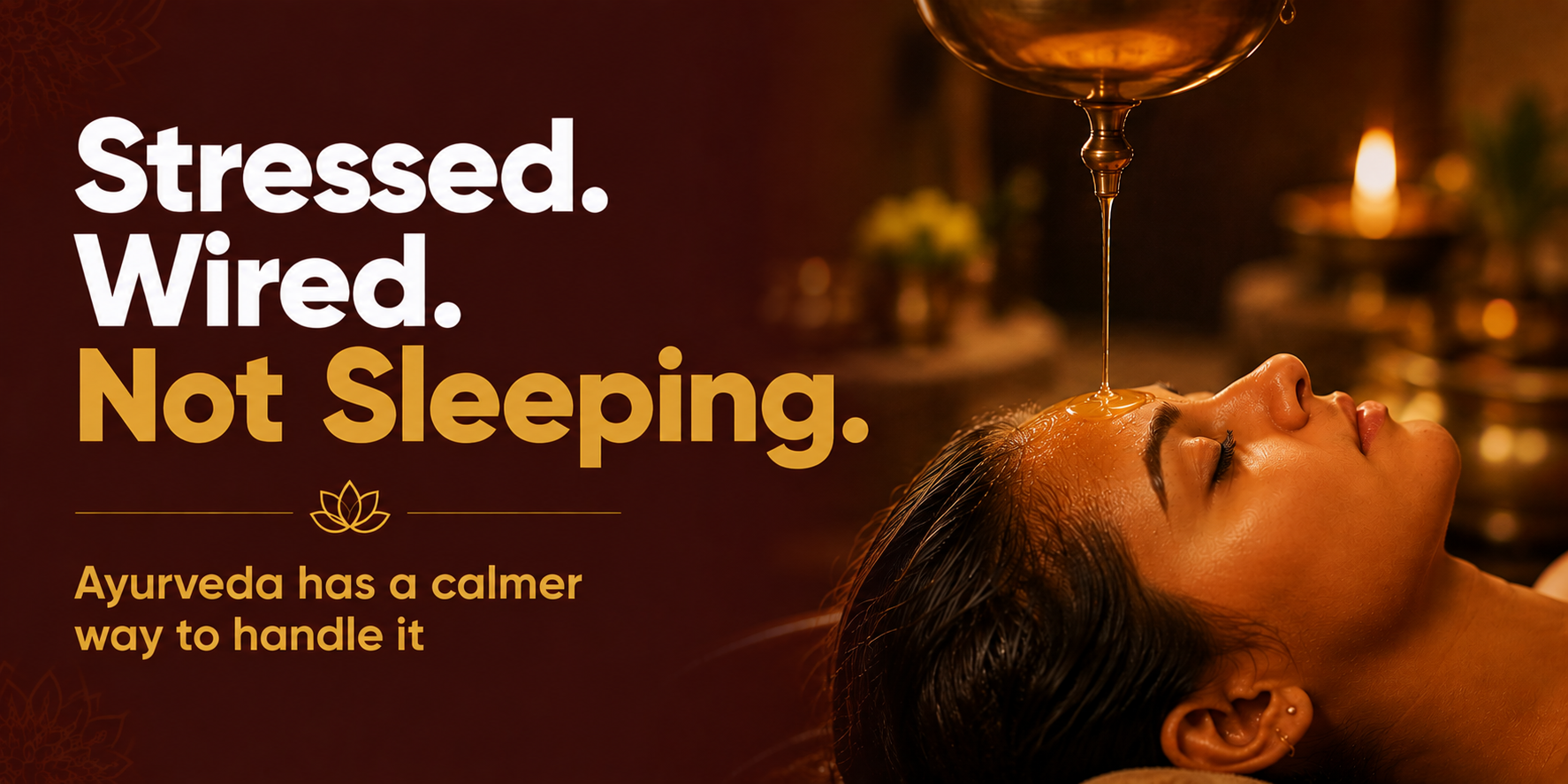
A single, targeted therapy to help the body relax, chosen after your assessment. Options include Shirodhara, a gentle stream of warm oil over the forehead, Shiro Abhyanga, Nasya, Mukha Abhyanga, Sarvanga Abhyanga, Padabhyanga, Nadi Swedan and steam therapy.
Sessions last about 30 to 90 minutes, in private therapy rooms with attached showers. This level often suits work stress, mental fatigue, head heaviness or occasional sleep problems.
Level 2: Signature treatments
For people who feel broadly well but want regular support before stress builds up, Herbal Hills offers Signature treatments. These include Sukha, focused on mind relaxation, Vishudhi, focused on rejuvenation, and Santulana, focused on dosha balance.
The doctor helps you choose which one suits you, and how often a session makes sense for your routine.
Level 3: HH Health Treatment
The HH Health Treatment is a one-month, doctor-supervised programme for stress that has started to affect sleep, energy or daily life. It includes consultations, personalised Panchakarma therapies, diet guidance, lifestyle counselling, stress-management advice and regular progress reviews.
Ayurvedic medicines, if the doctor prescribes them, are billed separately. The programme is meant to support you alongside any care from a psychiatrist, psychologist or family doctor.
Level 4: Mann Shuddhi package
The Mann Shuddhi package follows the same one-month programme, with the same doctors, consultations, therapy schedule and follow-up. The difference is that doctor-prescribed Ayurvedic medicines are included.
It is designed to support mental relaxation, better sleep quality, stress management and mental clarity, with therapies such as Shirodhara and Nasya where suitable, and progress reviewed by the doctor through the month.
HH Health Treatment or Mann Shuddhi?
| Included | HH Health Treatment | Mann Shuddhi |
|---|---|---|
| Consultation and follow-up | Yes | Yes |
| Personalised Panchakarma therapies | Yes | Yes |
| Diet and lifestyle guidance | Yes | Yes |
| Ayurvedic medicines | Billed separately, if prescribed | Included |
Your doctor helps you decide which level fits your needs.
Ayurvedic medicines and safety
Herbs can interact with other medicines, including those for anxiety, sleep, blood pressure and thyroid. Take any Ayurvedic medicine only as prescribed by a doctor who knows your full history.
Never stop or change psychiatric or other prescribed medicines on your own. If medicines are prescribed, they are available from the in-house Ayurvedic medicine shop, made by Herbal Hills, which has been manufacturing for more than 20 years.
Key takeaways
- Anxiety symptoms affect the body, the mind and behaviour.
- Stress and anxiety and sleep problems often feed each other.
- Simple daily habits help many people with milder worry.
- Lasting or severe anxiety symptoms need a professional assessment.
- Ayurveda may support calm, sleep and routine, alongside mental health care.
Start small, be patient with yourself, and ask for help early.
Frequently asked questions
Common signs include constant worry, restlessness, a racing heart, tense muscles, poor concentration, irritability, stomach upset and sleep problems.
Yes. A busy mind and an alert body make it hard to fall or stay asleep, and poor sleep then makes worry feel stronger.
See a doctor, psychiatrist or psychologist if worry lasts more than two weeks, affects work or sleep, brings panic attacks or low mood, or if you use alcohol to cope. Chest pain or thoughts of self-harm need urgent help.
No. Anxiety needs assessment and care from a doctor or mental health professional. Doctor-planned Ayurvedic routine, diet and therapies may support that care. Never stop psychiatric medicines on your own.
Shirodhara is a therapy in which a gentle, continuous stream of warm oil is poured over the forehead. It is commonly chosen for relaxation, mental fatigue, work stress and poor sleep, after a doctor’s assessment.
Both follow the same one-month, doctor-guided programme with consultations, therapies, diet guidance and follow-up. Mann Shuddhi includes doctor-prescribed Ayurvedic medicines, while HH Health Treatment bills them separately.
This article is for general education and does not replace medical advice. Ayurvedic therapies and medicines at Herbal Hills are planned by qualified doctors after a personal consultation.
Find a Herbal Hills centre near you
A doctor can listen to your concerns, check your sleep and routine, and plan a gentle next step alongside any care you already receive. Herbal Hills has five centres in Western Mumbai, in Juhu (Andheri West), Goregaon West, Kandivali West and two in Borivali West, open Tuesday to Sunday, 10 am to 7 pm. Find your nearest centre.
A calmer mind starts with being heard.