
One Month for Your Joints

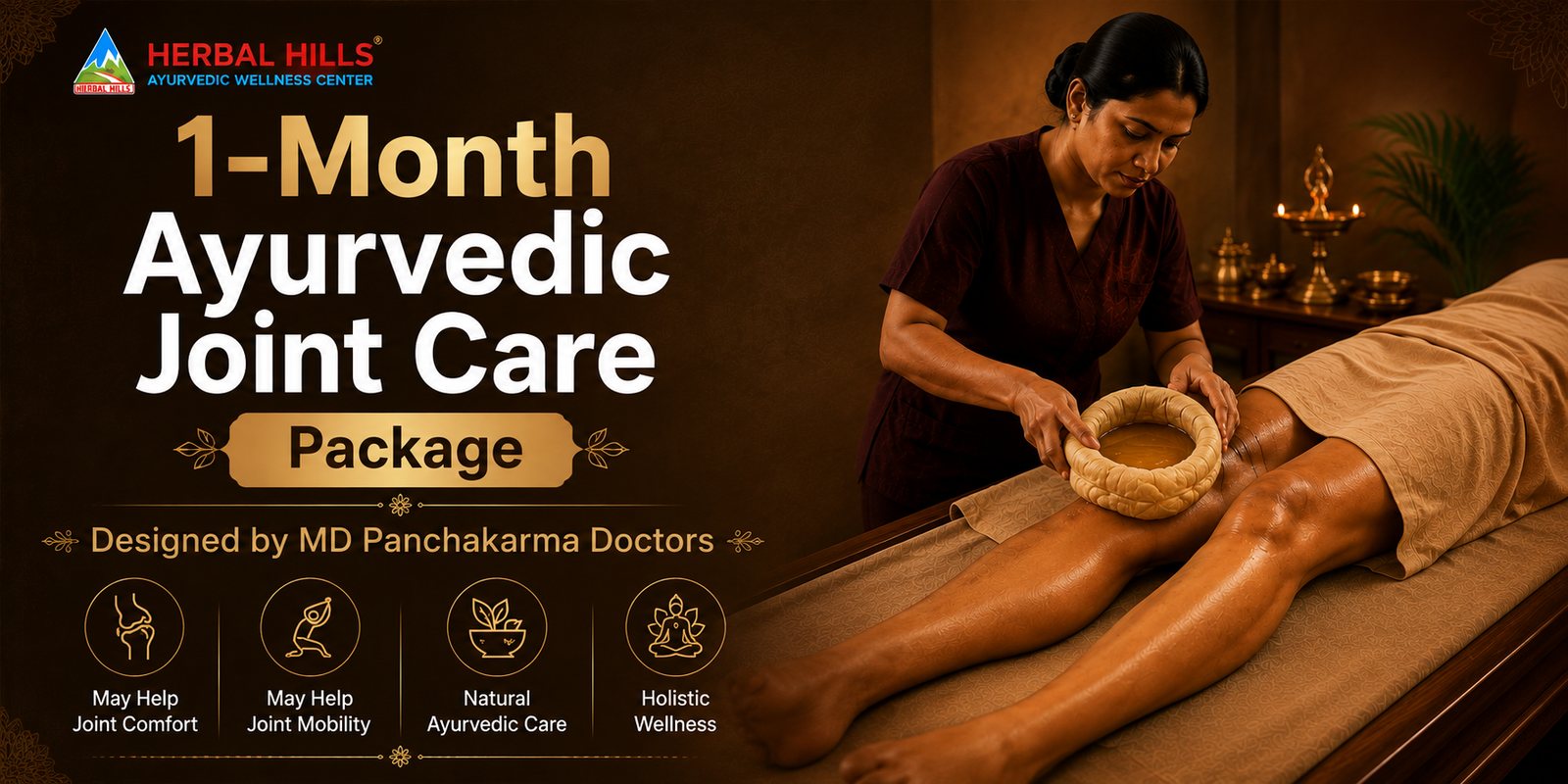
Joint Pain Care, Week by Week: What a One-Month Ayurvedic Joint Care Plan Includes, From Consultation to Home Care
For joint pain, a one-month Ayurvedic joint care plan at Herbal Hills starts with a doctor consultation and Nadi Parikshan, then combines therapies such as Janu Basti, Kati Basti and Abhyanga with herbal steam, doctor-prescribed medicines, diet correction and a home routine, ending with a follow-up review. It works alongside, not instead of, care from your orthopaedic doctor or physician, and every plan is built for the person, not the diagnosis alone.
The short version
- Joint pain affects people of all ages, not only seniors.
- Sudden, severe or hot, swollen joints need a medical check first.
- A one-month plan begins with consultation and Nadi Parikshan.
- Therapies may include Janu Basti, Kati Basti, Abhyanga and Swedana.
- Diet, medicines as prescribed and a home routine are part of the plan.
- The last week focuses on home care and a follow-up review.
- Keep taking your prescribed medicines unless your doctor says otherwise.
Joint pain is not only a senior problem
Knee pain, stiff fingers, sore shoulders and backache are now common complaints among working professionals and homemakers, not only older adults. Long sitting, little movement, weight gain, stress, injuries and even over-exercise can all play a part.
Early signs are easy to ignore. Paying attention to them, and getting the right check-up, gives you the best chance of staying active.
Why joints start to hurt
Joints can hurt for many reasons. Common ones include wear and tear of cartilage, as in osteoarthritis; inflammation, as in rheumatoid arthritis; crystal deposits, as in gout; injuries to ligaments or tendons; and strain from posture or overuse.
Because the reasons differ so much, the right plan also differs. A proper diagnosis, sometimes with blood tests or X-rays, comes before any joint care programme.
How Ayurveda looks at joint pain
Ayurveda looks at joint pain through three main factors.
- Vata: the dosha of movement and dryness. When it rises with age, irregular routine, cold food, travel or stress, joints may feel dry, stiff and creaky.
- Ama: undigested residue that Ayurveda links with heaviness, swelling and a dull ache.
- Agni: digestive strength. When it is weak, Ama is said to keep forming.
The doctor finds which factor leads in you.
Why one size does not fit all
Two people with knee pain may need very different care. Pain that is worse in the morning, moves from joint to joint and feels dry may point to Vata. Pain with heaviness and swelling that worsens after heavy meals may point to Ama.
That is why a good joint care plan starts with assessment, not with a fixed menu of therapies. The treatment changes depending on what the doctor finds.
Questions to ask before any joint pain treatment
- What is the likely cause of my pain, and do I need tests first?
- Which therapies do you suggest, and why?
- How many sittings will I need, and how far apart?
- How will this fit with my current medicines?
- What should I do at home between sittings?
- How will we know if it is helping?
A good centre will answer these clearly before you begin, and will be honest when another kind of care is better for you.
Who a one-month joint care plan may suit
- Knee pain or diagnosed arthritis.
- Shoulder or neck stiffness.
- Lower back pain.
- Joint swelling and restricted movement.
- People who want a structured plan alongside their ongoing medical care.
It may not suit everyone. People with a fresh injury, fever, infection, uncontrolled blood pressure or diabetes, or some heart conditions may need a different plan or medical treatment first.
Condition-specific joint care packages
Osteoarthritis, rheumatoid arthritis and gout behave differently, so Herbal Hills runs separate protocols rather than one general plan:
- Joint Care Therapy Package for osteoarthritis and gout
- Joint Care Therapy Package for rheumatoid arthritis
The doctor will suggest which one fits your diagnosis and reports.
Step 1: Consultation and Nadi Parikshan
The programme begins with a consultation and Nadi Parikshan, or pulse assessment, by MD Panchakarma doctors. They ask about your joint pain, how long it has lasted, what makes it better or worse, your digestion, sleep, work and activity.
Bring your reports, X-rays and a list of current medicines. The doctor uses all of this to decide whether Ayurvedic care suits you and how.
Step 2: A personal treatment plan
Every plan is built around your condition and body constitution. No two people receive exactly the same protocol.
The doctor decides which therapies you need, which joints to focus on, how many sittings to schedule, which medicines to prescribe and what to change in your diet and routine. The number of sittings is shared with you after the first consultation, so you know what the month will look like.
Step 3: Janu Basti for the knees
In Janu Basti, a ring of dough made from black gram flour is placed around the knee and warm medicated oil is gently pooled inside it for a set time. The oil is kept warm throughout.
It is traditionally used to support comfort and ease stiffness in the knee. Most people find it warm and relaxing rather than painful. For more on knee care, see our joint care in Mumbai guide.
Step 4: Kati Basti for the lower back
Kati Basti uses the same idea over the lower back. A dough boundary is placed on the lower spine and filled with warm herbal oil.
It is traditionally used to nourish the back muscles and ease stiffness and lower back pain. The doctor will check for warning signs such as numbness, weakness in the legs or bladder changes before planning it, as these need medical care first.
Step 5: Abhyanga with herbal steam
Abhyanga is a whole-body massage with warm medicated oil chosen for your dosha. It is usually followed by Swedana, a gentle herbal steam.
Together they are traditionally used to relax the muscles, support circulation and ease stiffness, which may help joints move more easily. In the programme, Abhyanga and Swedana are usually paired in the same sitting, followed by Janu Basti or Kati Basti as needed.
Step 6: Medicines, only as prescribed
The doctor may prescribe Ayurvedic tablets, oils or decoctions to support your joint care. These are chosen for you after the consultation and are available from the in-house medicine shop.
Do not buy or combine herbal products on your own. Tell the doctor about all your current medicines, including painkillers, blood thinners and steroids, so the timing can be planned safely around them.
Step 7: Diet correction to support Agni
In Ayurveda, joint care always includes digestion. The doctor will usually suggest warm, freshly cooked, easy-to-digest meals at regular times, and fewer heavy, fried, cold and very processed foods.
Diet is adjusted early, because therapies are thought to work better once digestion settles. If you have gout, diabetes or kidney disease, your doctor will make sure the diet suits those conditions too.
Week 1 of joint pain care: assessment and preparation
The first week is about understanding and preparing. It usually includes the pulse assessment, a review of your history and reports, the start of any prescribed medicines and early diet changes.
Some people notice that morning stiffness starts to ease as routine and digestion settle, but everyone responds differently. Note how your joints feel each morning so the doctor can track changes.
Weeks 2 and 3: active therapy
This is the core of the month. Abhyanga and Swedana are usually given in the same sitting, followed by Janu Basti or Kati Basti depending on which joints are affected.
Sittings are spread across the week rather than daily, so the body has time to respond between sessions. The doctor reviews your progress and may adjust the therapies, oils or medicines as you go.
Week 4: consolidation and home care
In the final week, therapies taper and the focus shifts to keeping your progress. You will receive a simple home routine, which may include self-massage, warm-food guidance and gentle joint-friendly movement, along with any medicines to continue.
A follow-up consultation at the end of the month reviews how you are doing and decides whether a second cycle is worthwhile.
The month at a glance
| Stage | Main focus |
|---|---|
| Week 1 | Consultation, Nadi Parikshan, reports, diet changes, medicines if prescribed |
| Weeks 2 and 3 | Abhyanga with Swedana, then Janu Basti or Kati Basti, spread across the week |
| Week 4 | Therapies taper, home routine, follow-up review |
| After the month | Home care, activity, review as advised |
The exact schedule is set by your doctor.
Home care for joint pain between sittings
- Keep moving gently every day. Short walks are often better than long rests.
- Avoid sitting in one position for more than 30 to 45 minutes.
- Use warmth, such as a warm shower, for stiffness, unless the joint is hot and swollen.
- Sleep on a supportive mattress.
- Wear comfortable, supportive footwear.
- Follow the diet and medicine plan your doctor gives you.
Movement and strength for joint care
Strong muscles around a joint help support it. Gentle strengthening, stretching and low-impact activities such as walking, cycling and swimming are often recommended for joint care.
Start slowly and increase gradually. Avoid exercises that cause sharp pain. A physiotherapist can show you safe exercises for your knees, back or shoulders, and this works well alongside Ayurvedic therapies.
Weight, posture and daily habits
Extra body weight increases the load on the knees, hips and lower back. Even a small, steady reduction may ease that load.
Check your posture at the desk, lift with your knees bent rather than your back, and avoid sitting cross-legged on the floor for long if your knees hurt. Small daily habits often matter as much as any therapy in the clinic.
What to expect, honestly
Many people find that movement feels easier and stiffness eases over the month, but results vary. They depend on the cause and stage of your condition, your age, your weight and how closely you follow the home plan.
Ayurvedic care does not reverse advanced joint damage, and some people will still need medical or surgical treatment. Your doctor will be clear about what is realistic for you.
Can I continue my regular medicines?
In most cases, yes. Do not stop medicines prescribed by your physician, rheumatologist or orthopaedic doctor, especially for rheumatoid arthritis, gout, diabetes or blood pressure.
Bring your current prescriptions to the consultation. The Ayurvedic doctor will plan the timing of any Ayurvedic medicines around them and will tell you if anything needs to be checked with your other doctors.
Myths about joint pain
Myth: Joint pain is just part of getting old
Fact: It is common with age, but young people get it too, and many causes can be managed.
Myth: Rest is always best
Fact: Gentle movement often helps more than long rest.
Myth: Natural care means you can stop your medicines
Fact: Never stop prescribed medicines on your own.
Myth: One therapy suits everyone
Fact: Plans differ by cause and body type.
When to see a doctor first
Get medical help promptly if:
- A joint is suddenly hot, red, very swollen or very painful.
- Joint pain comes with fever or you feel unwell.
- You cannot bear weight or move the joint after an injury.
- Pain wakes you at night or keeps getting worse.
- You have back pain with numbness, leg weakness or bladder or bowel changes.
The NHS guide to joint pain explains these warning signs. Modern care comes first here.
Joint pain treatment: how Ayurveda fits with modern care
Joint pain treatment works best as a team effort. Modern medicine diagnoses the cause, manages inflammation and treats emergencies. Physiotherapy builds strength and movement.
Ayurveda can add personalised diet, routine, external therapies and doctor-prescribed medicines that may support comfort and mobility. Keep all your doctors informed, so your care stays safe and joined up.
How Herbal Hills can help
At Herbal Hills, care begins with a free doctor consultation, including Nadi Parikshan, with MD Panchakarma doctors. The doctor reviews your reports and medicines and checks whether Ayurvedic joint care suits you.
If it does, you may be offered a one-month plan with therapies in private rooms with attached showers, diet guidance and a home routine. You can also read about our wider approach on the Ayurvedic joint care page.
Joint care closer to home
A month-long plan works best when the centre is easy to reach, because sittings are spread across several weeks. Herbal Hills has centres across the western suburbs of Mumbai, so many people can attend without a long commute.
Choose the centre nearest your home or office, and plan sittings on days when you can rest a little afterwards rather than rushing back to work.
Read more in Ayurvedic joint relief close to you.
Before your first visit: a checklist
- List which joints hurt, since when, and what makes them better or worse.
- Bring X-rays, scans and blood reports.
- Bring your current prescriptions and supplements.
- Note your usual meals, sleep and activity.
- Wear loose, comfortable clothing.
- Write down your questions about the plan and timings.
This helps the doctor plan your month clearly from day one.
Frequently asked questions
It usually includes a consultation and Nadi Parikshan, therapies such as Abhyanga with Swedana, Janu Basti or Kati Basti, Ayurvedic medicines if prescribed, diet correction, a home routine and a follow-up consultation. The doctor sets the exact plan.
The number of therapy sittings is decided after your Nadi Parikshan, because the plan is built around your condition and body type. The doctor shares the full schedule at your first consultation.
No. Janu Basti is a warm therapy in which medicated oil is pooled over the knee inside a dough ring. Most people find it comfortable and relaxing.
In most cases, yes. Do not stop prescribed medicines on your own. Bring your prescriptions so the doctor can plan Ayurvedic medicines around them.
It varies. Some people notice easier movement and less morning stiffness within the first few weeks, while others take longer. Results depend on the cause and stage of the condition and on following the home plan.
See a doctor promptly if a joint is suddenly hot, red and swollen, if pain comes with fever, after an injury you cannot bear weight on, or if back pain comes with numbness or leg weakness.
This article is for general education and does not replace medical advice. Ayurvedic therapies and medicines at Herbal Hills are planned by qualified doctors after a personal consultation.
Find a Herbal Hills centre near you
A doctor can assess your joints, review your reports and plan a month of care that suits you. Herbal Hills has five centres in Western Mumbai, in Juhu (Andheri West), Goregaon West, Kandivali West and two in Borivali West, open Tuesday to Sunday, 10 am to 7 pm. Find your nearest centre.
Move with more ease.