
The Chair Is Not Your Friend

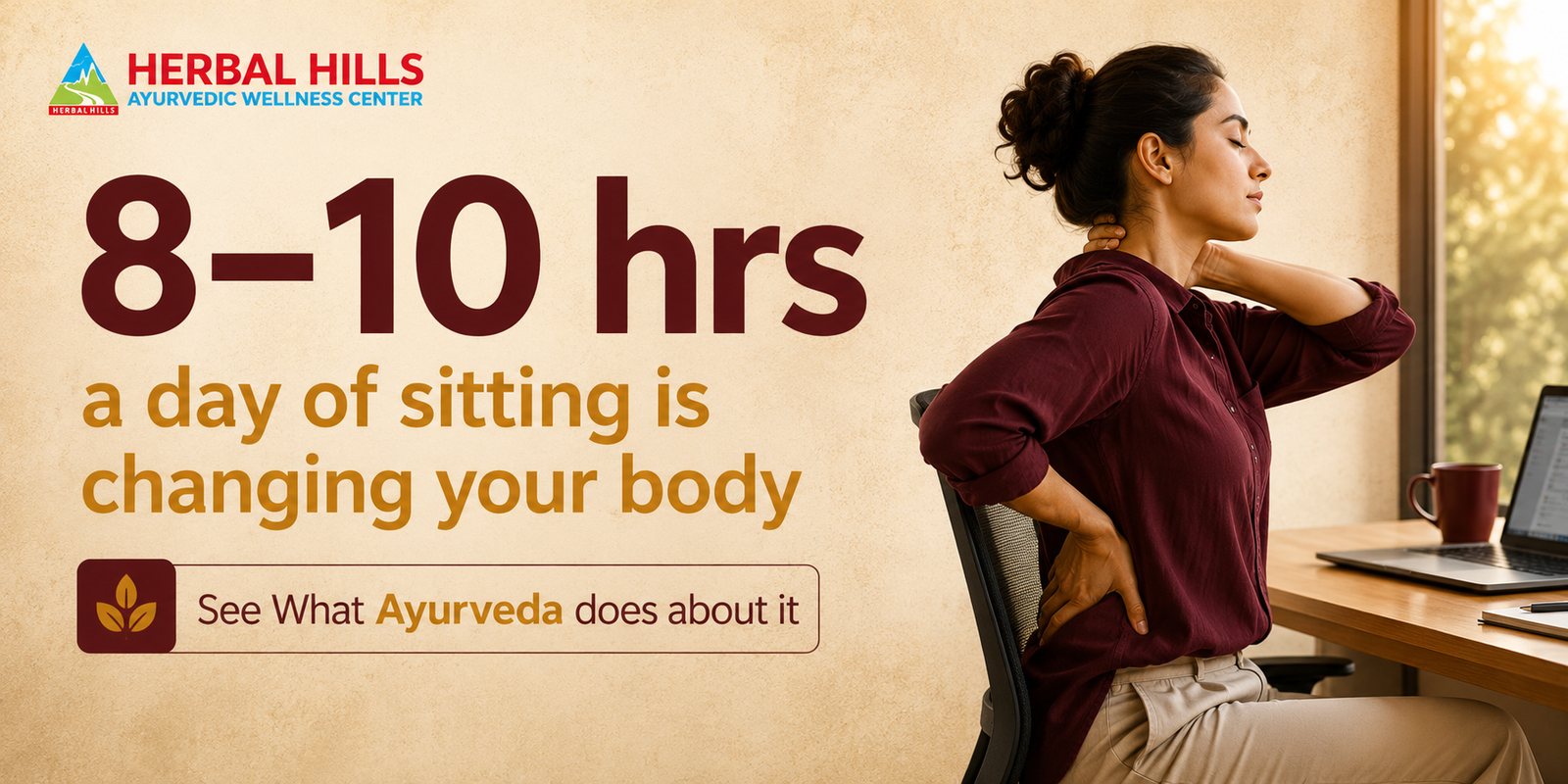
Sedentary Lifestyle: How Long Sitting Affects Your Neck, Back, Weight, Sleep and Mood, and How Ayurveda Helps You Undo It
A sedentary lifestyle means spending most of your waking hours sitting, with little movement in between. Over months, it can lead to neck and back pain, stiffness, weight gain, sluggish digestion, poor sleep and stress, even if your work is not physically hard. The good news: small, regular movement breaks, better posture, a steady daily routine and doctor-planned Ayurvedic care can undo much of the strain without changing your job.
“I don’t do heavy work, so why does my body hurt?”
It is one of the most common questions doctors hear at our centres. People say: I work in an office. I sit at a computer all day. I don’t lift anything heavy. So why do I have neck pain, back pain and constant stiffness?
The answer surprises most people. Many modern aches are not caused by too much physical work. They are caused by too little movement over too many hours. The body is built to move, and long sitting slowly changes how muscles, joints, digestion and the mind work.
What is a sedentary lifestyle?
A sedentary lifestyle is one with long hours of sitting or lying down while awake and little physical activity. Desk jobs, long commutes, screen time in the evening and weekends on the sofa all add up. Many people move less than they think: a working day can easily include ten or more hours of sitting.
The World Health Organization recommends that adults get at least 150 minutes of moderate activity a week and reduce sedentary time, because inactivity is linked with many long-term health problems.
Who is most at risk?
- Office professionals, software engineers and bankers.
- Entrepreneurs and business owners in long meetings.
- Teachers, designers and students at desks for hours.
- Work-from-home professionals who move even less than office workers.
- People with long daily commutes by car, train or bus.
- Anyone who spends evenings on the phone or in front of the TV.
A typical sedentary day
| Time | What usually happens |
|---|---|
| Morning | Rushed breakfast, long commute sitting |
| Work hours | 8 to 10 hours at a desk or laptop |
| Lunch | Eaten at the desk, often late |
| Evening | Commute, then phone or TV |
| Night | Late dinner, screens in bed, late sleep |
On a day like this, total movement may be less than 30 minutes, even for someone who feels busy all day.
Effects of sedentary lifestyle on your body
The effects of sedentary lifestyle build slowly, so they are easy to ignore. Common ones include:
- Neck pain and shoulder stiffness.
- Lower back pain and tight hips.
- Knee discomfort and reduced flexibility.
- Poor posture and muscle tightness.
- Weight gain, especially around the waist.
- Sluggish digestion, bloating and constipation.
- Stress, low mood and disturbed sleep.
- Low energy and general body fatigue.
Effect 1: Neck and shoulder pain
Looking down at a laptop or phone for hours pushes the head forward. Every few centimetres the head moves forward adds extra load on the neck muscles. Over time, this causes stiffness, aching between the shoulder blades and sometimes headaches. Raising the screen to eye level and taking short breaks helps more than most people expect. Persistent neck pain is often helped by therapies such as Greeva Basti, planned after a doctor’s assessment.
Effect 2: Lower back pain
Sitting for long periods, especially slumped or without lower back support, loads the discs and weakens the core and hip muscles. Tight hip flexors pull on the lower back. Many desk workers feel back pain at the end of the day or when they stand up after a long meeting. Our page on Ayurvedic care for back pain explains how doctors approach it.
Effect 3: Stiff joints and knees
Joints stay healthy with movement, which helps nourish the cartilage. When knees and hips stay bent for hours, they stiffen. Many people notice that the first few steps after sitting feel stiff, or that climbing stairs feels harder than it should for their age. Gentle daily movement and strengthening usually help.
Effect 4: Weight gain around the waist
A sedentary lifestyle burns fewer calories through the day, and long sitting is linked with a larger waist even in people who exercise once a day. Add desk snacks, sweet tea and late dinners, and weight creeps up slowly. In Ayurveda, inactivity and heavy food increase Kapha, which is linked with heaviness and slow metabolism.
Effect 5: Sluggish digestion
Movement helps the gut work. Long sitting, eating at the desk and late, heavy dinners can lead to bloating, acidity, constipation and a heavy feeling after meals. Ayurveda describes this as weak Agni, or digestive fire. A short walk after meals and regular meal times are simple first steps.
Effect 6: Stress and a restless mind
Work pressure, deadlines and constant notifications keep the mind busy while the body stays still. This mismatch is tiring. Movement is one of the body’s natural ways to release stress, and when it is missing, tension builds in the neck, shoulders and jaw. Our blog on the effects of stress on the body explains this link.
Effect 7: Poor sleep
A body that has not moved all day often does not feel physically tired at night, while the mind is still racing. Late screens make it worse. The result is difficulty falling asleep, light sleep and waking up tired. Daily activity, especially in daylight, is one of the most reliable ways to sleep better.
Effect 8: Low energy and fatigue
It sounds strange, but moving less often leaves people feeling more tired. Circulation slows, muscles weaken and the mind feels foggy. Many people reach for coffee or sugar in the afternoon, which helps briefly and then leaves them more tired. Short movement breaks often lift energy better than another cup of tea.
Effect 9: Long-term health risks
Over years, a sedentary lifestyle is linked with higher risk of type 2 diabetes, high blood pressure, heart disease and some other long-term conditions. This is why regular checks of weight, blood pressure and blood sugar matter for desk workers, especially after 35 or with a family history. Our blog on lifestyle diseases covers this in more detail.
Why these problems are connected
Long sitting, poor posture, irregular meals, little exercise and chronic stress all influence one another. That is why a person with back pain may also sleep poorly, someone with stress may develop digestive discomfort, and weight gain may come with stiff knees.
Rather than looking at one symptom alone, Ayurveda looks at the body as one connected whole. Treating only the back while ignoring sleep, stress and digestion usually gives short-lived relief.
How Ayurveda understands a sedentary lifestyle
Ayurveda describes lack of movement and heavy, irregular eating as causes of Kapha build-up, leading to heaviness, weight gain and sluggishness. Stress, screen overload, irregular routines and late nights aggravate Vata, leading to stiffness, dryness of the joints, pain, anxiety and poor sleep. Many desk workers show both patterns together.
The Ayurvedic answer is a steady daily routine, regular movement, warm and timely meals, and therapies chosen to balance the dosha that is most disturbed.
What the doctor looks at
At Herbal Hills, our MD Panchakarma doctors begin by understanding you, not just your symptoms. During the consultation they ask about:
- The nature of your work and daily sitting hours.
- Exercise habits, sleep quality and stress levels.
- Eating habits and digestion (Agni).
- Your body constitution (Prakriti) and current imbalance (Vikriti).
- Medical history and current medicines.
The doctor also checks your pulse through Nadi Parikshan.
Every patient does not need the same care
Two office professionals may both complain of neck pain, yet the reasons may be completely different. One may mainly need posture correction and local therapies. Another may benefit most from stress care. Someone else may need Panchakarma therapies. A fourth may need a structured one-month programme. That is why care at Herbal Hills is always personalised. Our blog on why two people react differently to the same treatment explains why.
Four levels of care at Herbal Hills
| Level | Suits | Includes |
|---|---|---|
| Individual Therapies | Local neck, shoulder, back or knee stiffness | Abhyanga, Swedan, local Basti therapies, as advised |
| HH Signature Treatments | Work fatigue, stress, mobility, prevention | Focused sessions for relaxation and recovery |
| HH Therapy Packages | More persistent concerns | One month of consultations, therapies, diet and lifestyle guidance; medicines billed separately |
| HH Health Packages | A full treatment programme | Consultations, therapies, diet plan and doctor-prescribed medicines included |
Individual therapies for local stiffness
For localised concerns such as neck pain, shoulder pain, back pain, knee discomfort or muscle tightness, the doctor may suggest individual therapies. These can include Abhyanga (oil massage), Swedan (herbal steam), local Basti therapies such as Kati Basti for the lower back and Greeva Basti for the neck, and other procedures where clinically suitable. See our Ayurvedic therapies for the full list.
HH Signature Treatments for work fatigue
Many professionals do not have one specific problem; they simply feel physically and mentally drained. HH Signature Treatments are designed for relaxation and recovery from work fatigue, rejuvenation and better mobility, stress management and preventive wellness. They help maintain health before small problems become bigger concerns.
Packages for persistent problems
When symptoms keep returning, a structured approach works better than occasional sessions. An HH Therapy Package includes initial and follow-up consultations, personalised therapy sessions, diet guidance, lifestyle counselling and progress monitoring over a month. An HH Health Package adds doctor-prescribed Ayurvedic medicines and continuous monitoring. The philosophy is the same; the difference is whether medicines are included.
You cannot change your job, but you can change your routine
Let’s be practical. An IT engineer cannot stop using a computer. A business owner cannot avoid meetings. A banker cannot stand all day. Changing your profession is rarely realistic, and it is not the goal.
Just as a vehicle runs better with regular servicing, your body also benefits from regular care. For many people, one wellness session every week or fortnight, along with exercise, healthy eating and stress care, helps maintain comfort. The right frequency is decided after your doctor’s assessment.
Sedentary lifestyle: simple desk habits
- Stand up every 30 to 45 minutes, even for two minutes.
- Raise your screen so the top is at eye level.
- Support your lower back and keep feet flat on the floor.
- Walk during phone calls when you can.
- Keep water at a distance, so you get up to refill it.
- Use the stairs for one or two floors.
- Take a 10-minute walk after lunch.
Five-minute desk stretches
- Neck: slowly tilt the ear towards each shoulder, holding for 15 seconds.
- Shoulders: roll them backwards ten times.
- Upper back: clasp hands in front and round the back gently.
- Chest: clasp hands behind and open the chest.
- Hips: stand and lunge gently forward on each side.
- Calves: rise onto your toes ten times.
Stop if any movement causes sharp pain.
An Ayurvedic daily routine for desk workers
Ayurveda’s daily routine, Dinacharya, suits desk workers well: wake at a regular time, drink warm water, move for 20 to 30 minutes in the morning, eat lunch as the main meal at a regular time, take a short walk after meals, eat a light dinner early and sleep by 10.30 pm. A short self-massage with warm oil before a bath helps Vata-type stiffness. Our blog on the Ayurvedic daily routine has the full plan.
Food that suits a sedentary lifestyle
A body that moves less needs lighter food. Choose warm, freshly cooked meals, more vegetables and dal, and fewer fried snacks, sweets and sugary drinks at the desk. Eat at regular times rather than grazing all day. Keep dinner light and at least two to three hours before bed. Ayurveda suggests ginger, cumin and black pepper to support sluggish digestion.
Exercise: how much is enough?
Aim for at least 150 minutes of moderate activity a week, such as brisk walking, cycling or swimming, plus muscle-strengthening exercise twice a week. Yoga is especially helpful for desk workers because it combines stretching, strength and breathing. If you are starting from very little activity, begin with 10-minute walks and build up slowly. Exercise does not fully cancel long sitting, so breaks during the day still matter.
Common myths about sitting
“I go to the gym, so sitting doesn’t matter.”
Exercise helps, but long unbroken sitting still affects the body.
“Back pain at my age is normal.”
Desk-related pain is common but often improves with posture and movement.
“A good chair solves everything.”
A good chair helps, but no chair replaces getting up.
“Only old people get stiff.”
Young desk workers often have stiffer necks and hips than active older adults.
When to see a doctor
See a doctor promptly if you have back or neck pain with numbness, tingling or weakness in the arms or legs, pain after a fall or injury, pain that wakes you at night, unexplained weight loss, fever, chest pain or breathlessness on exertion, or loss of bladder or bowel control. These need medical assessment first. For long-standing stiffness, weight gain or poor sleep, a doctor can help find the cause and plan care.
Sedentary lifestyle: the short version
A sedentary lifestyle, with long hours of sitting and little movement, slowly leads to neck and back pain, stiffness, weight gain, sluggish digestion, stress and poor sleep. You do not need to change your job. Stand up every 30 to 45 minutes, fix your screen and posture, walk after meals, exercise 150 minutes a week, eat lighter and earlier, and sleep on time. When problems persist, doctor-planned Ayurvedic care, from individual therapies to one-month packages, can help.
Your wellness journey at Herbal Hills
- Doctor consultation with Nadi Parikshan, free of charge.
- Lifestyle and Ayurvedic assessment of work, sleep, stress and digestion.
- Understanding the cause of your symptoms.
- A personalised plan: individual therapy, Signature Treatment, Therapy Package or Health Package.
- Regular follow-up for long-term wellness.
Frequently asked questions
It is a way of living with long hours of sitting or lying down while awake and little physical activity, common in desk jobs, long commutes and evenings spent on screens.
Common effects include neck and back pain, stiff joints, weight gain around the waist, sluggish digestion, stress, poor sleep and low energy. Over years, it is linked with diabetes, high blood pressure and heart disease.
Try to stand up and move every 30 to 45 minutes, even for two minutes, and take a short walk after lunch.
Exercise helps a great deal, but long unbroken sitting still affects the body, so movement breaks during the day are also important.
An Ayurvedic doctor looks at posture, routine, diet, stress and sleep together, and may suggest daily routine changes, individual therapies, Signature Treatments or a one-month package, depending on your assessment.
No. Most people improve with better posture, regular movement breaks, exercise, lighter meals, good sleep and, where needed, doctor-planned therapies.
This article is for general education and does not replace medical advice. Ayurvedic therapies and medicines at Herbal Hills are planned by qualified doctors after a personal consultation.
Care that fits around your working week
You do not need to leave work to look after your body. Herbal Hills has five centres in Western Mumbai, in Juhu (Andheri West), Goregaon West, Kandivali West and two in Borivali West, open Tuesday to Sunday, 10 am to 7 pm. Find your nearest centre.
Keep your job. Lose the stiffness.