

Blog
AI Can Learn Overnight. People Still Need a Good Night’s Sleep.


AI anxiety at work, layoff fears and the mental wellness of your teams: why Indian leaders are adding Ayurvedic wellness and herbal solutions to their AI strategy
AI anxiety at work is the worry, overwhelm and quiet sleeplessness that employees and managers feel as artificial intelligence reshapes their roles and layoff headlines multiply. It is not a weakness and it is not a passing fad. Left unspoken, AI anxiety shows up as foggy decisions, short tempers and disengagement, which is why mental wellness now belongs on the leadership agenda.
Three words dominate boardroom conversations right now: AI, mental wellness and wellbeing. Most leaders treat them as three separate files. This article makes the case that they belong in one, that AI anxiety is a business issue as much as a personal one, and that the oldest of the three ideas, Ayurvedic wellness, has something useful to offer the newest.

Why is AI anxiety rising among capable people?
Every week brings a new tool that writes, codes, designs or analyses faster than last week’s. Alongside the launches come headlines about AI layoffs, AI job loss, restructured teams and roles that “may not exist in five years.” Very few employees have been told exactly what AI will mean for them, so they fill the gap with the worst version of the story. That gap is where AI anxiety grows.
The Pew Research Center, a nonpartisan research organisation in Washington DC, surveyed more than 5,000 working adults on exactly this. About half said they were worried about how AI will be used at work, and one in three said they felt overwhelmed. The survey was American, but anyone who has sat in an Indian office cafeteria lately has heard the same conversation in Hindi, Marathi and English. AI anxiety is not a Silicon Valley problem.
AI anxiety is not limited to junior staff. Middle and senior managers carry a double load: they are asked to drive AI adoption and productivity targets while reassuring teams about questions they cannot fully answer themselves.
How to spot AI anxiety in your team
AI anxiety rarely announces itself. People do not walk into HR and say they are afraid of a chatbot. It shows up sideways, in behaviour that is easy to mistake for a performance or attitude problem. Watch for these patterns, especially in the weeks after an AI announcement or a restructuring rumour:
- Sleep complaints and visible tiredness, including people mentioning that they lie awake thinking about work.
- Always-on behaviour: late-night emails and messages from people trying to prove they cannot be replaced.
- Withdrawal in meetings from people who used to contribute freely.
- Irritability, short tempers and more friction between teams.
- Resistance to new tools, or the opposite, quiet overuse of them with no one checking the output.
- A rise in short, unplanned leave, and in people who come to work but cannot focus.
None of these signs on its own proves AI anxiety, and none of them calls for a diagnosis from a manager. They are a prompt to ask, listen and make support easy to reach.
A good first conversation is short and private. Ask how the person is finding the changes, listen more than you speak, and avoid promising what you cannot control. Then point to practical support: time to learn new tools, clarity on what is changing, and confidential care if sleep or worry has become a problem. Most people are relieved simply to be asked.
Is the fear justified, or is it the uncertainty that hurts?
The picture is more balanced than the headlines. The World Economic Forum, the Geneva-based international organisation that surveys over 1,000 large employers for its Future of Jobs Report, projects that by 2030 about 170 million new jobs will be created and 92 million displaced, a net gain of 78 million. Work will change a great deal. It will not simply disappear.
For Indian employers the opportunity is real too. Companies that invest in reskilling now can move existing people into the new roles AI creates, which is usually faster and cheaper than hiring from outside. That message, said clearly and often, does more to reduce AI anxiety than any poster about wellbeing.
What wears people down is not change itself but not knowing. The World Health Organization lists job insecurity, excessive workload and low control over one’s work among the working conditions that put mental health at risk. A rapid, poorly explained AI rollout can quietly create all three at once, and that is when AI anxiety turns into workplace stress.
What does workplace stress cost an Indian company?
This is the part of the conversation that belongs to the CFO as much as to HR, because AI anxiety has a price. The WHO estimates that around 12 billion working days are lost globally every year to depression and anxiety, costing nearly US$1 trillion in lost productivity.
Closer home, a Deloitte India study of nearly 4,000 employees estimated that poor mental health costs Indian employers about ₹1.1 lakh crore a year. The largest share, roughly ₹51,000 crore, came from presenteeism: people who come to work but cannot perform at their best. That is the hidden cost of AI anxiety. It rarely appears as sick leave. It appears as a strong performer who has gone quiet in meetings.
Why is mental wellness now a leadership decision, not an HR perk?
Companies that are winning with AI tend to share one trait: their people feel safe enough to experiment, ask questions and admit what they do not yet know. A frightened team protects itself; a settled team learns. In that sense, managing AI anxiety and the mental wellness of staff and senior management is not separate from the AI strategy. It is one of the conditions for it working.
The gains are practical. Clearer thinking at the top leads to better decisions under pressure. Better sleep supports concentration and patience. Visible support from leadership reduces the quiet attrition that follows every restructuring rumour, and it protects the investment a company has already made in training its people.
Leaders are not immune. Founders and CXOs often carry their own AI anxiety about competitors moving faster, budgets and board expectations, and they rarely say it aloud. Long hours and poor sleep at the top flow down the organisation as rushed decisions and mixed messages. Looking after the leadership team is not indulgence; it is risk management.
Where does Ayurvedic wellness fit in a high-tech workplace?
It may seem odd to answer a twenty-first-century problem with a science that is thousands of years old. But Ayurveda describes the AI-age employee with surprising precision. It understands chronic stress, including the AI anxiety many employees now describe, as a disturbance of Prana Vata, the energy that governs the mind and nervous system, and Sadhaka Pitta, which governs emotional processing. Long screen hours, constant notifications, irregular meals and late nights, the everyday sources of stress at work, are exactly the habits Ayurveda says aggravate them.

The response is a structured, doctor-led program rather than a single relaxing session. At Herbal Hills, Ayurvedic stress relief begins with a consultation and Nadi Parikshan (pulse assessment), followed by therapies chosen for the individual. Shirodhara, a steady stream of warm medicated oil over the forehead, is traditionally used for deep relaxation and better sleep. Shiro Abhyanga releases tension held in the head, neck and shoulders, the classic desk-worker pattern. Nasya is used to support mental clarity.
Ayurveda also looks below the surface. Months of stress, rushed eating and poor sleep are believed to leave the body carrying accumulated Ama, often described as metabolic residue, which Ayurveda links to heaviness and dull thinking. That is why body detox is part of the conversation: programs such as Vishudhi body cleansing work on the body so that the mind has less to carry. Our Director’s note on what detox really means in Ayurveda explains the idea further.
Herbal solutions complete the picture. Herbs such as Ashwagandha, Brahmi and Shankhpushpi are traditionally used in Ayurveda to support calm, resilience and restful sleep. At Herbal Hills they are prescribed by a doctor after consultation, never handed out as a generic stress pill.
A daily routine that protects the mind in a screen-heavy job
Programs and herbs work best on top of steady daily habits. Ayurveda calls this Dinacharya, a daily routine that keeps the body’s rhythms predictable. For people dealing with AI anxiety and long screen hours, a few simple habits make a noticeable difference, and they cost nothing:
- Keep a fixed sleep and wake time, even on weekends, and aim to be in bed before 11 pm.
- Keep the last hour before bed free of screens and work messages.
- Eat warm, freshly cooked meals at regular times, and avoid working through lunch at the desk.
- Step away from the screen for a few minutes every hour to stretch the neck and shoulders and rest the eyes.
- Practise a few minutes of slow breathing, such as Anulom Vilom, before difficult meetings or at the end of the day.
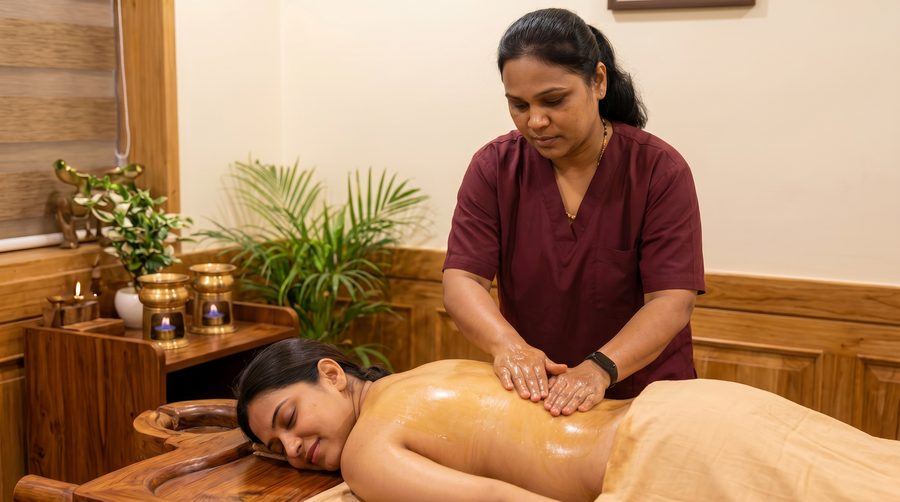
- Before sleep, a gentle oil massage of the scalp and the soles of the feet is traditionally used in Ayurveda to settle the mind.
- Go easy on tea and coffee after mid-afternoon.
These habits are general guidance, not a treatment plan. If poor sleep or AI anxiety has lasted for weeks, a doctor’s consultation is the right next step.
7 simple ways to reduce AI anxiety at work
AI anxiety responds well to clarity, time and support. Here is what a CEO or HR head can do this quarter:
- Say what you know, and what you do not. Uncertainty feeds AI anxiety, and people handle hard news better than silence, so explain what AI will and will not change in your organisation, even if the answer is “we are still deciding.”
- Pair every AI rollout with time to learn. Give people protected hours to practise with a new tool, not just a login and a deadline.
- Show the reskilling path. When employees can see how their role can grow with AI, AI anxiety gives way to curiosity.
- Let leaders go first. Senior leaders who speak openly about their own need to recover give everyone else permission to do the same, because a culture follows what its leaders do rather than what the policy says.
- Protect sleep. Set clear norms on late-night emails and weekend messages, so being always available is not mistaken for commitment. Poor sleep makes AI anxiety worse.
- Train managers to notice. Show line managers the early signs of AI anxiety and workplace stress, and how to respond with a conversation rather than a performance warning.
- Offer confidential, qualified care. Give employees access to support they can use without explaining themselves to their manager, such as a doctor-led corporate wellness program.
AI anxiety at work: frequently asked questions
AI anxiety at work is the worry, overwhelm and uncertainty employees and managers feel as artificial intelligence changes their roles and layoff news spreads. It often shows up as poor sleep, overthinking, irritability and low focus. It is a normal response to uncertainty, and it responds well to honest communication and real support for mental wellness.
Look for changes rather than single events: poor sleep, late-night emails, withdrawal in meetings, irritability and difficulty focusing, especially after AI announcements. Managers should not try to diagnose. The right response is a private, supportive conversation and easy access to confidential, qualified care.
Yes. Stress rarely stays at home. Deloitte estimates that poor mental health costs Indian employers around ₹1.1 lakh crore a year through absenteeism, presenteeism and attrition. When people are anxious about their future, decisions slow down, mistakes rise and good employees start looking elsewhere, often before anyone notices.
Ayurveda understands chronic stress as a disturbance of Prana Vata, which governs the mind and nervous system, and Sadhaka Pitta, which governs emotional processing. Therapies such as Shirodhara, Shiro Abhyanga and Nasya, along with doctor-prescribed herbs, are traditionally used to calm the nervous system, support sleep and restore mental clarity.
Yes. Herbal Hills offers a doctor-led corporate wellness program delivered at its five centres in Mumbai’s western suburbs. Companies prepay a program value from ₹30,000, employees each begin with a doctor consultation, and HR receives usage totals only, never diagnoses. The organisation gets one agreement and one consolidated invoice.
No. Ayurvedic wellness supports wellbeing and works alongside, not instead of, care from a psychiatrist, psychologist or physician. Anyone experiencing persistent low mood, panic, or thoughts of self-harm should seek professional mental health care promptly. Our doctors will advise when a referral is more appropriate than an Ayurvedic program.
This article is for general education and does not replace medical advice. Ayurvedic programs at Herbal Hills are planned by qualified doctors after a personal consultation and work alongside any medical care an employee is receiving.
How Herbal Hills thinks about wellness in the age of AI
We noticed something simple: companies were budgeting carefully for AI licences, cloud and training, and almost nothing for the people expected to use them well. So when we designed our corporate wellness program, we treated recovery as infrastructure rather than a reward.
That shaped three decisions. Every employee starts with a doctor, not a menu, so the plan fits the person. We offer programs, not one-off massages, because nervous systems do not reset in an hour and AI anxiety builds over months, not days. And we built in confidentiality from day one: the company sees usage totals only, never diagnoses.
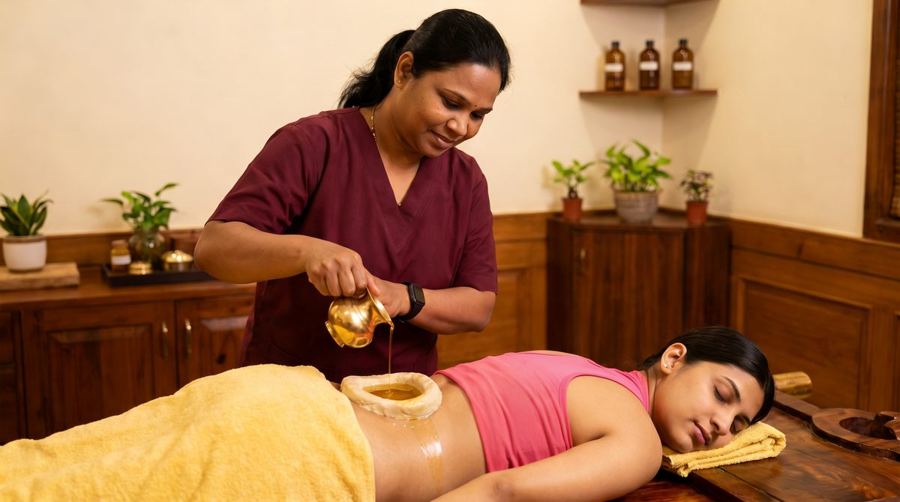
For teams feeling the strain of change, the Mann Shuddhi Health Package is a one-month program of eight sessions combining Shiro Abhyanga, Shirodhara, Nasya and full-body Abhyanga with steam, plus a doctor-curated herbal medicine kit for calm and sleep. For those who prefer therapies only, there is the Mann Shuddhi Therapy Package. For leaders who need a complete reset rather than a top-up, the 5 Days Panchakarma Package fits eight doctor-planned therapy sessions into five days, with flexible scheduling. Detox-focused Detox Pro health packages address the body’s side of the same story.
Companies simply prepay a wellness credit, starting at ₹30,000, and employees use it across our centres. Larger commitments earn up to 35% more treatment value and up to a year of validity, all under one agreement and one GST invoice.
Five Ayurvedic wellness centres across Western Mumbai
Herbal Hills has five centres in Mumbai’s western suburbs, from Juhu to Borivali: Juhu, Andheri West, Goregaon West, Kandivali West and Borivali West. For companies with offices along the Western line, from Andheri’s business districts to the Goregaon and Malad corridors, that means care within a short drive of where your teams already work, booked by appointment around their schedules, so help with AI anxiety is close at hand. See all locations.
AI will keep learning overnight. Make sure your people can still rest.
Request a corporate wellness proposal and our team will call to understand your organisation’s needs.