

Blog
The Calmest Person in the Boardroom Usually Wins

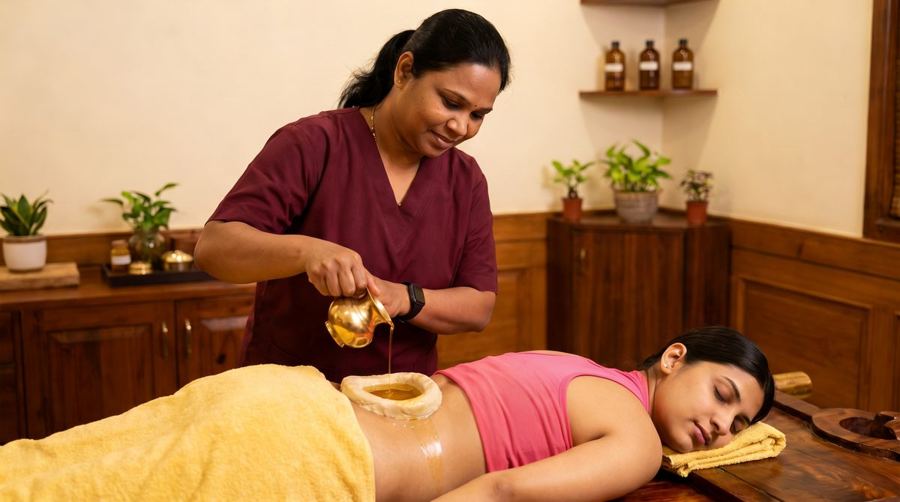
How to stay calm under pressure: Ayurvedic mental wellness, mind detox and doctor-curated programs that help CEOs and directors think clearly and decide better
It is seven in the evening. A large client is unhappy, a regulator has written, and the team is waiting to see how you react. Everyone in the room will remember the next ten minutes. Whatever the problem, the person who can stay calm under pressure usually leads the way out of it.
Learning to stay calm under pressure is less about willpower in the moment and more about the reserve you carry into it. Leaders who sleep well, eat on time, recover properly and are not running on an exhausted nervous system find a calm mind far easier to reach. Ayurvedic mental wellness focuses on rebuilding that reserve through doctor-led therapies, detox and daily routine.
Is the ability to stay calm under pressure a trait or a skill?
We often describe certain leaders as “naturally cool-headed,” as if calm were something you are born with. In practice, the ability to stay calm under pressure behaves more like fitness. It can be built, it can be maintained, and it quietly erodes when it is neglected. The same senior executive can be composed in one quarter and short-fused in the next, simply because the reserve has run down.
That matters because the cost of a reactive decision at the top is rarely small. A sharp email to a key partner, a rushed hire, an unnecessary escalation: each one travels down the organisation and lands on dozens of people. Leaders who stay calm under pressure protect more than their own peace of mind; they protect everyone downstream of their decisions.
Signs your calm is running low
Most leaders notice the loss of mental peace late, usually after a regrettable reaction, when they have already failed to stay calm under pressure. The earlier signs are quieter. Watch for these, especially during a long quarter, a fundraise, an audit or a restructuring:
- You wake up already thinking about work, or wake at 3 am and cannot get back to sleep.
- Small problems feel urgent, and you find yourself reacting before you have all the facts.
- You put off decisions you would normally make quickly, then make several at once late at night.
- Your patience with your team, or your family, is shorter than usual.
- Coffee, sugar or late-night screens have become the way you get through the day.
- Weekends no longer feel like rest; you simply catch up on sleep and email.
None of these signs means something is wrong with you. They mean the reserve that helps you stay calm under pressure needs topping up, and that is far easier to do before a crisis than in the middle of one.
What does decision fatigue do to experienced professionals?
One of the most quoted studies on decision fatigue comes from PNAS, the journal of the US National Academy of Sciences. Researchers followed more than 1,000 parole decisions by experienced judges. Favourable rulings started at around 65% at the beginning of each session, fell towards zero as the session wore on, and jumped back to about 65% right after a food break.
Later researchers have debated how large the effect really is, but the lesson most leaders recognise is simple. Long stretches of decisions, without real breaks, push even skilled people towards the safest, simplest answer rather than the best one. A director’s day is often exactly that: one decision after another, from the first call to the last message at night. Decision fatigue is one of the main reasons capable people find it hard to stay calm under pressure late in the day.
Are leaders getting the sleep their decisions need?
Often not. When McKinsey & Company, the global management consultancy, surveyed nearly 200 business leaders, 43% said they did not get enough sleep at least four nights a week. Almost half believed this had little effect on their leadership.
Ayurveda would disagree, and so would most people who have tried to chair a difficult meeting after a broken night. Sleep is when the mind clears the day. Without it, patience shortens, small problems look larger, and a calm mind becomes something you have to force instead of something you have. Of all the habits that help you stay calm under pressure, sleep is the one most leaders trade away first.
Yoga, meditation and healthy food: where do they help, and where do they stop?
Many leaders already do the right things. They practise yoga, meditate, walk, and eat cleaner than they did ten years ago. These habits genuinely help, and nothing in this article suggests giving them up.
But they have two limits. First, they depend on daily discipline, and discipline is usually the first casualty when a crisis arrives. The early morning yoga session is the easiest meeting to cancel. Second, they work best on a system that is broadly in balance. Years of late nights, travel, irregular meals and constant alertness can leave a deeper fatigue that a 20-minute practice struggles to reach. Even healthy food, as our Director explains in why healthy food is not enough, only helps as much as your digestion allows.
This is why some leaders who meditate every day still struggle to stay calm under pressure when a hard month arrives. The practice is not wrong; the reserve underneath it is simply too low.
What is Ayurvedic mental wellness, and how is it different?
Ayurvedic mental wellness is a doctor-led approach that treats the mind and body as one system. Ayurveda describes the mind through three qualities: Sattva (clarity and steadiness), Rajas (activity and restlessness) and Tamas (heaviness and dullness). Sustained pressure tends to push a leader towards Rajas, the racing, reactive mind, and eventually into Tamas, the tired, foggy one. The aim of treatment is to restore Sattva, the state of mental clarity in which good judgement comes naturally. For a leader, that is what it means to stay calm under pressure from the inside out.

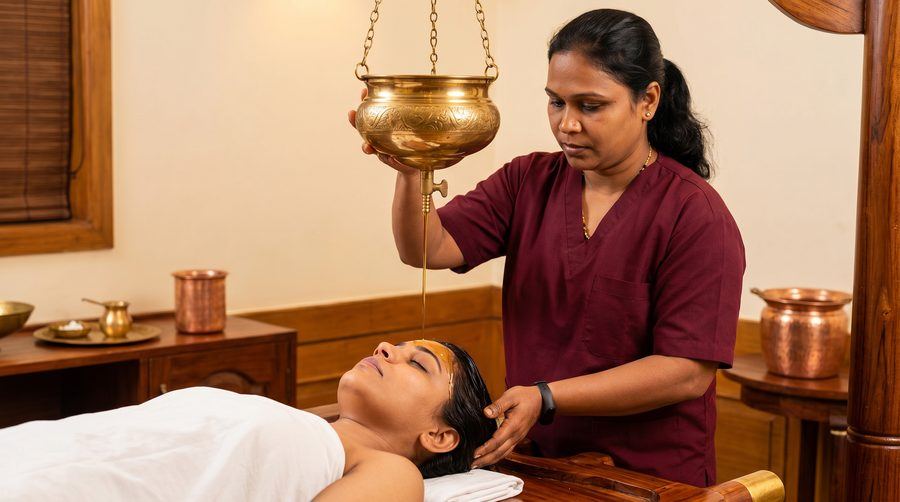
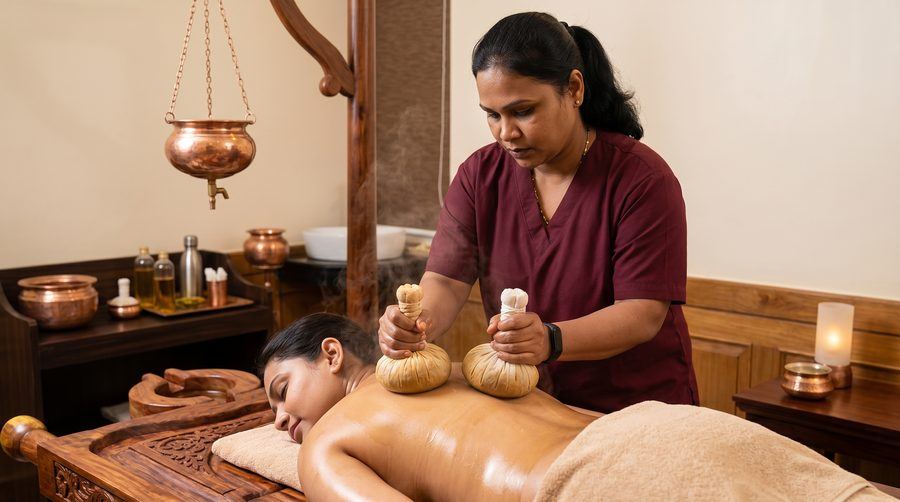
In practice, it begins with a doctor. A consultation and Nadi Parikshan (pulse assessment) identify what is driving the imbalance, often aggravated Prana Vata, which governs the nervous system. The doctor then plans a course of therapies, such as Shirodhara, a steady stream of warm medicated oil over the forehead that is traditionally used for deep relaxation and better sleep; Shiro Abhyanga, a medicated head massage; Nasya, used to support mental clarity; and Pada Abhyanga, a calming foot massage often recommended for disturbed sleep. Herbs, diet and a daily routine are prescribed alongside.
The difference from an ordinary relaxation session is structure. It is a program with a beginning, a plan and a doctor who reviews progress, rather than an hour of relaxation that fades by Monday.
Why does detox belong in a conversation about the mind?
In Ayurveda, the mind and the gut are closely linked. Irregular meals, late dinners, travel food and stress weaken Agni, the digestive fire, and allow Ama, often described as metabolic residue, to accumulate. Ayurveda associates Ama with heaviness, lethargy and clouded thinking, the very opposite of executive clarity.
That is why a “mind detox” in the Ayurvedic sense starts with the body. Programs such as Vishudhi body cleansing and the Detox Pro health packages are designed to lighten the system so the mind has less to carry. Many leaders describe the result simply as feeling lighter and thinking more clearly, though experiences vary and the program is always planned individually. A lighter body makes it easier to stay calm under pressure.
7 simple ways to stay calm under pressure
Calm responds well to small, repeated habits. Here are seven ways to stay calm under pressure that a busy leader can start this week:
- Pause before you respond. Take three slow breaths, longer out than in, before you answer a difficult message or question. It is the simplest way to stay calm under pressure in the moment, and it gives your judgement time to catch up with your reaction.
- Separate facts from noise. Write down what you actually know, what you are assuming and what you need to find out. Most pressure comes from the second list.
- Protect your first and last hour. Keep the first hour of the day free of email and the last hour free of screens. These two hours decide how much reserve you carry into everything else.
- Batch your decisions. Group routine decisions into one or two slots a day, and take a real break with food between long stretches. This is the most practical defence against decision fatigue.
- Eat on time. Regular, warm, freshly cooked meals keep Agni steady. Skipped lunches and late dinners are a common hidden reason leaders find it hard to stay calm under pressure.
- Guard your sleep. Aim for a fixed sleep and wake time, even on weekends. If sleep has been broken for weeks, treat it as a priority rather than a personal failing.
- Rebuild the reserve with a doctor. A structured, doctor-led program such as the Mann Shuddhi Health Package restores what years of pressure have used up, so that calm becomes your default again.
A daily routine for a calm mind
Ayurveda calls a steady daily routine Dinacharya. It keeps the body’s rhythms predictable, which in turn makes mental peace easier to hold on to. For leaders who want to stay calm under pressure, a few simple habits make a noticeable difference, and they cost nothing:
- Wake at a fixed time and drink a glass of warm water before tea or coffee.
- Spend five to ten minutes on gentle stretching or slow breathing, such as Anulom Vilom, before checking your phone.
- Make lunch the main meal of the day, eaten away from the desk.
- Step outside for a short walk after lunch instead of going straight into the next meeting.
- Keep dinner light and at least two to three hours before bed.
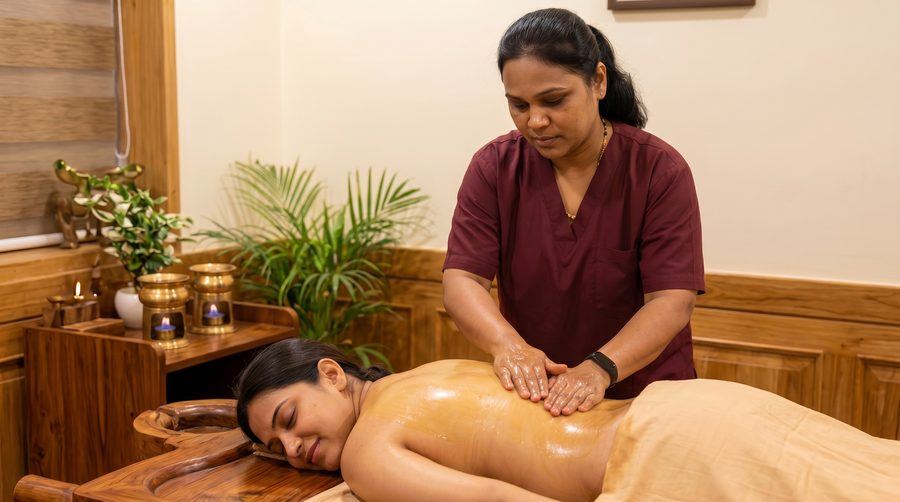
- Before sleep, a gentle oil massage of the scalp and the soles of the feet is traditionally used in Ayurveda to settle the mind.
- Write tomorrow’s top three priorities before you leave work, so your mind does not carry them to bed.
These habits are general guidance, not a treatment plan. If sleep, worry or a racing mind have lasted for weeks, a doctor’s consultation is the right next step.
What does a company gain when its leaders stay calm under pressure?
A calm leader makes slower first reactions and faster good decisions. Teams bring problems forward earlier because they are not afraid of the response. Meetings resolve issues instead of escalating them. Over time, the organisation’s whole temperature drops a few degrees, and good people stay longer.
For a board or promoter family, this is also a matter of continuity. The most valuable asset in many Indian companies is the judgement of a handful of senior people. Protecting that judgement, and the ability of senior people to stay calm under pressure, is not indulgence. It is risk management. The same thinking applies to the wider team, as we explain in our note on AI anxiety at work.
How to stay calm under pressure: frequently asked questions
In the moment, slow your breathing, pause before responding and separate the facts from the noise. Over time, the ability to stay calm under pressure depends on what happens outside the crisis: enough sleep, regular meals, real recovery and a nervous system that is not already exhausted. Ayurveda focuses on building that reserve, not just managing the moment.
Ayurvedic mental wellness is a doctor-led approach that treats the mind and body together. It begins with a consultation and Nadi Parikshan, then combines calming therapies such as Shirodhara and Nasya, detox where needed, Ayurvedic herbs, and a personal diet and routine plan to support a steadier, clearer mind.
Decision fatigue is the drop in judgement that can follow a long run of decisions without real breaks. People under decision fatigue tend to choose the safest or simplest option rather than the best one, and find it harder to stay calm under pressure. Regular breaks, food on time and good sleep help protect against it.
Yoga and meditation are valuable and worth continuing. But they depend on daily discipline, which is often the first thing to slip under heavy pressure, and they may not reach years of accumulated fatigue. A structured Ayurvedic program adds therapies, detox and doctor guidance that can support and deepen those practices.
Mann Shuddhi is a one-month Herbal Hills program for stress, sleep and mental clarity. It includes doctor consultations, eight therapy sessions such as Shiro Abhyanga, Shirodhara and Nasya, and a doctor-curated herbal medicine kit in the Health Package version. A therapies-only Mann Shuddhi Therapy Package is also available.
Less than most expect. Mann Shuddhi needs eight sessions of 75 to 90 minutes spread across a month, roughly two a week. For a deeper reset, the 5 Days Panchakarma Package fits eight therapy sessions into five days. Sessions are booked by appointment at five centres across Western Mumbai.
This article is for general education and does not replace medical advice. Ayurvedic programs at Herbal Hills are planned by qualified doctors after a personal consultation and work alongside, not instead of, any medical or psychological care. Anyone with persistent anxiety, low mood or sleep problems should also consult a qualified medical professional.
Think of it as a board review for the mind
Every serious company audits its accounts, reviews its strategy and strengthens its governance. At Herbal Hills, our doctors approached a leader’s mental wellness the same way. The consultation is the audit: what is draining you, and why. The therapies are the restructuring: calming an overworked nervous system and clearing what the body has been carrying. The herbs, diet and routine are the governance: small, steady habits that help you stay calm under pressure long after the program ends.
That thinking runs through the programs our doctors have curated. The Mann Shuddhi Health Package is a one-month program for stress, sleep and mental clarity, with eight therapy sessions and a doctor-curated herbal kit, while the Mann Shuddhi Therapy Package offers the therapies on their own. Leaders who need a deeper reset can take the 5 Days Panchakarma Package, eight therapy sessions in five days. And for the body side of clarity, Vishudhi and Detox Pro address the heaviness that a demanding lifestyle leaves behind.
For organisations, these come together in the Herbal Hills corporate wellness program. Its Leadership Health Program places senior team members on a Health Package or the 5-Day Panchakarma with flexible scheduling. The company works through one agreement and one invoice, and every consultation stays strictly between the leader and their doctor.
Close to where Western Mumbai’s leaders work and live
Herbal Hills runs five Ayurvedic wellness centres in Mumbai’s western suburbs, stretching from Juhu to Borivali, with centres in Juhu, Andheri West, Goregaon West, Kandivali West and Borivali West. For directors and senior teams based along the Western line, that means a doctor-led program that fits between board meetings rather than requiring a trip out of the city, so help to stay calm under pressure is close to the office. Find your nearest centre.
Calm is the one asset your competitors cannot copy.
Request a Leadership Health Program proposal and our team will call to plan it around your leadership team’s calendar.