

Blog
Abhyanga, Shirodhara, Potli, Basti and Panchakarma: A Practical Guide to Ayurvedic Treatments

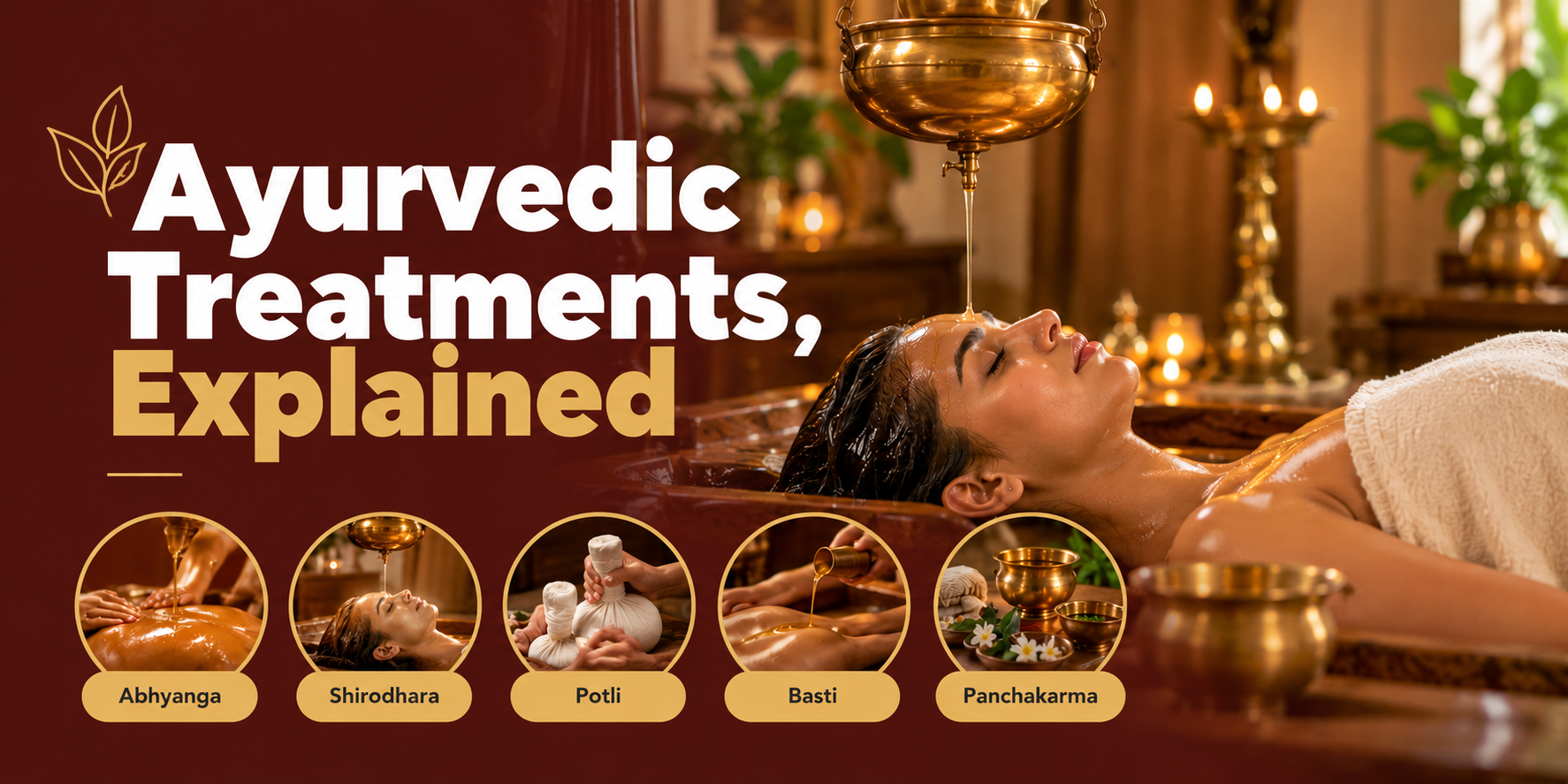
Ayurvedic Treatments Explained: What Each Therapy Involves, What It Is Commonly Used For, and How a Doctor Chooses the Right One for You
Ayurvedic treatments such as Abhyanga (warm oil massage), Shirodhara (warm oil poured over the forehead), Potli (heated herbal pouch massage) and Basti (medicated enema, part of Panchakarma) are among the most asked-about therapies in Ayurveda. Each suits different concerns, from general wellness, to stress and sleep, to muscle and joint stiffness, to deeper Vata-related imbalances. A doctor consultation decides which one, or which combination, actually suits you, so you do not have to guess from the name alone.
The short version
- Abhyanga is the everyday, full-body warm oil therapy.
- Shirodhara is most often chosen for stress, worry and poor sleep.
- Potli massage uses warm herbal pouches for stiffness and local tension.
- Basti is a medicated enema, central to Panchakarma, and also used in shorter courses.
- Leech therapy is a selective, doctor-supervised therapy for specific concerns.
- Panchakarma combines several ayurvedic treatments into one planned programme.
- The right choice depends on your constitution and concern, decided at a consultation.
Why the names can be confusing
Search for Shirodhara or Basti in Mumbai and you will find plenty of results, but not always a clear answer to the question most people actually have: what does this therapy involve, and is it the one I need?
This guide walks through the most searched ayurvedic treatments one at a time: what each one is, what it is typically used for, and how it fits alongside a single Ayurvedic massage session and a full Panchakarma programme.
If you are deciding between a general Abhyanga session and something more specific like Shirodhara or Basti, or you have simply heard these words and want to know what they mean before you speak to a doctor, this is the place to start.
How ayurvedic treatments are chosen
In Ayurveda, the therapy follows the assessment, never the other way round. A doctor first understands your Prakriti (natural constitution) and Vikruti (current imbalance), usually through a conversation and Nadi Parikshan, or pulse assessment.
Only then are ayurvedic treatments chosen, along with the oil, the duration and the number of sessions. Two people with the same complaint may be given different therapies because their constitutions differ. Read more about this first step in our guide to Nadi Pariksha in Ayurveda.
For a general background on Ayurveda as a system, see the NCCIH overview of Ayurvedic medicine.
Abhyanga: the everyday therapy
Abhyanga is a full-body massage with warm, herb-infused oil selected for your constitution. It is the therapy most people mean when they search for an Ayurvedic massage, and it is often the first of the ayurvedic treatments recommended for general wellness, everyday stress and circulation.
For many first-time visitors, Abhyanga is the entry point. It is relaxing, easy to understand, and gives the doctor a chance to see how your body responds before suggesting anything more specific.
Learn more about Abhyanga massage at Herbal Hills, or read our Ayurvedic massage checklist on what to check before you book.
Shirodhara: what it is and how it is done
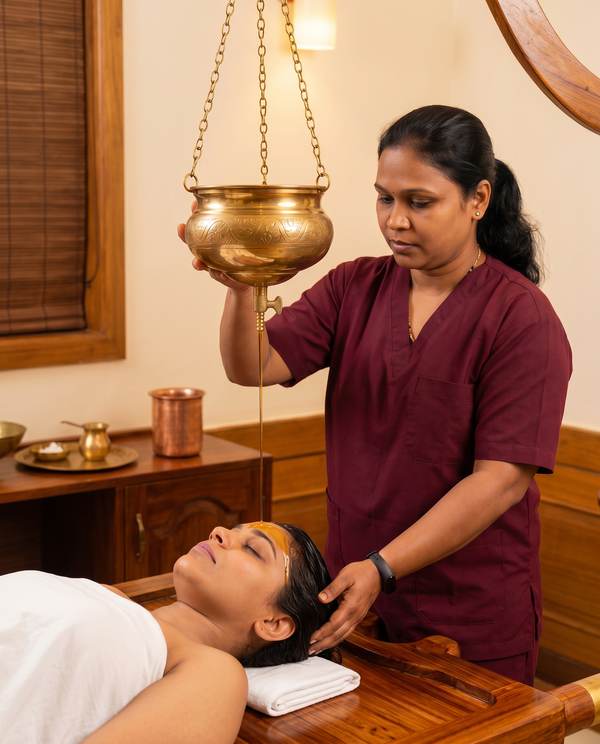
Shirodhara is a therapy in which warm, medicated oil, or occasionally a herbal decoction or a milk-based liquid, is poured in a slow, continuous stream over the forehead for a set duration.
The liquid is warmed and the stream kept steady using a special vessel suspended above the head. The session is usually followed by a short period of rest, so you leave calm rather than rushed. Among all ayurvedic treatments, it is the one people most often describe as deeply calming.
What Shirodhara is commonly used for
Shirodhara is most often sought for stress, worry, difficulty sleeping and general mental tiredness. Depending on the oil chosen, it is also used for certain headache and scalp-related concerns.
As with all ayurvedic treatments, the specific oil and duration are decided during your consultation, not fixed in advance. Some people benefit from a single session for relaxation, while long-standing stress or sleep concerns usually need a planned series.
See our dedicated page on Shirodhara treatment at Herbal Hills for more detail.
Which oils are used in Shirodhara?
The oil, or liquid base, is chosen for your constitution and the concern being addressed. A sesame-oil base infused with calming herbs is common for Vata-related stress, while other bases may be chosen for heat-related Pitta concerns. The exact formulation is part of what your consultation decides.
Herbal Hills uses more than 40 Ayurvedic oils across its therapies, which is why the oil you receive should never be a default choice.
If you have sensitive skin, allergies or a scalp condition, mention it before the session. The doctor can choose a gentler base, adjust the temperature of the oil or suggest a different therapy altogether. Small details like these are what separate a planned Ayurvedic session from a routine one.
How much does Shirodhara cost in Mumbai?
Shirodhara cost varies with the duration of the session, the oil or formulation used, and whether it is a single session or part of a longer plan. A consultation is the most reliable way to get a recommendation and a price that match the specific session suggested for you.
When comparing ayurvedic treatments on price, ask what is included: the consultation, the type of oil, the length of the session and any follow-up advice.
Potli massage: the warm herbal pouch therapy
Potli massage uses one or more warm cloth pouches, or potlis, filled with herbs, and sometimes rice or sand, pressed and massaged over the body. It is often used for muscle stiffness, joint discomfort and local tension.
The warmth and the herbs work together, and the technique differs from Abhyanga because the pouch itself, not just the hands, does much of the work. Potli massage and Abhyanga are sometimes combined in one session.
Types of Potli massage and their benefits
Several classical ayurvedic treatments use potlis, each with a different filling:
- Podikizhi, with warm herbal powders, often chosen for stiffness and heaviness.
- Elakizhi, with fresh medicinal leaves, often chosen for joint stiffness.
- Navarakizhi, with medicated rice cooked in milk and herbs, often chosen for nourishment.
- Manalakizhi, with warm sand, often chosen for local pain and stiffness.
The benefits people most often report from Potli massage are easier movement, less local tension and a pleasant, deep warmth. Which type suits you depends on whether your concern is dry and stiff or heavy and swollen, something your doctor assesses.
Basti: more than one meaning
Basti refers to medicated enema therapy, most closely associated with Panchakarma, where it is one of the five classical therapies. It is considered especially important for Vata-related imbalances.
But Basti is not only given as part of a full multi-day programme. Certain protocols, including Niruha Basti, which uses a herbal decoction, are also used as standalone or shorter-course ayurvedic treatments for specific concerns, under a doctor’s supervision.
See our dedicated page on Niruha Basti treatment for a detailed explanation.
Kati Basti, Janu Basti and Greeva Basti are different
The word Basti is also used for a separate group of external ayurvedic treatments. In these, a ring of dough is placed on one part of the body and filled with warm medicated oil, which is held there for a set time.
- Kati Basti for the lower back.
- Janu Basti for the knees.
- Greeva Basti for the neck.
These are not enemas. They are local oil therapies, commonly used for stiffness and discomfort in that area, and they are often what people mean when they ask about Basti for back or knee concerns.
Leech therapy (Raktamokshana): a selective therapy
Leech therapy is a form of Raktamokshana, a classical blood-letting therapy, used selectively for certain skin and circulation concerns under medical supervision.
It is one of the more specific ayurvedic treatments people search for by name, usually because someone has suggested it for a particular concern rather than as a general wellness option. That is exactly why a doctor consultation, not a menu, should be the way anyone arrives at this therapy. Read more about leech therapy at Herbal Hills.
Panchakarma: when several therapies work together
Panchakarma is a planned programme that combines several ayurvedic treatments: preparation with internal and external oleation (Snehana) and herbal steam (Swedana), followed by one or more of the five classical therapies, Vamana, Virechana, Basti, Nasya and Raktamokshana, and then diet guidance to protect the benefit.
It is chosen for deeper or long-standing concerns, or as a doctor-supervised reset. Not everyone needs it, and not everyone needs all five therapies. Our guide to Panchakarma treatment in Mumbai explains what a real programme includes.
Which therapy suits a first session?
| If your main concern is | The therapy often considered | Notes |
|---|---|---|
| General wellness, circulation, routine self-care | Abhyanga | A common first session |
| Stress, worry, difficulty sleeping | Shirodhara | Oil and duration decided at consultation |
| Muscle stiffness, local tension | Potli massage | Often combined with Abhyanga |
| Lower back, knee or neck stiffness | Kati, Janu or Greeva Basti | Local oil therapies, not enemas |
| Deeper Vata-related concerns | Basti, such as Niruha Basti | Standalone course or part of Panchakarma |
| Deeper, multi-concern cleansing and rejuvenation | A full Panchakarma programme | Planned and supervised by a doctor |
This table is a starting point for a conversation with your doctor, not a substitute for one. The same concern can point to different ayurvedic treatments depending on your constitution and history.
What is the best Ayurvedic treatment?
There is no single best Ayurvedic treatment for everyone. The best choice is the one matched to your constitution, your current imbalance and your goal, whether that is relaxation, better sleep, easier movement or a deeper reset.
A centre that recommends the same therapy to every visitor is selling a menu, not planning your care. Good ayurvedic treatments start with questions about you, not with a price list.
One or two sessions, or a planned course?
One or two sessions of Abhyanga or Shirodhara can leave you relaxed and refreshed, and that is valuable in a busy Mumbai week. But for long-standing stress, poor sleep, stiffness or sluggish digestion, a single session rarely makes a lasting difference.
That is where a planned course of ayurvedic treatments helps: a series of therapies, the right oils, diet and routine guidance, and follow-up visits so the doctor can adjust the plan as you respond.
Common myths about ayurvedic treatments
Myth: all ayurvedic treatments are just different massages. Massage is only one part of Ayurveda. Shirodhara, Basti, leech therapy and Panchakarma work in quite different ways and serve different purposes.
Myth: if it is herbal, it suits everyone. Herbs and oils have specific properties. An oil that calms one person may not suit another, which is why the doctor chooses it after assessing you.
Myth: Panchakarma is the strongest option, so it must be the best. Panchakarma is valuable when it is needed, but many people do well with simpler ayurvedic treatments and good daily habits.
Myth: you need to know the therapy name before you book. You only need to know your concern. Choosing the therapy is the doctor’s job.
What to expect after a session
After most oil-based ayurvedic treatments, people feel relaxed, warm and sometimes a little sleepy, so it helps to plan a quiet few hours. The doctor may suggest a warm bath after some time, light and warm food, and an early night.
Some therapies, such as Basti or the core Panchakarma steps, come with specific diet and rest instructions. Following them carefully is part of the therapy, not an optional extra.
Is it safe to choose a therapy on your own?
Relaxing therapies like Abhyanga are generally gentle, but some ayurvedic treatments, especially Basti, leech therapy and the core Panchakarma therapies, need medical supervision and are not suitable for everyone.
Tell the doctor about any diagnosed condition, pregnancy, recent illness or regular medicines. Continue any medical care alongside Ayurvedic therapy, not instead of it, and never stop a prescribed medicine on your own.
How to prepare for your first therapy
- Have a light meal a couple of hours before, rather than arriving very full.
- Wear comfortable clothes and allow time to rest after the session.
- Bring a list of your current medicines and any recent reports.
- Plan to avoid a cold shower or heavy exercise straight after oil therapies.
- Ask the doctor what to eat and how to rest for the rest of the day.
These simple steps help you get more from whichever ayurvedic treatments are recommended.
Start with the concern, not the name
If you have come across Shirodhara, Basti or Potli by name and are not sure whether it is right for you, that is exactly what a consultation is for. Our doctors match ayurvedic treatments to your concern, so you do not need to arrive already knowing the terminology.
You can also browse the full list of Ayurvedic therapies at Herbal Hills to see what is available across our centres, or read about our approach to authentic Ayurvedic treatment in Mumbai.
Frequently asked questions
Some of the most common ayurvedic treatments are Abhyanga (warm oil massage), Shirodhara (warm oil poured over the forehead), Potli massage (warm herbal pouches), Basti (medicated enema or local oil therapies) and Panchakarma, a planned programme combining several therapies.
Shirodhara is a therapy in which warm, medicated oil is poured in a slow, continuous stream over the forehead for a set duration, commonly used for stress, worry and difficulty sleeping, followed by a period of rest.
Cost depends on the duration, the oil or formulation used, and whether it is a single session or part of a longer plan. A consultation gives you a recommendation and a price matched to the session suggested for you.
Yes. Potli massage uses warm herbal pouches pressed and massaged over the body, often for muscle stiffness and local tension, whereas Abhyanga is a full-body hand massage with warm oil. The two are sometimes combined in one session.
No. Basti is one of the five classical Panchakarma therapies, but certain protocols such as Niruha Basti are also used as standalone or shorter courses. Kati, Janu and Greeva Basti are different again: they are local oil therapies, not enemas.
Book a doctor consultation first through the website. The specific therapy, oil and duration are confirmed after the doctor assesses you, rather than booked directly from a fixed menu.
This article is for general education and does not replace medical advice. Ayurvedic therapies and medicines at Herbal Hills are planned by qualified doctors after a personal consultation.
Find a Herbal Hills centre near you
A doctor can assess you, explain which therapy suits you and plan the right number of sessions. Herbal Hills has five centres in Western Mumbai, in Juhu (Andheri West), Goregaon West, Kandivali West and two in Borivali West, open Tuesday to Sunday, 10 am to 7 pm. Find your nearest centre.
Find the therapy that is right for you.