
Stiff Is Not Old. Stiff Is a Warning.

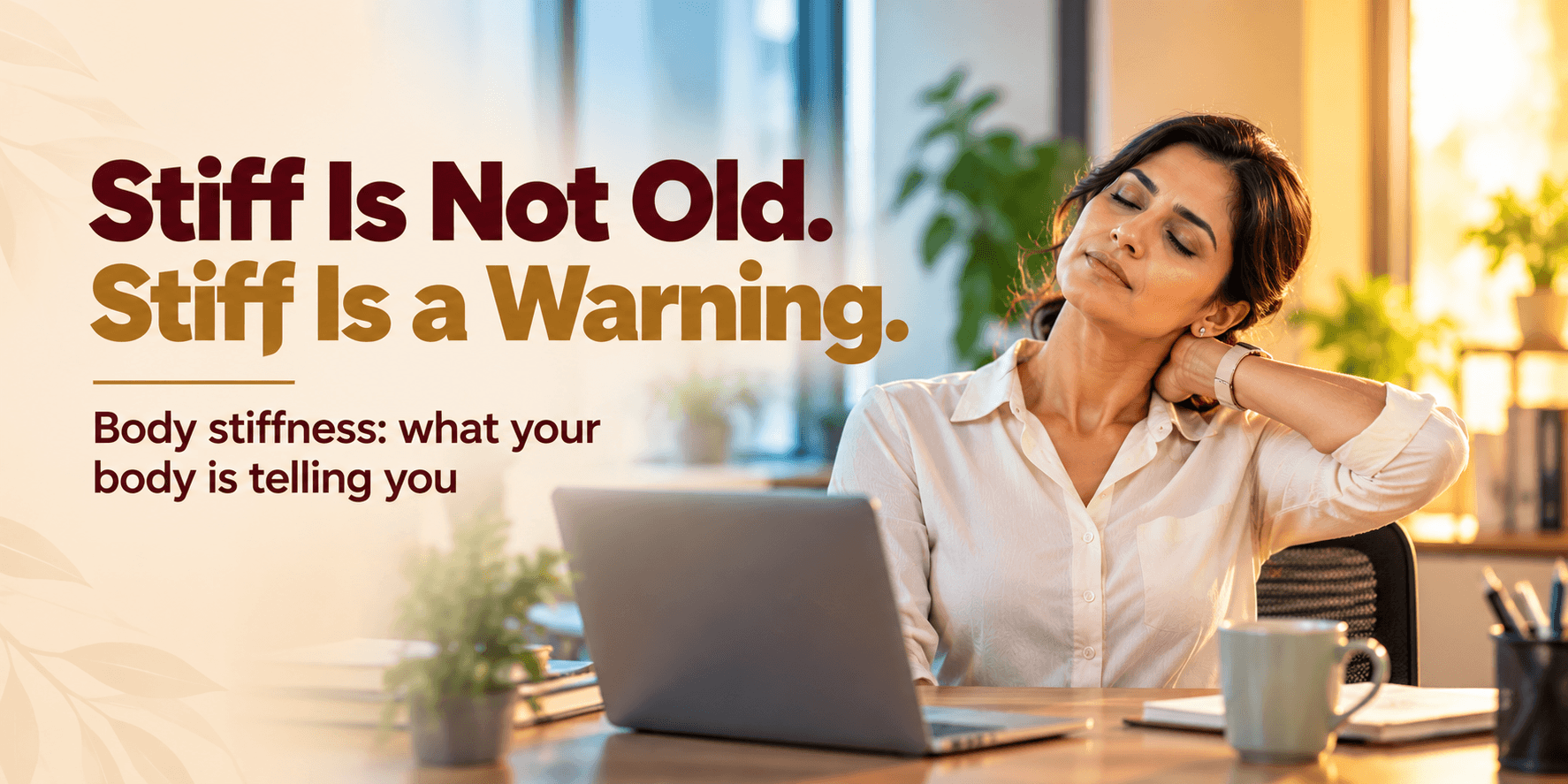
Why you should never ignore body stiffness: how it leads to muscle spasms and a vicious circle of joint problems, and how Ayurvedic oil therapies restore flexibility
You notice it in small moments. Bending to tie a shoelace takes a little more effort. The first steps out of bed feel wooden. After a weekend game, a calf muscle suddenly cramps and refuses to let go. Most of us shrug and say the same thing: “It will go away on its own.” Sometimes it does. Often, it quietly settles in. Your body doesn’t creak without a reason.
Quick answer: Body stiffness is a signal that muscles, joints or connective tissue have lost some of their natural suppleness, usually because of too little movement, long sitting, cold, poor sleep or strain. Ayurveda identifies two distinct types: a dry, tight stiffness driven by Vata, and a heavy, sluggish stiffness linked to Ama. Each needs a different treatment. Noticing stiffness early, and acting on it, is the first step to moving freely again.
Will body stiffness go away on its own?
Occasional stiffness after a long flight or an unusual workout usually does settle within a day or two. Stiffness that keeps returning, every morning, after every meeting, after every game, does not. Ignored stiffness doesn’t leave. It settles in.
“It will go away on its own” may be the most expensive sentence in joint care. Each week of waiting allows muscles to shorten a little more and joints to lose a little more of their natural ease, until the problem is no longer stiffness but pain. That is why the single most important step is awareness. Awareness is the first therapy: the moment you notice your body has become stiffer than it used to be is the best moment to act, because it is the moment when restoring flexibility is easiest.
Listen for the early signals. Needing your hands to get up from the floor. Calves that tighten at night. A neck that won’t turn fully when you reverse the car. Joints that crack every time you stand. A reach that has quietly become shorter. None of these is an emergency. All of them are invitations to act before the body has to shout.
How does ignored stiffness turn into a vicious circle?
Stiffness rarely stays stiffness. It starts a chain reaction. A stiff body moves less, because movement feels uncomfortable. Moving less makes muscles tighter and weaker, especially in the calves, thighs and lower back. Tight, weak muscles are prone to spasms and cramps, so the next walk or workout ends early, or doesn’t happen at all. With less activity, weight creeps up, joints carry more load with less muscle support and less natural lubrication, and the stiffness returns stronger than before.
Stiffness stops you moving; not moving makes you stiffer. Round and round it goes, until a simple morning walk feels like a challenge and the conversation shifts from flexibility to joint problems. The good news is that every circle has a first link. Break the circle at the first link, not the last, and the whole chain loosens with it.
Why does my body feel stiff in the morning?
Overnight, you lie still for hours. Muscles shorten slightly, circulation slows and the fluid that cushions your joints settles. For most people, a few minutes of movement shakes this off. When it takes longer, or when the stiffness returns after every long meeting or car journey, the body is telling you something has shifted.
Modern life makes it worse. A study in The Lancet Global Health, one of the world’s most respected medical journals, found that nearly half of Indian adults did not get enough physical activity in 2022, more than double the share in 2000. The body you don’t move is the body you lose. A stiff morning is a message, not a mood.
Why do muscles spasm after exercise?
A muscle spasm is a sudden, involuntary tightening of a muscle that does not release on its own. After exercise, the usual culprits are fatigue, a skipped warm-up, dehydration, and muscles that were already tight before you started. They are especially common when people return to sport after a long gap, or push hard on the weekend after a week at the desk.
Occasional spasms are usually harmless. But spasms that keep returning, cause severe pain, follow an injury or come with numbness, weakness, swelling or fever need a doctor’s attention, and chest pain always needs urgent care. Your body speaks softly before it shouts; frequent spasms are it raising its voice. Very often, the whisper it ignored was stiffness.
What are the two kinds of stiffness in Ayurveda?
This is where Ayurveda offers something most approaches miss. Two people can say “I feel stiff” and mean opposite things.
The first is Vata stiffness, the dry kind. Vata carries the qualities of dryness, cold and movement. When it is aggravated, by age, cold air-conditioning, irregular routines, overexertion or poor sleep, it dries the body’s natural lubrication. This stiffness feels tight and brittle, often with cracking joints, and it is worst in the morning and in cold weather. Tellingly, it feels better with warmth, oil and gentle movement.
The second is Ama stiffness, the heavy kind. Ama is Ayurveda’s term for residue left by weak digestion, which is believed to clog the body’s channels. This stiffness feels dull, heavy and sometimes puffy rather than tight. It is often worse after heavy or late meals, comes with sluggishness and a coated tongue, and does not improve much with oil. In fact, Ayurveda teaches that applying heavy oils too early can make this type worse.
Warm oil for a dry joint, dry heat for a heavy one. Getting this distinction right is the difference between relief and frustration, and it is exactly what an Ayurvedic doctor assesses in the first consultation.
Which Ayurvedic therapies restore movement?
Loosen before you lose it. Ayurveda’s answer to stiffness is hands-on and deeply practical: warm, skilled massage and heat that unlock tight tissues and give joints back their natural glide. For dry, Vata-type stiffness, the classical answer is to bring back warmth and lubrication. Sarvanga Abhyanga, a full-body massage with warm medicated oils, nourishes tight tissues, and is usually followed by Nadi Swedan, a herbal steam that helps the oils penetrate and the muscles release. For deeper stiffness, Elakizhi uses warm boluses of medicinal leaves pressed rhythmically over stiff areas.
For heavy, Ama-type stiffness, the approach reverses. Udvartana, a vigorous massage with dry herbal powders, is traditionally used to reduce heaviness and stimulate circulation, while Podikizhi, a herbal powder bolus therapy, brings dry warmth to stiff, sluggish joints. Once the heaviness lifts, oil therapies can follow.
In both cases, therapies are supported by attention to digestion, sleep and routine, and by doctor-prescribed herbal medicines where needed, because Ayurveda treats stiffness as a whole-body pattern, not just a sore spot.
What simple daily habits keep the body flexible?
Therapies restore movement. Habits keep it. A few minutes a day matters more than an hour once a month. Flexibility isn’t about touching your toes; it’s about tying your shoes easily at 70.
- Move within 10 minutes of waking, with gentle neck rolls, shoulder circles and ankle rotations before you even leave the bed.
- Break up sitting every 30 to 45 minutes; stand, stretch or walk for two minutes.
- Do a short flexibility routine daily, such as cat-cow, hamstring stretches and hip openers, or a few rounds of Surya Namaskar if your doctor approves.
- Warm up for five to ten minutes before any sport, and cool down afterwards.
- Keep warm in air-conditioned offices, especially the neck, lower back and knees.
- Eat dinner early and lightly, since late, heavy meals are a classic Ama trigger.
- Try a short self-massage with warm sesame oil before your bath a few times a week, if your stiffness is the dry kind.
When does stiffness need a doctor?
Most everyday stiffness responds to movement and good habits. See a doctor if morning stiffness lasts longer than about 30 minutes, if joints are swollen, red or warm, if stiffness keeps worsening over weeks, if it follows an injury, or if it comes with fever, unexplained weight loss, numbness or weakness. These can point to inflammatory or other conditions that need proper diagnosis.
Frequently asked questions
Occasional stiffness after unusual activity often settles in a day or two. Stiffness that keeps returning usually does not, and tends to worsen as muscles shorten and joints lose ease. Recurring stiffness is best treated early, with daily movement and, where needed, Ayurvedic oil therapies, before it leads to spasms, pain and reduced activity.
Morning stiffness usually comes from hours without movement, which lets muscles tighten and joint fluid settle. Cold rooms, long sitting the day before, dehydration and poor sleep make it worse. In Ayurveda it is commonly linked to aggravated Vata. Stiffness that lasts more than about half an hour, or comes with swelling, should be checked by a doctor.
Ayurveda distinguishes dry stiffness, driven by Vata, which feels tight, cracking and better with warmth and oil, from heavy stiffness, linked to Ama, which feels dull, swollen and sluggish, often worse after heavy meals. The difference matters because they need almost opposite treatment, which is why a doctor assesses you first.
Occasional spasms after exercise are common and often linked to fatigue, tight muscles, dehydration or skipping the warm-up. See a doctor promptly if spasms are frequent, very painful, follow an injury, or come with numbness, weakness, swelling, fever or chest pain, as these can signal a problem that needs medical attention.
For dry, Vata-type stiffness, doctors often use Sarvanga Abhyanga with Nadi Swedan or Elakizhi, which bring warmth and oil to tight tissues. For heavy, Ama-type stiffness, dry therapies such as Udvartana and Podikizhi are used first. The right choice depends on your assessment, so therapies are always planned after a consultation.
Yes. Gentle daily movement is one of the best long-term answers to stiffness. Short mobility routines, regular stretching, yoga and walking keep muscles supple and joints nourished. If stiffness makes exercise painful, Ayurvedic therapies can ease the tissues first, making it easier to build and keep a regular movement habit.
This article is for general education and does not replace medical advice. Persistent, severe or worsening stiffness or spasms should be assessed by a qualified doctor. Ayurvedic therapies at Herbal Hills are planned by qualified doctors after a personal consultation.
Two people, the same complaint, opposite treatments
At Herbal Hills, our doctors often meet two people on the same morning with the same words: “I feel stiff.” One is a lean marketing head who sleeps five hours, lives in an air-conditioned office and cracks every joint when she stands up. The other is a cheerful businessman who loves late dinners, feels heavy by evening and wakes up puffy and slow. Same word, opposite bodies, and very different plans.
That is why every program starts with a consultation and Nadi Parikshan, not a menu. For dry, Vata-type stiffness, our Santulana program is designed to bring Vata back into balance through warming oil therapies, steam and routine. For muscles that tighten and ache after work or sport, Vishrama focuses on relief and release. For heaviness and Ama, our doctors begin with Udvartana and Podikizhi before moving to oils. And if your stiffness is part of a bigger plan, such as returning to sport or trekking, our guide to preventive joint care after 50 shows how we build care around your goals.
For Western Mumbai’s air-conditioned offices and long commutes
Few lifestyles are as hard on the body as a Mumbai workday: hours in a chilled office, the same posture at the desk, then a long ride home on the Western line or through traffic. Ayurveda would call it a perfect recipe for Vata. Herbal Hills has five Ayurvedic wellness centres along this route, from Juhu to Borivali, in Juhu, Andheri West, Goregaon West, Kandivali West and Borivali West, so relief can be a short detour rather than a day off. Find your nearest centre.
Stiff Is Not Old. Stiff Is a Warning.
Stiffness won’t wait for you to notice it, so notice it first. Book your consultation today or call +91 90710 81231, break the circle at the first link, and find out which kind of stiff you are before it decides how you move.