
Days Follow the Doctor

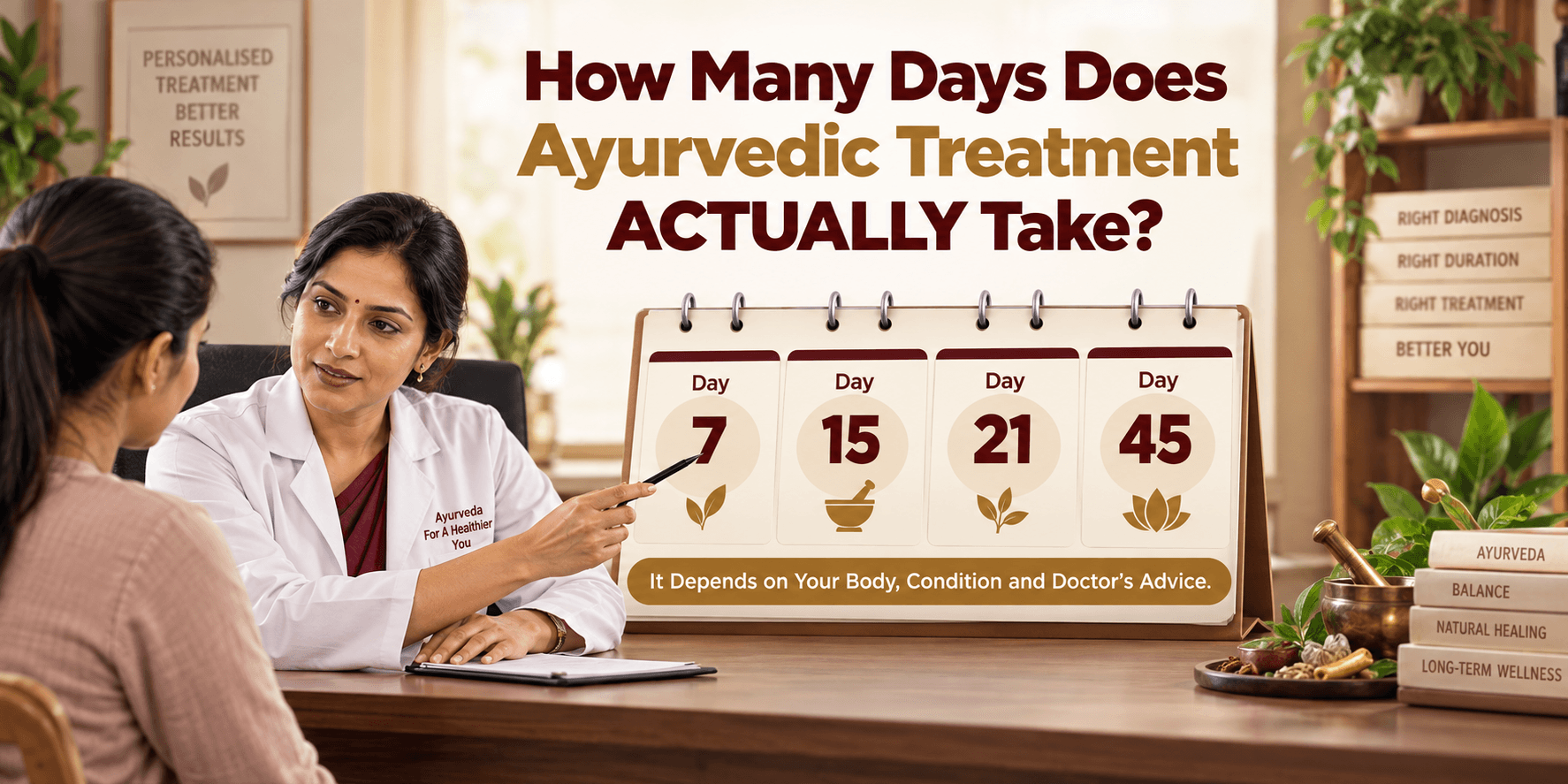
How Many Days Panchakarma Treatment Takes: What 7, 15, 21 and 45 Days Mean, the Three Classical Phases, and How to Plan Your Programme
How many days Panchakarma treatment takes has no single fixed answer: it depends on your body, your health condition and your goals, and the number of days should follow the doctor’s assessment, not the other way round. Programmes of 7, 15, 21 or 45 days are common, but each one means something different. This guide explains what those numbers usually mean, the three classical phases of Panchakarma in plain words, why two people get different durations, and the options at Herbal Hills. It ends with practical planning tips.
The short version
- There is no fixed number of days that suits everyone.
- Shorter programmes of about 7 days often suit relaxation or a first introduction.
- Longer plans of 15, 21 or 45 days are usually for specific health goals.
- Every Panchakarma has preparation, main procedures and after-care.
- Your assessment, condition, strength, season and response decide the days.
- At Herbal Hills, options include the 5 Days Panchakarma Package and one-month packages.
- Book a consultation first, then the calendar.
How many days Panchakarma treatment takes: the honest answer
Almost every patient asks the same question at the first visit: how many days of Panchakarma will I need? It is a fair question.
The honest answer is that how many days Panchakarma treatment takes is decided after the doctor understands you. Ayurveda believes treatment should be personalised, not standardised. A number chosen before the assessment is only a guess.
Why there is no fixed number of days
Think about two people visiting the same doctor. One wants to feel more relaxed and reset a busy routine. The other has been living with a health concern for several years.
Should both receive the same treatment for the same number of days? Probably not. That is why the first step is always understanding the person, before deciding the plan.
What Panchakarma actually is
Panchakarma means five actions. It is a group of classical Ayurvedic procedures used to support the body’s natural balance, always planned and supervised by a doctor. The best-known are Vamana, Virechana, Basti and Nasya.
Panchakarma is not one fixed treatment. For background on Ayurveda as a whole, see the NCCIH overview of Ayurvedic medicine.
The three classical phases in plain words
Classical Panchakarma has three phases, and each one takes time:
- Purvakarma: preparation, with oleation and sweating.
- Pradhanakarma: the main procedures chosen by the doctor.
- Paschatkarma: after-care, with a gradual return to normal food.
When people ask how many days Panchakarma treatment needs, they often count only the main procedure. In reality, all three phases together make up the programme.
Phase 1: Purvakarma, the preparation
Purvakarma prepares the body for the main procedure.
Snehana, or oleation, uses medicated oils or ghee, either as massage on the skin or, when advised, taken by mouth in measured amounts. Swedana, or sweating, uses herbal steam or warmth to help the body relax and loosen.
The doctor decides how many days of preparation you need. It can vary from person to person.
Phase 2: Pradhanakarma, the main procedures
Pradhanakarma is the main procedure. The doctor chooses it according to your assessment. Common examples include:
- Vamana, a classical procedure usually linked with Kapha.
- Virechana, a guided purgation usually linked with Pitta.
- Niruha Basti and other Basti procedures, usually linked with Vata.
- Nasya, the nasal application of medicated oils.
Not everyone needs all of these.
Phase 3: Paschatkarma, the after-care
Paschatkarma is the after-care phase. After the main procedure, digestion is thought to be delicate for a while, so food is reintroduced step by step.
This usually means starting with thin, light preparations and slowly moving back to normal meals over several days. This phase is easy to skip in a busy life, but Ayurveda treats it as part of the treatment itself.
Why after-care counts as treatment time
Many people plan only for the days at the centre, then return straight to office lunches and late dinners. The days after the main procedure are when the body settles. So when you think about how many days Panchakarma treatment takes, add the after-care days to your plan, even if you spend them at home following the doctor’s diet.
Panchakarma treatment duration: what 7, 15, 21 and 45 days usually mean
| Length | What it usually means |
|---|---|
| About 7 days | Relaxation, stress management or a first introduction to Ayurveda |
| About 15 days | More time for personalised therapies, diet and healthier routines |
| About 21 days | A fuller programme with regular supervision |
| About 45 days | Long-standing health concerns or specific goals, as advised by the doctor |
These are general patterns, not rules.
What a 7-day programme usually means
A programme of about 7 days is often used for relaxation, stress relief or a gentle first experience of Ayurveda. It may include oil massage, herbal steam and a few focused therapies, with diet guidance.
If you are asking how many days Panchakarma treatment you need just to relax, this may be enough. But the doctor may feel a classical main procedure needs more preparation and after-care than 7 days allows.
What 15 and 21 days usually mean
Programmes of about 15 or 21 days give more room for all three phases. There is time for proper preparation, the main procedure the doctor selects, and a steady return to normal food.
They also allow the doctor to watch your response and adjust the plan as you go. People with a specific health goal are more often advised this length.
What 45 days usually means
Longer programmes of around 45 days are usually reserved for long-standing health concerns or specific wellness goals identified during the consultation. They may combine more than one main procedure, with longer preparation and after-care, and regular reviews.
A longer programme is not automatically better. It is only useful when the doctor feels your body needs that much time, and when you can follow the diet and routine throughout.
What decides how many days Panchakarma treatment takes
- Assessment: your Prakriti, current imbalance and Nadi Parikshan findings.
- Condition: what you are dealing with and for how long.
- Goals: general wellness or a specific concern.
- Strength: your age, energy and how much your body can comfortably handle.
- Season: some procedures suit certain times of year better.
- Response: how your body reacts as the plan goes on.
Each of these can lengthen or shorten the plan.
Why two people get different durations
Two friends may book together and still be advised different plans. One may need a short programme of external therapies. The other may need longer preparation before a main procedure such as Virechana or Basti.
This is not inconsistency. It is the point of Ayurveda. The right length depends on your body, your goals and the doctor’s judgement.
The consultation comes before the calendar
During the consultation, the doctor asks about your health concerns, daily routine, eating habits, sleep, stress, medical history and current medicines. They also look at your constitution, or Prakriti, and your current imbalance, or Vikriti.
At Herbal Hills, this is a free doctor consultation for proper diagnosis, including Nadi Parikshan. Only after this does the doctor suggest a plan and how many days Panchakarma treatment should take for you.
Can you choose the number of days yourself?
You can share your limits openly: how much leave you have, when you can travel and what fits your family life.
But the doctor should still decide whether a plan is safe and useful within that time. If your available days are too short for the procedure you need, the doctor may suggest a gentler plan now and a fuller programme later. That is usually wiser than rushing.
Is a shorter Panchakarma duration less useful?
Not necessarily. A shorter Panchakarma duration that is well planned and followed carefully can be more helpful than a long one done in a hurry.
What matters is that the plan fits your needs, that preparation and after-care are respected, and that you follow the diet and routine. A few well-chosen days may suit a first-time visitor, while a longer plan may suit a long-standing concern.
Panchakarma options at Herbal Hills
Herbal Hills offers a few structured ways to begin, all planned after a free doctor consultation:
- Individual therapies for a specific need.
- Signature therapies for relaxation and balance.
- The 5 Days Panchakarma Package, with 8 sessions over 5 days.
- One-month Health Packages and Detox Pro packages for longer, doctor-supervised plans.
The doctor helps you choose the option that fits your assessment, your goals and your time.
The 5 Days Panchakarma Package
The 5 Days Panchakarma Package includes 8 sessions over 5 days. It suits people who want a focused, short programme and whom the doctor feels are suitable for it.
The doctor plans which procedures are used, explains the preparation and tells you what to eat during and after the five days. It is a practical first step for many people.
One-month Health Packages and Detox Pro
For people with longer-standing concerns, the doctor may suggest a one-month plan. The Detox Pro Therapy Package includes consultations and follow-up, personalised therapy sessions spread across the month, and diet and lifestyle guidance.
One-month Health Packages follow the same idea, with the medicine kit included where the doctor prescribes one. Spreading sessions across a month can be easier for working people than taking many days off at once.
Comparing the Herbal Hills options
| Option | Length | Usually suits |
|---|---|---|
| Individual or Signature therapies | Single sessions | A specific need or relaxation |
| 5 Days Panchakarma Package | 8 sessions over 5 days | A focused, short programme |
| Detox Pro Therapy Package | One month | Longer-standing concerns |
| One-month Health Packages | One month, medicines included | Longer plans with prescribed medicines |
Your doctor confirms which one fits and how many days Panchakarma treatment should take in your case.
Planning leave and work
Once the doctor has told you how many days Panchakarma treatment will take, look at your calendar honestly. Some procedure days and the days just after them are best kept light, with no heavy meetings, late nights or long drives.
Ask the doctor which days need the most rest. Many people find it easier to take leave for those days and work lighter hours on the others.
Travel and rest days
Avoid planning long journeys, flights or late-night events in the middle of a programme or soon after the main procedure. Travel disturbs sleep, meals and digestion.
If you are coming from outside Mumbai, plan to stay nearby for the key days. Leave a few quiet days at the end for after-care, rather than travelling home straight away.
What to eat during the programme
Diet is part of the treatment, not an extra. During most programmes, the doctor advises warm, light, freshly cooked food, such as khichdi, soups and simple dal and rice, at regular times.
Usually you will be asked to avoid heavy, fried, very spicy or packaged food, cold drinks, alcohol and late dinners. Follow your own doctor’s diet.
After the programme ends
The last therapy session is not the end. Food is brought back slowly, usually from thin preparations to normal meals over several days, as the doctor advises.
Keep up the routine changes that helped: earlier dinners, regular sleep and gentle movement. When you count how many days Panchakarma treatment takes, include these days too. Rushing back to old habits is one of the most common reasons people feel the benefit fades.
Myths about how many days Panchakarma treatment takes
Myth: Longer is always better
Fact: The right length is the one your body needs, not the longest one available.
Myth: Everyone needs 21 days
Fact: Many people are advised shorter plans, and some need no Panchakarma at all.
Myth: The treatment ends on the last session
Fact: After-care and gradual return to normal food are part of the programme.
Myth: You can pick a package online and skip the consultation
Fact: Assessment comes first.
When to see a doctor first
Panchakarma is a supervised treatment, not a quick wellness break. Speak to your doctor before booking if you are pregnant or breastfeeding, elderly or frail, recovering from illness or surgery, or living with heart, kidney, liver or lung disease, diabetes or high blood pressure.
Never stop a prescribed medicine to begin Ayurvedic treatment. New, severe or unexplained symptoms, such as chest pain, breathlessness or weight loss, need modern medical care first.
Questions to ask before you book
- What does my assessment show, and why is this plan suited to me?
- Which phases and procedures are included?
- Which days need the most rest?
- What should I eat before, during and after?
- How will you review my progress?
- Do I need any medical tests first?
For more ideas, read 5 important questions before starting Ayurvedic treatment.
Key takeaways
- How many days Panchakarma treatment takes depends on you, not on a fixed package.
- 7, 15, 21 and 45 days are common patterns, each with a different purpose.
- Preparation, main procedures and after-care all count as treatment time.
- Assessment, condition, goals, strength, season and response decide the length.
- At Herbal Hills, start with a free consultation, then choose between short and one-month options.
Frequently asked questions
How many days Panchakarma treatment takes has no fixed answer. Programmes of about 7, 15, 21 or 45 days are common, but the right length depends on your assessment, health condition, goals, strength, season and response. The doctor decides the duration after a consultation.
For relaxation, stress relief or a first introduction to Ayurveda, about 7 days may suit some people. For specific health goals, the doctor may advise a longer plan so there is time for preparation, the main procedure and after-care.
Purvakarma is preparation with oleation and sweating. Pradhanakarma is the main procedure, such as Vamana, Virechana, Basti or Nasya, chosen by the doctor. Paschatkarma is after-care with a gradual return to normal food.
Their bodies, health concerns, goals, strength and response are different. A plan that suits one person may be too short or too long for another, so the doctor sets the length for each person after assessment.
Options include individual and Signature therapies, the 5 Days Panchakarma Package with 8 sessions over 5 days, and one-month Health Packages and Detox Pro packages. All are planned after a free doctor consultation.
Most plans use warm, light, freshly cooked food such as khichdi, soups and simple dal and rice at regular times, and avoid heavy, fried, packaged or cold food. Follow the exact diet your doctor gives you.
This article is for general education and does not replace medical advice. Ayurvedic therapies and medicines at Herbal Hills are planned by qualified doctors after a personal consultation.
Find a Herbal Hills centre near you
A doctor can assess you, explain which phases and procedures suit you, and tell you how many days to plan for. Herbal Hills has five centres in Western Mumbai, in Juhu (Andheri West), Goregaon West, Kandivali West and two in Borivali West, open Tuesday to Sunday, 10 am to 7 pm. Find your nearest centre.
Let your health set the calendar.