
Panchakarma · Raktamokshana
Siravedh – Ayurvedic Bloodletting Therapy in Mumbai
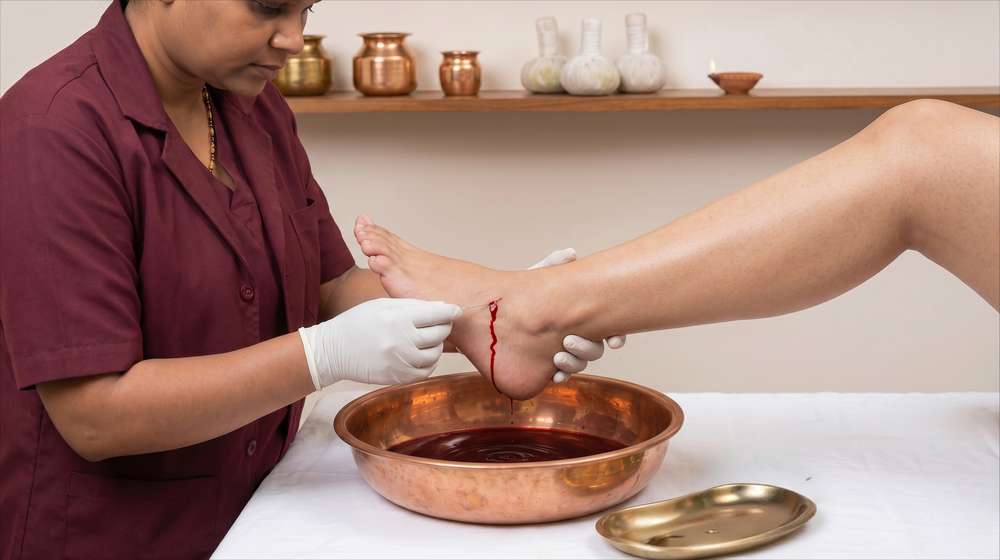
Siravedh (Siravyadha) is an Ayurvedic bloodletting procedure in which a small, controlled amount of blood is released from a vein under an Ayurvedic doctor’s supervision. Herbal Hills Center offers Siravedh bloodletting therapy in Mumbai after consultation with an Ayurvedic doctor; a session takes about 30 minutes.
Siravedh is not a routine therapy. This guide explains what it is, how it differs from leech therapy, how patients are selected, what happens during the procedure, aftercare and who should not have it.
Selected Cases Only
Siravedh is offered only after a careful medical assessment and informed consent. Many people who ask about it are advised a gentler option instead — that decision is part of good care.
⏱️
Duration
30 Mins
🏥
Session Type
In-Clinic
🩺
Performed Under
Doctor Supervision
📝
Requires
Assessment & Consent
What Is Siravedh?
Siravedh (also written Siravyadha) is a classical Ayurvedic procedure and one of the methods of Raktamokshana — letting out blood from an affected part of the body. A sterile needle is used to puncture a chosen vein, so a small, controlled amount of blood flows out into a collection vessel under supervision.
In Ayurveda, it is traditionally used where Pitta and Rakta (blood tissue) are thought to be disturbed, with symptoms such as local heat, burning, redness or heaviness. It is considered a more direct method than leech therapy and is reserved for selected cases.
At Herbal Hills, every Siravedh bloodletting therapy session is planned and supervised by an Ayurvedic doctor after a full assessment and informed consent.
How Siravedh Works in Ayurveda
Classical Ayurvedic surgery texts describe Siravyadha in detail — which veins may be used, how to prepare the person, how much blood may be let out and the signs to stop. They describe Raktamokshana as particularly suited to Pitta- and Rakta-related conditions, where removing a small amount of blood is thought to reduce local heat and congestion.
Today, these principles are combined with modern safety standards: sterile, single-use needles, careful patient selection, monitoring during the procedure and proper wound care. Your doctor explains what Siravedh can and cannot be expected to do before you decide.
What It Supports
What Siravedh Is Traditionally Used For
Ayurveda describes Siravedh as a way to reduce excess Pitta and Rakta locally. Results vary from person to person, and your doctor will explain what to expect in your case.
🔥
Local Heat & Burning
Including burning sensation in the feet and soles.
🩸
Rakta Imbalance
Where blood is thought to be disturbed in Ayurveda.
💧
Local Congestion
Heaviness or fullness in one area.
✨
Selected Skin Concerns
As part of a wider skin-care plan.
🦴
Selected Pain Concerns
Only after careful assessment.
⚖️
Pitta Balance
A classical Pitta-reducing procedure.
How It Works
The Siravedh Procedure, Step by Step
Whichever centre you choose for your Siravedh bloodletting therapy, the procedure follows the same five stages.
1
Assessment & Consent
Our Ayurvedic doctor assesses your strength, condition, medicines and overall health, explains the whole process and takes your informed consent.
2
Positioning
You may be seated, standing or lying down, depending on the area and what is most comfortable and appropriate.
3
Tying the Band
A soft cloth band is tied above the chosen area to make the vein easier to locate.
4
Vein Puncture & Bloodletting
Using a sterile needle, the vein is carefully punctured and a small, controlled amount of blood flows into a collection vessel.
5
Supervision & Aftercare
You are observed throughout. The site is cleaned and dressed, and you receive clear post-procedure advice. Duration: about 30 minutes.
How Patients Are Selected
Siravedh is not performed routinely. Before recommending it, the doctor considers your age, strength, digestion, blood counts if needed, blood pressure, medicines and the nature of your concern. Many people are advised gentler therapies first — such as diet, herbs, Virechan or leech therapy — and Siravedh is considered only if it is clearly appropriate.
Siravedh vs Leech Therapy
Both are forms of Raktamokshana, but they use different methods:
- Siravedh (this page) — a controlled venesection from a vein, done by a doctor. More direct, for selected cases.
- Leech therapy — medicinal leeches draw a small amount of blood slowly. The gentlest form.
Your doctor chooses the method — or neither — after examining you.
Siravedh Bloodletting Therapy in a Wider Plan
Siravedh bloodletting therapy is usually one part of a plan. Your doctor may combine it with Virechan (the main Panchakarma procedure for Pitta), cooling herbs and diet, and therapies for joints such as those in our Ayurvedic joint pain treatment in Mumbai. You can explore every therapy on our Ayurvedic therapies page.
Who Should Not Have Siravedh?
Siravedh is not recommended for people who are:
- Pregnant or breastfeeding.
- Anaemic, very weak or recovering from a major illness.
- Living with bleeding disorders or taking blood-thinning medicines.
- Living with low immunity, uncontrolled diabetes or heart conditions.
- Very young or very elderly, unless the doctor decides otherwise.
A full Ayurvedic consultation is required before any treatment. Siravedh supports your wellbeing alongside — never instead of — the care of your physician.
Siravedh Bloodletting Therapy in Classical Ayurveda
Acharya Sushruta, the classical authority on Ayurvedic surgery, described Siravyadha as “half of all treatment” for certain surgical conditions — in the same way that Basti is described as half of all treatment in internal medicine. He gave detailed guidance on which veins to use for which body areas, the right season (avoiding extreme heat and cold), the right time of day and the person’s preparation beforehand, often with oleation and mild heat.
He also listed the signs of correctly performed bloodletting, such as a feeling of lightness, easing of the local complaint and a clear, settled mind, and warned against letting out too much blood. These cautions are the reason modern practice limits Siravedh bloodletting therapy to carefully selected people and keeps the quantity small.
At Herbal Hills, our doctors follow this classical framework while applying modern standards of hygiene, consent and monitoring. In practice, this means Siravedh bloodletting therapy is offered rarely, explained fully and always done in a calm, controlled setting.
Siravyadha, Siravedha and Sira Vedha: What the Names Mean
You will find this therapy written in several ways, and they all describe the same classical procedure. “Sira” means a vein, and “vyadha” or “vedha” means piercing, so Siravyadha, Siravedha, Sira Vedha and the shorter Siravedh are simply different spellings of “vein puncture”. Classical texts use Siravyadha most often, while many clinics in Maharashtra and Gujarat use Siravedh or Siravedha.
All of these belong to Raktamokshana, the group of Ayurvedic methods for letting out a small amount of blood from an affected area. The gentler, non-instrument form of Raktamokshana uses medicinal leeches, which is explained on our leech therapy treatment page. Vein puncture is the more direct form, which is why the doctor reserves it for carefully selected people and explains why it has been chosen over leech therapy or another gentler option.
When you read about the Siravyadha procedure elsewhere, you may see different veins, quantities or timings mentioned. These details are always decided by the doctor for each person, according to classical guidance and your health, and are never something to try at home or outside a clinic.
In the classical texts, vein puncture sits within a wider plan rather than standing alone. The person is usually prepared for a few days beforehand with suitable food, rest and sometimes gentle oiling and warmth, and is given simple guidance on diet and routine afterwards. Our doctors follow the same idea: the procedure is one step in a plan that also includes diet, daily routine and, where useful, other therapies, all reviewed at follow-up visits.
For most people, the follow-up visit a few days later is as important as the procedure itself. The doctor checks the site, asks how you have felt since, reviews your energy, sleep and digestion, and decides together with you whether anything more is needed. Clear, written aftercare advice is given at every stage, so you always know what to expect and whom to call. You are also welcome to bring a family member to the consultation and the follow-up, so that they understand the plan too and can help you follow the advice at home.
Siravedh Today: Classical Practice and Modern Medicine
Modern medicine also uses controlled removal of blood, called therapeutic phlebotomy, but only for a few specific blood conditions diagnosed by a specialist, and always under that specialist’s care. The classical procedure is not a replacement for that treatment, and our doctors will not offer it in place of care you need from a haematologist or any other specialist.
What the two approaches share is caution. In both, the person is screened first, the quantity is small and measured, sterile single-use equipment is used, and blood pressure and wellbeing are watched before, during and after. At Herbal Hills, the doctor also reviews your recent blood reports and your medicines, especially blood thinners, before deciding.
If you have been told you need blood tests or a specialist review, please complete those first. Bring the reports to your consultation so the doctor can judge, with the full picture, whether a classical Raktamokshana method is suitable for you at all, or whether a gentler Ayurvedic therapy would serve you better.
Many people who ask about the procedure find, after a full consultation, that another approach suits them better. That is a normal and welcome outcome: the aim is the right care for you, not a particular procedure. Whatever is decided, you will leave the consultation with a clear explanation, written advice and a plan for what to do next.
What to Expect on the Day
Plan to arrive a little early, having eaten a light meal and taken your usual medicines unless the doctor has said otherwise. The doctor rechecks your blood pressure and general condition before starting. The procedure itself is short; most of the session is preparation, monitoring and rest. Bring someone with you if you would like support, and avoid booking anything strenuous for the rest of the day after Siravedh bloodletting therapy.
Aftercare: What to Expect
After the procedure, the site is pressed, cleaned and dressed. You may feel light or tired for a short while, so you are asked to rest before leaving.
- Keep the dressing clean and dry for the time advised.
- Drink water and eat a light, nourishing meal.
- Avoid strenuous activity, heavy lifting and very hot baths for the rest of the day.
- Contact the centre straight away if the site bleeds again, becomes red, hot or painful, or if you feel faint or unwell.
How Many Siravedh Sessions Are Needed?
Siravedh is usually done once, or occasionally repeated after an interval of weeks, depending on your condition and how you respond. Your Ayurvedic doctor decides whether further sessions are needed after reviewing you.
Why Choose Herbal Hills Center for Siravedh?
- Experienced Ayurvedic doctors dedicated to personalised care.
- Strict hygiene and sterile, single-use needles.
- Careful patient selection and individual evaluation.
- Classical Ayurvedic principles combined with modern safety standards.
- Emphasis on safety, comfort, informed consent and ethical practice.
Questions to Ask Before Agreeing to Siravedh
Because Siravedh is a minor invasive procedure, it is reasonable to ask questions before agreeing. Useful questions include:
- Why is Siravedh recommended for me rather than a gentler therapy?
- Who will perform the procedure, and who will be present?
- How much blood will be let out, and how will I feel afterwards?
- What should I do if the site bleeds again at home?
- Can I continue my current medicines?
Our doctors welcome these questions. Good Siravedh bloodletting therapy starts with a clear, unhurried conversation, and it is always your choice whether to proceed.
Choosing a Siravedh Centre in Mumbai
Look for a centre where an Ayurvedic doctor assesses you thoroughly, explains the procedure, takes your written consent, uses sterile single-use equipment and gives clear aftercare. At Herbal Hills, all five centres follow the same consultation-first standard, starting with a free Nadi Parikshan.
Ayurveda is a recognised system of medicine in India under the Ministry of AYUSH, and our doctors follow its classical principles.
Find Us
Siravedh Bloodletting Therapy in Mumbai: Our 5 Centres
Siravedh is offered only after a doctor’s assessment. Choose the location nearest to you and our team will confirm availability.
Herbal Hills Kandivali West
Unit No. 101, Maitri Swami Kripa, Mahatma Gandhi Cross Rd No. 3, Kamala Nagar, Kandivali West, Mumbai 400067
+91 88288 55200 · Tue–Sun
Herbal Hills Goregaon West
Office No. 1, Ground Floor, Swarupam, Plot No. 79, Jawahar Nagar Road No. 10, Goregaon West, Mumbai 400104
+91 86577 77967 · Tue–Sun
Herbal Hills Borivali West (L.T. Road)
Office No. A/102, 1st Floor, New Gopal Premises CHS, L.T. Road, 212 TPS Road, Borivali West, Mumbai 400092
+91 86575 55515 · Tue–Sun
Herbal Hills Borivali West (Yogi Nagar)
Rajkamal CHS, 1st Floor, Office No. 2, Next to Celebration Restaurant, Yogi Nagar, Borivali West, Mumbai 400092
+91 97696 26565 · Tue–Sun
Herbal Hills Andheri West (Juhu Lane)
G-3/4, Ground Floor, Bharat Apartment, C. D. Barfiwala Marg, Juhu Lane, Andheri West, Mumbai 400058
+91 86579 15422 · Tue–Sun
Common Questions
Frequently Asked Questions About Siravedh
In Ayurveda, Siravedh is traditionally used to reduce excess Pitta and Rakta, such as local heat, burning and congestion. It is recommended only for some conditions after careful evaluation.
No. Siravedh uses controlled bloodletting from a vein, while leech therapy uses medicinal leeches. Both fall under Raktamokshana, but use different methods.
Siravedh is generally well tolerated when performed under trained Ayurvedic doctors using sterile methods. Careful patient selection, consent and supervision are essential, and it is not suitable for everyone.
In Ayurveda, Siravedh is considered a targeted, controlled method of Raktamokshana, used to reduce what Ayurveda describes as disturbed Rakta in selected cases. It is not a general detox and is not offered routinely.
Siravedh is not recommended for pregnant women, people with anaemia, bleeding disorders, severe weakness, or low immunity. A full Ayurvedic consultation is required before starting treatment.
Some people feel light or tired for a short while afterwards. You are asked to rest, drink water and eat a light meal before leaving, and to avoid strenuous activity for the rest of the day.
Herbal Hills offers Siravedh, after a doctor’s assessment, at its centres in Mumbai: Kandivali West, Goregaon West, Borivali West (L.T. Road and Yogi Nagar) and Andheri West (Juhu Lane). Every plan starts with a free consultation with an Ayurvedic doctor.
Why Herbal Hills Center
Trusted by Thousands. Authentic Ayurveda.
🏆
20+ Years
of Excellence
👨⚕️
Qualified Doctors
Ayurvedic specialists
📍
5 Centres
Across Mumbai
💧
Fresh Herbal Oils
Every session
🔒
100% Private
Confidential care
Considering Siravedh? Talk to Our Doctors First
Each Siravedh session is planned carefully after a free Ayurvedic doctor consultation, based on your strength, condition and overall health. Book your Siravedh bloodletting therapy consultation at the centre closest to you.
Siravedh – Ayurvedic Bloodletting Therapy Free consultation at 5 Mumbai centres