
Ayurvedic Nasal & Respiratory Therapy
Dhum Paan – Ayurvedic Treatment for Nasal Congestion in Mumbai
Dhum Paan is an Ayurvedic treatment for nasal congestion in which smoke from a medicated herbal wick (Dhumavarti) is inhaled gently through the nose and breathed out through the mouth. At Herbal Hills Center in Mumbai, a session takes about 15 minutes and is planned by an Ayurvedic doctor after consultation.
Living with a blocked nose, sinus heaviness or recurrent colds? This guide explains how Dhum Paan works, the Dhum Paan therapy benefits described in Ayurveda, what happens in a session, who should avoid it and how it fits with Nasya and other therapies.
Why Kapha Matters
Ayurveda links a blocked nose, heavy head and thick mucus mainly to excess Kapha dosha in the head and chest. The warm, light, drying quality of herbal smoke is the classical opposite of Kapha.
⏱️
Duration
15 Mins
🏥
Session Type
In-Clinic
🌬️
Treatment Goal
Nasal Comfort
🔄
Sessions Needed
As Suggested by Our Doctor
What Is Dhum Paan?
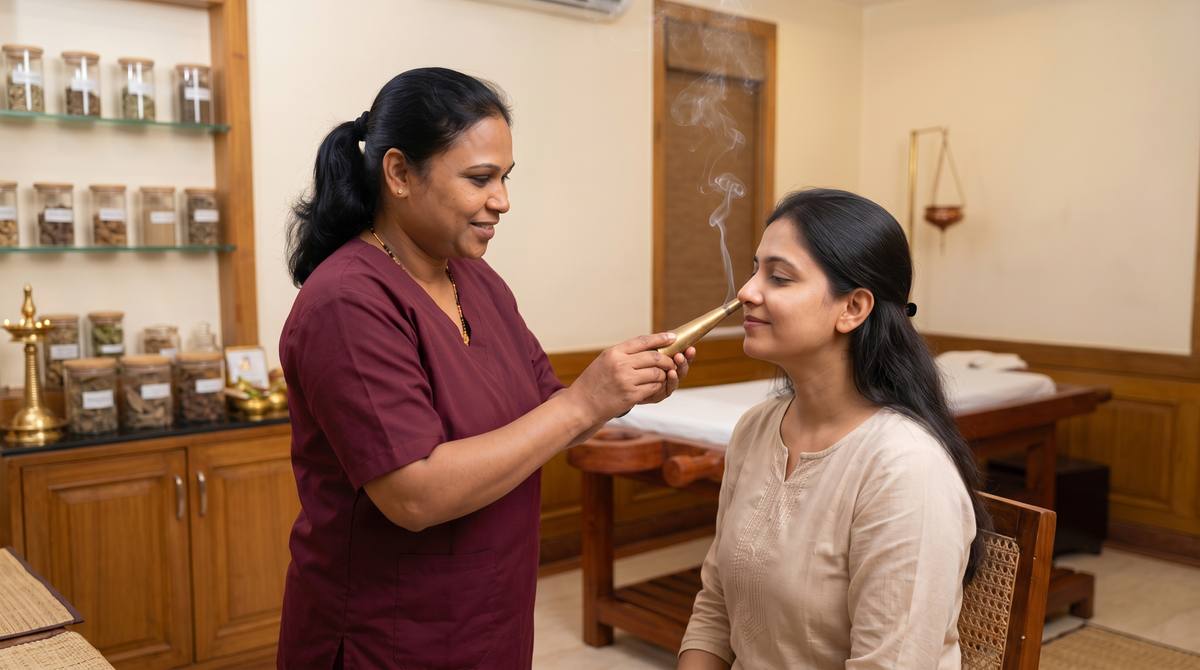
Dhum Paan (also written Dhoomapana) is a classical Ayurvedic therapy in which specially prepared herbal smoke — produced by lighting a Dhumavarti, or herbal wick — is gently inhaled through the nostrils using a pipe-like instrument called a Dhumanetra. The smoke is breathed out only through the mouth.
According to Ayurveda, nasal congestion, sinus heaviness and blocked breathing are mainly caused by excess Kapha dosha collecting in the head and chest. Dhum Paan is traditionally used to reduce this Kapha, loosen accumulated mucus and help clear blocked channels so breathing feels easier.
It is a short, focused therapy that is often combined with Nasya or other therapies. At Herbal Hills, every Ayurvedic treatment for nasal congestion begins with a doctor’s consultation.
How This Ayurvedic Treatment for Nasal Congestion Works
In classical Ayurveda, Dhum Paan is described as one of the daily and seasonal routines for keeping the head and throat clear, especially after Nasya, after a bath or after meals in Kapha seasons. The herbs used are aromatic and warming, and the smoke is meant to reach the nose, sinuses and throat lightly.
The direction of breathing matters. You inhale through the nose and exhale only through the mouth, so the herbal smoke passes over the nasal and sinus tissues without being drawn deep into the lungs. This one-way flow is what makes Dhum Paan different from ordinary smoke.
Because it works on Kapha in the head, this Ayurvedic treatment for nasal congestion is usually chosen when the nose feels blocked, heavy and full of mucus, rather than dry and burning.
What It Supports
Dhum Paan Therapy Benefits
The Dhum Paan therapy benefits described in Ayurveda centre on nasal comfort and Kapha balance. Results vary from person to person, and your doctor will explain what to expect in your case.
👃
Eases Nasal Congestion
Traditionally used to help clear a blocked nose.
🌬️
Eases Sinus Heaviness
Supports a lighter feeling in the face and head.
🤧
Supports Comfort in Colds
Often used when colds bring a lot of mucus.
🧠
Lightens Head Heaviness
May ease the dull heaviness linked to Kapha.
😮
Freshens Breath
Aromatic herbs are traditionally used to freshen the mouth.
⚖️
Balances Kapha
Works on Kapha in the head and throat region.
Is It for You?
Concerns Dhum Paan May Help Support
Ayurvedic doctors commonly consider Dhum Paan for the concerns below. It supports your wellbeing alongside — never instead of — any treatment prescribed by your physician or ENT specialist.
👃
Nasal Congestion & Blocked Nose
Especially with thick mucus.
🌬️
Sinus Heaviness & Pressure
A full, heavy feeling across the face.
🤧
Recurrent Colds with Nasal Block
As part of a seasonal plan.
💧
Excess Mucus
When mucus collects in the nose and throat.
🧠
Head Heaviness
Dull heaviness linked to congestion.
😮
Bad Breath & Oral Dryness
Linked to Kapha in the mouth and throat.
How It Works
The Dhum Paan Procedure, Step by Step
Whichever centre you choose for your Ayurvedic treatment for nasal congestion, Dhum Paan follows the same four stages.
1
Ayurvedic Consultation
Our Ayurvedic doctor assesses your nasal symptoms, breathing pattern and Kapha-Vata balance to select the right herbal blend and confirm Dhum Paan is appropriate for you.
2
Preparation of Dhumavarti
A herbal wick (Dhumavarti) made from herbs traditionally used for the upper respiratory tract is lit and placed in the Dhumanetra (herbal pipe instrument).
3
Herbal Smoke Inhalation
You gently inhale the herbal smoke through the nostrils and exhale only through the mouth. Duration: about 15 minutes per session. Sensation: gentle warmth with a mild herbal aroma, generally comfortable.
4
Post-Treatment Guidance
The doctor advises on follow-up care and diet (such as avoiding cold water, cold food and dust) and whether more sessions or other therapies are needed.
Types of Dhum Paan in Classical Ayurveda
Charaka Samhita describes three main types of Dhum Paan, each with a different purpose. Prayogika Dhum Paan is the mild form used as part of a healthy daily routine. Snehika Dhum Paan uses unctuous herbs and is gentler on dry tissues. Vairechanika Dhum Paan is the stronger, cleansing form used when Kapha is heavy and the head feels blocked. As part of your Ayurvedic treatment for nasal congestion, the doctor chooses the type, the herbs in the wick and the number of puffs after examining you, which is why the therapy is never taken off a menu.
What a Dhum Paan Session Feels Like
You sit upright and relaxed. The therapist lights the herbal wick and guides you to breathe the smoke in gently through one nostril at a time, then out through the mouth, in a slow rhythm. Most people notice a warm, aromatic feeling in the nose and throat, and some feel a light urge to clear the throat or blow the nose afterwards. A session takes about 15 minutes, and you can pause at any time. For most people, this is one of the most comfortable parts of their Ayurvedic treatment for nasal congestion.
Dhum Paan and Nasya: How They Work Together
Dhum Paan is very often paired with Nasya, the classical nasal therapy in which medicated oil or drops are placed in the nostrils. Classical texts recommend Dhum Paan after Nasya to clear any remaining Kapha and leave the head feeling light.
The two therapies have different roles: Nasya lubricates and works deeply through the nose, while Dhum Paan dries and clears. If your main concern is sinus problems, our Nasya page explains that therapy in detail. If your main concern is a blocked, mucus-filled nose, Dhum Paan is usually the focus, sometimes with steam therapy such as Nadi Swedan.
Herbal Smoke Therapy for Sinus Heaviness
People sometimes search for herbal smoke therapy for sinus. Dhum Paan is the classical form of this, but it is a supportive therapy: it is used to ease heaviness and help clear mucus, while the cause of repeated sinus trouble — allergies, diet, weather or structural issues — is addressed through the wider plan your doctor creates.
If you have facial pain with fever, nasal bleeding, a one-sided blocked nose that does not clear, or swelling around the eyes, please see an ENT specialist first.
How Many Dhum Paan Sessions Are Needed?
The number of sessions depends on how frequent and severe your nasal congestion is. Some people feel better after a few sessions, while others with ongoing problems may need a longer plan, often alongside Nasya, diet changes and herbal medicines, as advised by the doctor.
Choosing a centre close to home or work makes it easier to attend sessions on consecutive days, which is how many Ayurvedic treatment for nasal congestion plans are scheduled.
Nasal Congestion and Mumbai’s Seasons
Many people in Mumbai notice that a blocked nose follows the weather. The monsoon brings humidity, damp walls and dust mites; the change into winter brings cool mornings; and air-conditioned offices add sudden temperature swings. In Ayurvedic terms, all of these can increase Kapha in the head and throat.
That is why an Ayurvedic treatment for nasal congestion is often planned around the seasons. Your doctor may suggest a short course of Dhum Paan and Nasya at the start of the monsoon or at the turn of winter, together with simple diet changes, so the nose stays clearer through the months when congestion usually returns.
Seasonal planning also means you do not need to wait until symptoms are severe. A consultation when you first notice the familiar heaviness lets the doctor choose gentler measures early. For people who travel often between air-conditioned and humid spaces, the doctor may also suggest small daily habits — such as covering the head in cold drafts and avoiding iced drinks — that make this Ayurvedic treatment for nasal congestion work better between visits.
Ayurvedic Treatment for Nasal Congestion Beyond Dhum Paan
Dhum Paan is rarely the only step. Depending on your symptoms, the doctor may combine it with Nasya (medicated oil in the nostrils), Nadi Swedan (local herbal steam), or Ksheera Dhoomam (medicated milk steam to the face), along with herbal medicines and simple diet changes. This is why each Ayurvedic treatment for nasal congestion is planned after a consultation rather than as a single fixed therapy. If your symptoms change during the course, tell the doctor so your Ayurvedic treatment for nasal congestion can be adjusted.
Who Benefits Most from Dhum Paan?
People who book Dhum Paan at our centres often have a heavy, blocked nose that feels worse in the morning or during the monsoon, a feeling of mucus at the back of the throat, or congestion that builds up with dust on the daily commute or with air-conditioning at work. Many have already tried steam at home and want a more structured Ayurvedic treatment for nasal congestion. Your doctor will tell you whether Dhum Paan suits you or whether a gentler option is better.
Before and After Your Dhum Paan Session
Before your session
- Tell the doctor about asthma, nosebleeds, migraines, pregnancy or any breathing problems.
- Avoid a heavy meal just before the session.
- Blow your nose gently so the passages are as clear as possible.
After your session
- Avoid cold water, cold drinks, ice cream and cold, heavy food for the rest of the day.
- Avoid dust, smoke and strong air-conditioning drafts.
- Sip warm water and keep your head and ears covered in cold wind.
- Report any dryness, irritation or bleeding to the doctor.
These simple habits help each Ayurvedic treatment for nasal congestion session settle well.
Is Dhum Paan Safe? Who Should Avoid It?
Dhum Paan is considered safe when it is done by trained Ayurvedic doctors using controlled herbal smoke and traditional guidelines, with each session tailored to your needs.
It is not suitable for everyone. It may not suit children, pregnant women, or people with active nosebleeds, asthma, serious respiratory infections, high nasal sensitivity, fever or Pitta-type burning and dryness in the nose. A thorough Ayurvedic consultation will determine your suitability before treatment begins. Dhum Paan supports your wellbeing alongside your prescribed care; it does not replace medical treatment.
Daily Habits That Support a Clear Nose
Ayurveda places as much weight on routine as on therapy. Your doctor may suggest:
- Starting the day with warm water and avoiding cold drinks.
- Eating light, warm, freshly cooked meals and limiting heavy dairy, sweets and fried food, especially at night.
- Gentle steam inhalation with plain water when the nose feels heavy.
- Breathing practices such as Anulom Vilom, if suitable for you.
- A few drops of medicated oil in the nostrils (Pratimarsha Nasya) as advised.
These habits help the benefits of an Ayurvedic treatment for nasal congestion last between sessions.
Choosing a Dhum Paan Centre in Mumbai
Look for a centre where an Ayurvedic doctor examines you first, where the herbal wicks are prepared from known herbs, and where the therapy is done in a ventilated, private room. At Herbal Hills, all five centres follow the same consultation-first standard, starting with a free Nadi Parikshan. You can also explore all our Ayurvedic therapies.
Ayurveda is a recognised system of medicine in India under the Ministry of AYUSH, and our doctors follow its classical principles.
Find Us
Ayurvedic Treatment for Nasal Congestion: Our 5 Centres
Every centre offers the same doctor-planned Dhum Paan, private therapy rooms and trained therapists. Choose the location nearest to you.
Herbal Hills Kandivali West
Unit No. 101, Maitri Swami Kripa, Mahatma Gandhi Cross Rd No. 3, Kamala Nagar, Kandivali West, Mumbai 400067
+91 88288 55200 · Tue–Sun
Herbal Hills Goregaon West
Office No. 1, Ground Floor, Swarupam, Plot No. 79, Jawahar Nagar Road No. 10, Goregaon West, Mumbai 400104
+91 86577 77967 · Tue–Sun
Herbal Hills Borivali West (L.T. Road)
Office No. A/102, 1st Floor, New Gopal Premises CHS, L.T. Road, 212 TPS Road, Borivali West, Mumbai 400092
+91 86575 55515 · Tue–Sun
Herbal Hills Borivali West (Yogi Nagar)
Rajkamal CHS, 1st Floor, Office No. 2, Next to Celebration Restaurant, Yogi Nagar, Borivali West, Mumbai 400092
+91 97696 26565 · Tue–Sun
Herbal Hills Andheri West (Juhu Lane)
G-3/4, Ground Floor, Bharat Apartment, C. D. Barfiwala Marg, Juhu Lane, Andheri West, Mumbai 400058
+91 86579 15422 · Tue–Sun
Common Questions
Frequently Asked Questions About Dhum Paan
It is considered safe when done by trained Ayurvedic doctors. The therapy uses controlled herbal smoke and follows traditional guidelines, with each treatment tailored to your individual needs. It is not suitable for everyone, so the doctor checks first.
Dhum Paan is a traditional Ayurvedic therapy for a blocked nose. It is used to help clear mucus, ease nasal heaviness and support easier airflow, especially when congestion is linked to Kapha imbalance or recurrent colds.
The number of sessions depends on how frequent and severe your nasal congestion is. Some people feel better after just a few sessions, while others with ongoing problems may need a longer treatment plan as advised by the doctor.
No. Dhum Paan is generally not painful. You may feel gentle warmth or a mild herbal sensation during inhalation, but the procedure is brief and comfortable when performed correctly under supervision.
Dhum Paan may not be suitable for children, pregnant women, or people with active nosebleeds, asthma, serious respiratory infections, or high nasal sensitivity. A thorough Ayurvedic consultation will determine your suitability before treatment begins.
Nasya places medicated oil or drops in the nostrils to lubricate and work deeply through the nose, while Dhum Paan uses herbal smoke to dry and clear excess Kapha. They are often given together, with Dhum Paan after Nasya.
Herbal Hills offers Dhum Paan at five centres in Mumbai: Kandivali West, Goregaon West, Borivali West (L.T. Road and Yogi Nagar) and Andheri West (Juhu Lane). Every course starts with a free consultation with an Ayurvedic doctor.
Why Herbal Hills Center
Trusted by Thousands. Authentic Ayurveda.
🏆
20+ Years
of Excellence
👨⚕️
Qualified Doctors
Ayurvedic specialists
📍
5 Centres
Across Mumbai
💧
Fresh Herbal Oils
Every session
🔒
100% Private
Confidential care
Ready to Breathe Freely Again?
Consult our Ayurvedic doctor today — the consultation is free — and find out if Dhum Paan is the right therapy for you. Book your Ayurvedic treatment for nasal congestion consultation at the centre closest to you.
Dhum Paan – Ayurvedic Treatment for Nasal Congestion Free consultation at 5 Mumbai centres